How to Count 6/8 on Guitar: The Difference from 3/4
6/8 usually has two main beats, each divided into three eighth notes. In contrast, 3/4 divides into three groups of two eighth notes. The difference is grouping, not simply speed. Before picking up the guitar, say six evenly spaced numbers: 1, 2, 3 | 4, 5, 6. Clap on positions one and four. The divider marks a group boundary, not an extra pause. This lesson separates the counting from the guitar movement, then uses a steady click as a practice aid.
الميزات والخيارات الرئيسية
- Group the same six equal eighth-note lengths as 2 + 2 + 2 in 3/4 or, normally, 3 + 3 in 6/8
- Start with voice and claps, keeping the six subdivisions distinct from the two main beats
- If each click represents an eighth note, 120 clicks per minute equals 40 dotted-quarter main beats per minute
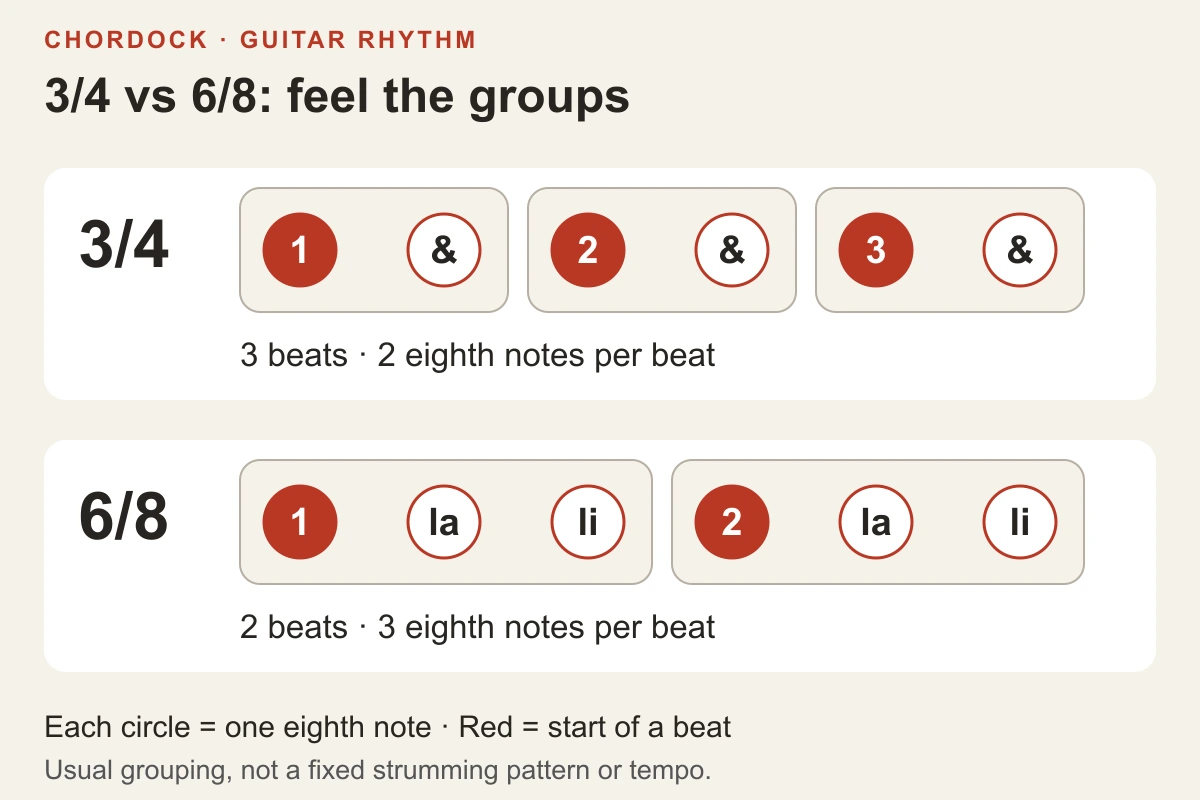
Compare the grouping, not just the number six
Read each circle in the diagram as one eighth-note length. The top row groups them in pairs; the bottom row groups them in threes. In 3/4 there are three quarter-note beats, while 6/8 normally has two dotted-quarter beats. One dotted quarter lasts three eighth notes. In the counts 1 & 2 & 3 & and 1 la li 2 la li, the numbers mark main beats and the symbols or syllables fill the divisions. Both measures contain six eighth-note lengths, but neither requires six separate attacks: follow the written durations and rests. Holding the eighth-note duration constant lets you compare the two groupings within equal-length measures. An identical BPM number alone does not guarantee equal speed if it counts a different note value.
Put down the guitar and say 1, 2, 3 | 4, 5, 6
The following is a practice exercise devised by the CHORDOCK editorial team. Choose a comfortable pace and say all six numbers at equal intervals. For the 6/8 exercise, clap lightly on positions one and four without leaving out the other spoken numbers. Four here is a subdivision position, not a fourth main beat. You can replace the words with ONE la li | TWO la li to hear the two groups more directly. Then keep the same spacing but clap on positions one, three, and five to compare the three groups of 3/4. Listen for a rushed final number or a pause after six. The claps identify the group starts; they do not need to be forceful. Feeling two groups with gentle, even-volume claps is enough for this exercise. If switching between the two becomes confusing, stop comparing and return to positions one and four only.
Borrow an even click from the metronome
CHORDOCK’s metronome does not have a dedicated 6/8 setting. For this exercise, manually set it to 120 BPM and uncheck “Accent beat one”, treating one click as one eighth note. Its initial 4/4 label and cycling dots do not become a 6/8 guide: ignore those visual groups and use your own spoken 1, 2, 3 | 4, 5, 6. Selecting 6/4 is not a way to select 6/8. Here 120 means 120 eighth-note clicks per minute. Each main beat spans three clicks, so the dotted-quarter rate is 120 ÷ 3 = 40 per minute. Once you can keep the six-count pattern for four measures, continue speaking and pick one open guitar string quietly once per click. If you already fret Em comfortably, you may instead try six gentle downstrums, returning the hand without touching the strings or adding another attack. That is only a counting drill, not a rule that all 6/8 songs use six downstrums. If your hand tightens or your counting stops, put the guitar down and return to clapping.
Pio: Why are there only two main beats when I count to six?
Dock-sensei: You are arranging six smaller divisions into two groups of three. Counting 1, 2, 3 | 4, 5, 6 helps locate them for practice. Saying ONE la li | TWO la li can make the two main beats easier to feel.
An eight-minute practice for today
- One minute: point out 2 + 2 + 2 in the 3/4 diagram and 3 + 3 in the 6/8 diagram; identify the numbers that mark the main beats
- Two minutes: without an instrument, say 1, 2, 3 | 4, 5, 6 evenly and clap lightly on one and four. Add no pause at the divider or after six
- Three minutes: manually choose 120 BPM and uncheck “Accent beat one”. Treat each click as an eighth note and group six with your voice, not the 4/4 label or dots. After four steady measures, pick one open string once per click, or continue without the guitar
- Two minutes: record four measures of voice and claps, or voice and guitar. Check equal spacing and the group starts on one and four; return to voice and claps if the pattern becomes uneven
Review and references
Last content review:
Beat grouping in 3/4 and 6/8, dotted-quarter beats, the distinction from tuplets, and note values in tempo marks were checked against author-published lessons. The voice, clap, and guitar drills are editorial suggestions. The absence of a dedicated 6/8 setting and the procedure that unchecks “Accent beat one” to use an even click were checked against the current metronome implementation.
- Simple and Compound Meter — musictheory.net
- Compound Meter and Time Signatures — Open Music Theory
- Other Aspects of Notation: Tempo — Open Music Theory
- Music Theory for the 21st-Century Classroom: Tuplets — University of Puget Sound
References support the editorial review. They do not provide an individual diagnosis or guarantee compatibility with every instrument or model.
الأسئلة الشائعة
Does 6/8 have six beats or two?
Normally it is compound duple meter: two dotted-quarter main beats. Counting six during slow practice counts their smaller eighth-note divisions.
Does playing 3/4 faster turn it into 6/8?
No. Changing speed alone does not change the grouping. This exercise keeps the eighth-note spacing constant while comparing groups of two and groups of three.
Must I play six downstrums in every 6/8 measure?
No. Six downstrums are only this lesson’s optional counting drill. Real arrangements can sustain notes, include rests, or pick strings separately; choose the pattern required by the music.
Why does 120 BPM give a main-beat rate of 40?
Only because this exercise assigns each of the 120 clicks per minute to an eighth note. Three clicks make one dotted-quarter main beat, so 120 ÷ 3 = 40. For a song, check the note symbol beside the tempo number, not just the number itself.
I cannot find a 6/8 button in CHORDOCK. What should I use?
There is no dedicated 6/8 mode. Uncheck “Accent beat one” and borrow the evenly spaced sound while grouping six with your voice. The meter label and cycling dots are not a 6/8 guide, and selecting 6/4 does not switch the tool to 6/8.
Are the three eighth notes in 6/8 automatically triplets?
No. Three ordinary eighth notes within a normal 6/8 beat have not been changed into a tuplet. Read them as the meter’s usual equal divisions, separately from any specifically notated triplet.