C Chord Inversions on Piano: Shapes and Fingering
C–E–G looks familiar, but E–G–C can seem like a different chord. Separate the notes you need from their arrangement. Keep the C-major ingredients, and compare three shapes with your right hand only, without pedal. This is a next step after learning basic C, F and G chords, not a test of fast changes.
الميزات والخيارات الرئيسية
- Low to high: C–E–G is root position, E–G–C is first inversion, G–C–E is second inversion
- The root stays C. The lowest sounding note determines the inversion
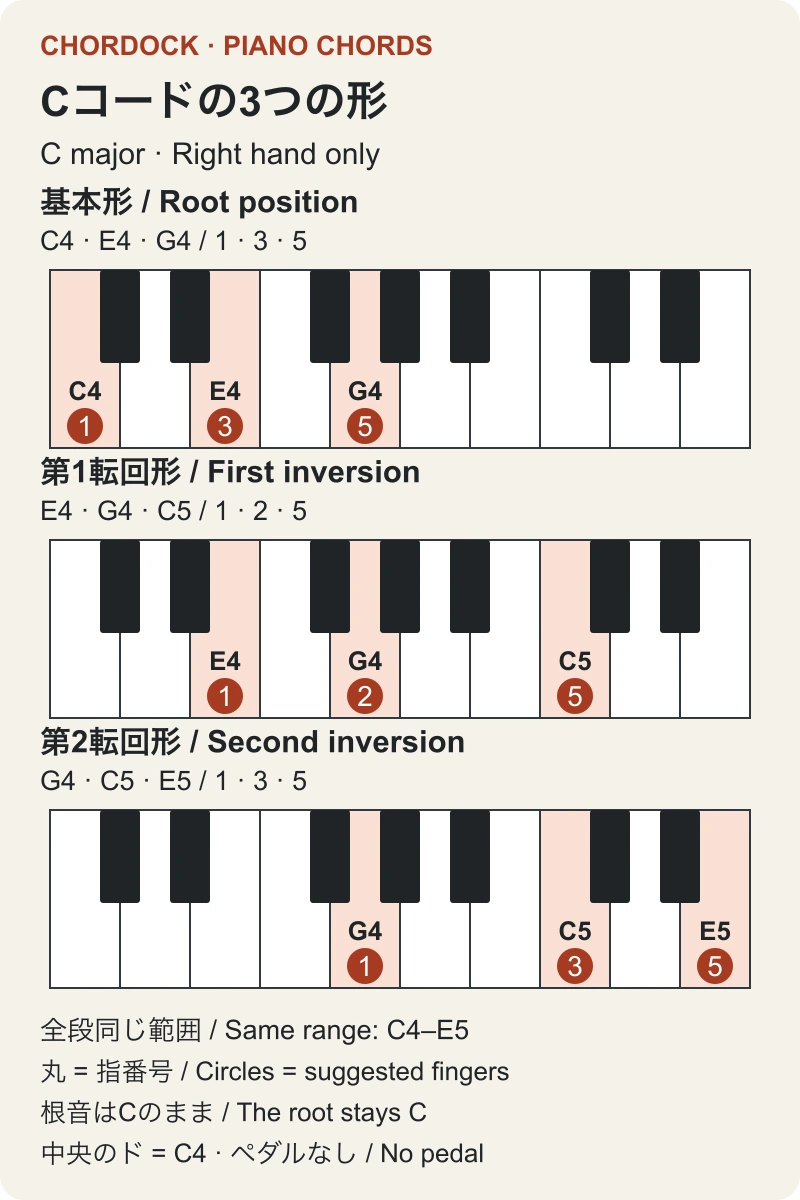
- Suggested right-hand fingers: 1–3–5, 1–2–5, then 1–3–5. Leave the left hand and pedal out today
1. Move a low note up, not the whole chord
Use C4 for middle C. Start with C4–E4–G4, then move C4 up one octave to get E4–G4–C5. Moving the low E4 up next gives G4–C5–E5. The notes still belong to C major. Each row of the chart covers the same keyboard range so you can track the changing positions. This differs from transposing the entire chord by the same distance. The 4 and 5 in note names identify registers, not fingers.
2. Place one right-hand shape at a time
Finger 1 is the thumb, 2 the index, 3 the middle, 4 the ring and 5 the little finger. Try 1–3–5 for C4–E4–G4, 1–2–5 for E4–G4–C5 and 1–3–5 for G4–C5–E5. Check notes individually, then play them together if the reach is comfortable. Release everything before moving to the next shape; shared notes need not stay under the same fingers. These are starting fingerings, not rules for every hand or musical context. Stop for pain or strain. If a shape is out of reach, point to its notes rather than forcing the stretch.
3. Name the bass separately from the root
With only these three right-hand notes, the lowest note changes from C to E to G, while the root stays C. C/E and C/G specify E and G in the bass. C/E does not ask for an E-major chord. When both hands play, consider the entire chord: adding left-hand C3 below right-hand E4–G4–C5 makes C the bass, so the whole chord is in root position. Inversions can help shape accompaniment, but a song's written bass and melody still matter. Today, compare these isolated sounds rather than replacing chords in a song.
Pio: If E is at the bottom, how can it still be C major?
Dock-sensei: The lowest note and the root are different ideas. E–G–C still has all the C-major ingredients. Leave your left hand out today and listen to what changes when a different note is lowest.
An eight-minute session
- 2 minutes: leave the pedal off and find C4, E4 and G4 with the right hand. Point to the relocated C and E in the other chart rows, checking that each moved up one octave
- 2 minutes: place root position, first inversion and second inversion once each. Check individual notes before sounding them together, then release and rest. Do not repeatedly force an awkward fingering
- 2 minutes: play each shape once and name its lowest note: C, E, G. Then identify C as the root of each. Use the remaining time to revisit just one uncertain shape
- 2 minutes: if comfortable, manually set 60 BPM and 4/4. In the first bar, play root position on beat 1, hold through beat 2, then release on beat 3. Rest and prepare on beats 3 and 4. Use the same rhythm for first inversion in bar 2 and second inversion in bar 3. Rest for one bar in bar 4. Remove the click if needed
Review and references
Last content review:
Piano, manufacturer and university lessons informed checks of notes, fingers, root and bass. Both languages were reviewed twice for right-hand shapes versus whole-chord inversion, finger versus octave numbers and transposition. The chart and eight-minute routine with rests are original editorial suggestions.
- C Major Chord on Piano — flowkey
- Basic Piano Chords for Beginners, Part 1 — Yamaha / Jerry Kovarsky
- Music Theory for the 21st-Century Classroom: Inverted Triads — University of Puget Sound / Robert Hutchinson
References support the editorial review. They do not provide an individual diagnosis or guarantee compatibility with every instrument or model.
الأسئلة الشائعة
Which exact notes are in the three shapes?
Here, root position is C4–E4–G4, first inversion E4–G4–C5 and second inversion G4–C5–E5. C4 means middle C. Check the register as well as the letter when finding each key.
Should first inversion also use fingers 1–3–5?
For right-hand E4–G4–C5, 1–2–5 is a common starting point, not a universal requirement. Ask a teacher about an uncomfortable shape. Do not copy this right-hand fingering directly to the left hand.
Does changing only the upper notes change the inversion?
Not if the lowest note stays the same. C4–E4–G4 and C4–G4–E5 are both in root position. Different upper spacing is not necessarily a different inversion.
Is it still C/E if my left hand adds a lower C?
The right-hand shape may be E–G–C, but a C below it makes the overall chord root position. For C/E, check that E is the lowest sounding note, including the left hand and other instruments.
Can I replace every C chord with any inversion?
The ingredients stay the same, but different bass and top notes change the sound and connections. Respect specified bass notes and melody. This exercise teaches three C-major shapes, not unrestricted substitutions in songs.
Will CHORDOCK automatically grade my inversions?
This exercise does not grade your playing. Manually set 60 BPM and 4/4, then check notes and fingers yourself. The eight-minute plan includes breaks and is an editorial suggestion, not a mastery deadline.