Guitar Dm Not Ringing? Check xx0231 and the First String
Does the thinnest string go silent when you form Dm? Start by sounding F at fret one with only your index finger, then check that it survives as you add the other fingers. Use xx0231 in standard EADGBE tuning with no capo to isolate the problem one string at a time. Fast changes and a harder grip are not today's targets.
Wichtige Funktionen und Optionen
- xx0231 lists frets from string 6 to 1. Skip strings 6 and 5 and start at the open fourth string
- Index: string 1, fret one. Middle: string 3, fret two. Ring: string 2, fret three. Three fingers, four sounding strings
- Retest string 1 after each addition. Leaving it open changes F to E and makes Dsus2, not Dm
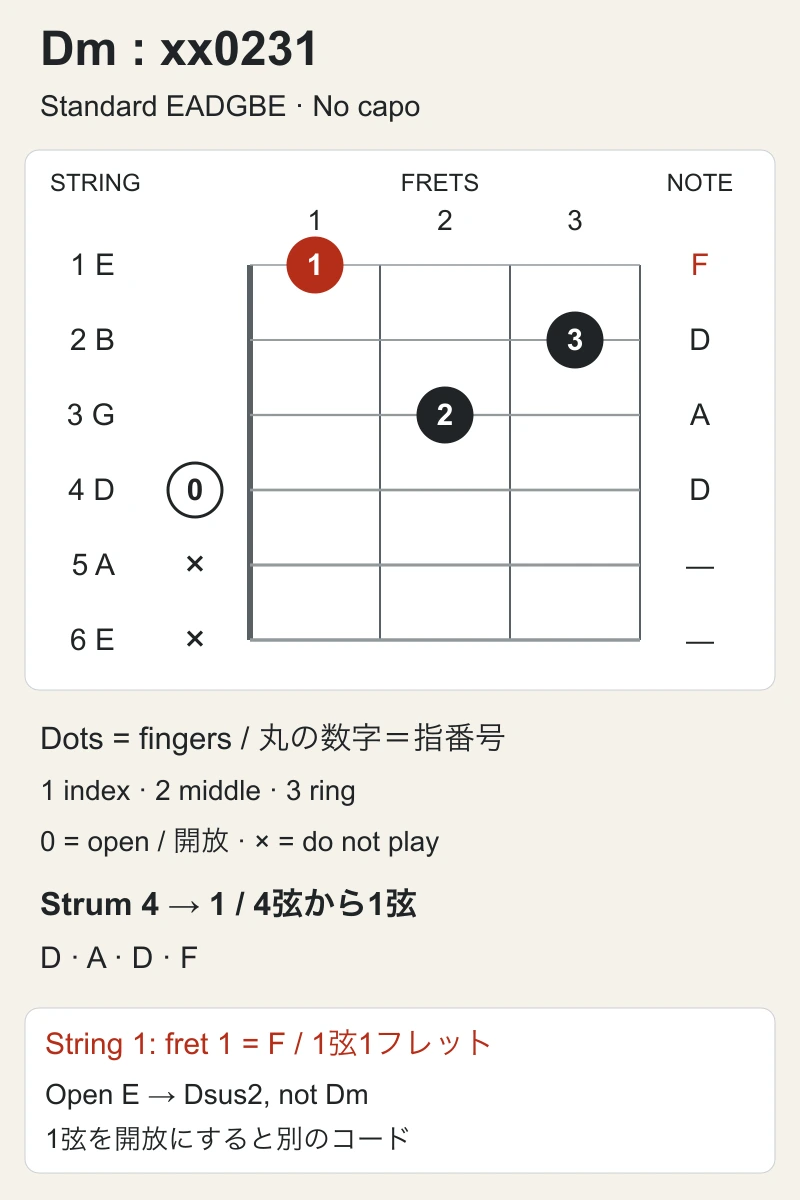
1. Read xx0231 as frets and strum strings four to one
The x marks on strings 6 and 5 mean do not play them; zero on string 4 means play it open. Put middle on string 3 at fret two, ring on string 2 at fret three and index on string 1 at fret one. The digit sequence starts at string six, but the diagram starts with string one at the top. Digits inside dots are fingers; numbers above the grid are frets. This shape needs no barre. Strum from string four toward the thinner strings, sounding four strings in all. Open string 5 is A, also a Dm chord tone, but including it gives Dm/A with A as the lowest note. Start at string four today to practise the basic shape with D in the bass.
2. Sound string one, then add middle and ring separately
Place the index just behind the first fret wire on string 1 and pick that string alone. Add middle on string 3 at fret two and retest string 1. Add ring on string 2 at fret three and listen again. If the note becomes dull after an addition, check whether that finger touches the neighboring string or whether the index has shifted. Pay particular attention to the side of the finger on string 2. Release and reposition so the fingertip contacts its intended string. Finally pick strings four through one separately. The little finger can replace the ring at string 2, fret three without changing the note. Try it if the ring is awkward. Avoid forcing a sharp wrist bend or an uncomfortable stretch. Rest between attempts and stop if there is pain.
3. Keep the first-string F: Dm and Dsus2 are different
Dm contains D, F and A. In xx0231 the sounding order from string four is D, A, D, F. If string one is muted, you lose the only F in this shape. Leaving it open instead gives xx0230, containing D, A, D, E: that is Dsus2, not another name for Dm. In the basic D-major shape xx0232, string one sounds F-sharp. Returning to Dm lowers that pitch by a semitone, but the usual D and Dm finger assignments also differ. Do not assume that keeping the same fingers and sliding one is the entire change. Where a song calls for Dm, first check the intended sound including F.
Pio: Leaving string one open feels easier. Can I still call that Dm?
Dock-sensei: That changes F to E, making the different chord Dsus2. For Dm practice, check F with just your index first. If it disappears as you add fingers, check where they touch before squeezing harder.
An eight-minute session for today
- 2 minutes: check standard EADGBE tuning and remove any capo. Read xx0231 from string six: skip six and five, leave four open. Briefly sound string 1 at fret one with the index alone, then rest
- 2 minutes: add middle on string 3, fret two, then ring on string 2, fret three. Listen to string 1 after each addition. If it becomes dull, check the newly added finger and index position. Release before repositioning
- 2 minutes: pick strings four through one and check D, A, D, F, then gently strum those four once. Stop them with the strumming hand and rest. Only if the ring is awkward, compare using the little finger at string 2, fret three
- 2 minutes: manually set 60 BPM and 4/4. Strum Dm once on beat one and count four beats. On beat one of the next bar, lightly touch the strings with the strumming hand to stop them, then rest for that whole bar. Repeat this two-bar cycle; turn off the click if rushing disrupts the shape
Review and references
Last content review:
Manufacturer and educator references informed two editorial passes. Fender's simplified-Dm wording for Dsus2 is not adopted; D-F-A and D-E-A were checked independently. Muting/open string one, fingers/frets, ring/little fingers, and Dm/Dm-A bass are distinguished. Diagram pitches were calculated from standard EADGBE. The eight-minute routine with rests is an editorial suggestion, not a mastery deadline or automatic grading.
- How to Play the D Minor Guitar Chord — Fender / Dillon Wallace
- How to Play the Dm Chord on Guitar — JustinGuitar / Justin Sandercoe
- D Minor Chord — Guitar-chord.org
References support the editorial review. They do not provide an individual diagnosis or guarantee compatibility with every instrument or model.
Häufig gestellte Fragen
Are the digits in xx0231 finger numbers?
They are frets. From string six: omit, omit, open, two, three, one. In today's fingering, middle takes string 3, ring takes string 2 and index takes string 1.
Which string do I start strumming Dm from?
For xx0231, start at open string 4 D and finish at string 1. Skip strings 5 and 6. Adding open string 5 A gives Dm/A with A in the bass, so today's exercise starts at string four.
Can I use the little finger instead of the ring on string two?
Yes. Fretting the same third fret on string 2 still produces D. Choose according to comfort and the next movement. The ring finger shown in the diagram is not the only valid choice.
Is leaving the first string open an easier Dm?
xx0230 is Dsus2, a different chord: F changes to E. Omitting string one entirely also removes F. Check the first-fret F for the complete Dm shape in this lesson.
What if string one will not ring even on its own?
Check that your fingertip contacts the intended string just behind the fret wire, then release and reposition. If comfortable adjustments do not help, ask a teacher or instrument shop to check your hold, finger position and instrument. Do not keep practising through pain.
Will the metronome automatically grade my Dm?
It does not grade chords. Manually set 60 BPM and 4/4 as a beat reference and check the strings yourself. The eight-minute plan and rests are editorial suggestions, not a learning deadline or a rule for playing songs.