How to Play Rests on Guitar: Stop the Sound and Keep Counting
You stop moving the pick at a rest, but the last note keeps ringing. Stop the string's vibration as well as the picking motion. Today, use only open string 1 in standard EADGBE tuning with no capo. Practise the moment a note begins separately from the moment it ends, without adding chord changes.
Wichtige Funktionen und Optionen
- Damp the string at the start of the rest; skipping a new attack does not stop a ringing note
- In 4/4, a quarter rest lasts one beat and an eighth rest lasts half a beat. Keep counting through both
- Start with one string. Lifting the fretting hand alone cannot stop an open string
1. Make the rest's start the note's end
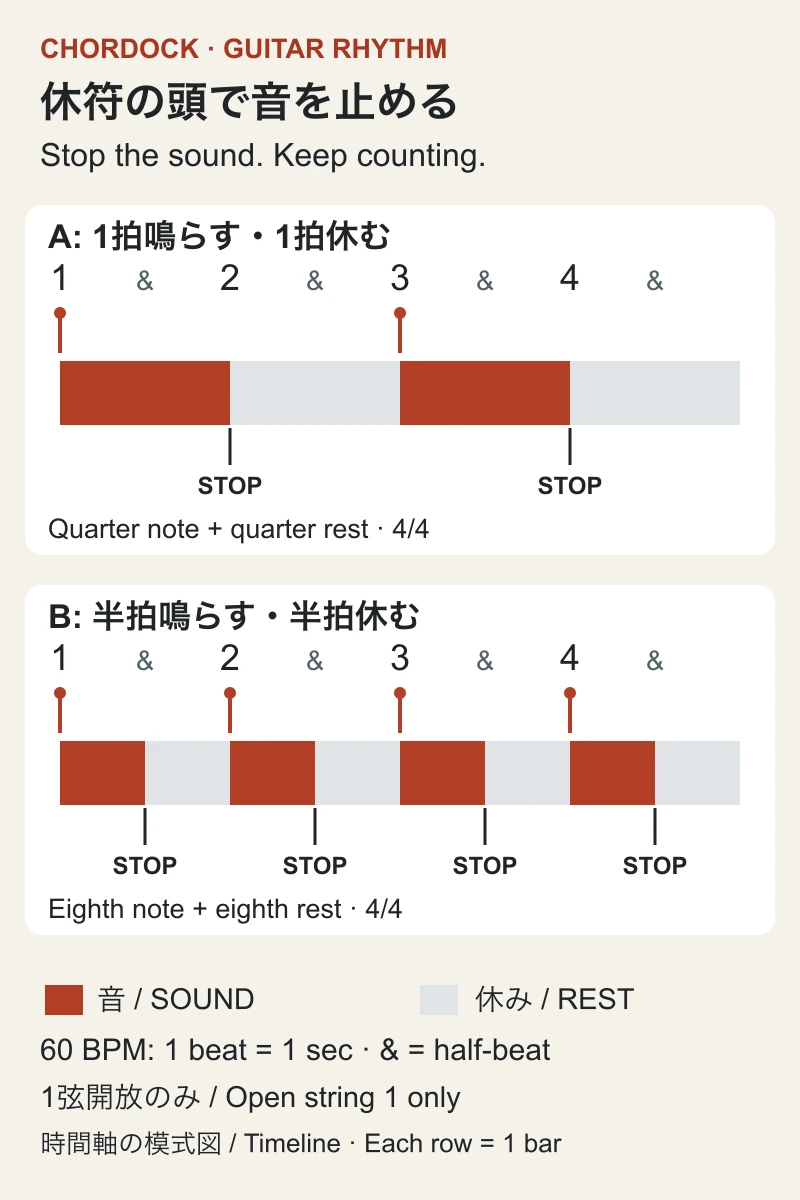
Pattern A is one bar of 4/4: quarter note, quarter rest, quarter note, quarter rest. Pluck open string 1 on one and stop it at the start of two. Pluck again on three, stop on four, and remain silent until the next one. Unlike a tie that sustains a note, this exercise leaves two and four silent. Resting does not mean skipping beats: say one, two, three, four evenly throughout. The coloured bars show sounding time; STOP at the right edge marks when to damp the string.
2. Stop one string without striking it
Pluck string 1 once, then gently return the pad of an available picking-hand finger to that string. When fingerpicking, you can return the finger that played; with a pick, try the middle finger without disturbing the grip. Avoid hitting the string with a nail or the pick. Because the string is open, lifting the fretting hand does not damp it. For a fretted note, releasing pressure while maintaining contact is another option, but keep today's task to the open string. Do not push hard or force the wrist into position; stop if there is pain. Distinguish this stopping action from playing short, muted notes with the hand resting near the bridge.
3. Count the “and” for a half-beat rest
When A feels manageable, try B. Split each beat evenly into a number and an “and” (&). Pluck an eighth note on the number and damp on the &; repeat for two-and, three-and and four-and. At 60 BPM with the quarter note as the beat, number to & takes half a second, as does & to the next number. The click can stay on the numbers; count the & yourself. Time the damping as carefully as the attack, releasing contact just before the next note. Start with four bars of A and one silent bar to review, then try B only if comfortable. Listen separately for lingering string sound and an unwanted click caused by hitting the string while stopping it.
Pio: I didn't pick during the rest, so why can I still hear the note?
Dock-sensei: The string keeps vibrating after you play it. Gently return a finger pad at the start of the rest. Let the sound stop, but keep your one-two-three-four count going.
An eight-minute session for today
- 2 minutes: without a click, pluck open string 1 and damp it with a picking-hand finger pad. Try four times, then use the remaining time to check placement and rest. Do not slap the string
- 2 minutes: manually set the metronome to 60 BPM and 4/4. Count in for one bar, then play four bars of A: pluck on one and three, damp at the start of two and four. Stay silent for one bar while counting and reviewing
- 2 minutes: try four more bars of A. Listen for sound left on two or four, or an early attack on three or the next one. If necessary, remove the click and return to sounding and stopping one note
- 2 minutes: if comfortable, play four bars of B. Count one-and, two-and, three-and, four-and; pluck on each number and damp on each &. Rest for one bar and review. Stay with A if B feels rushed
Review and references
Last content review:
Educator and manufacturer lessons informed checks of rest duration and damping. Both languages were reviewed twice for 4/4 attack and stop times, open strings, multiple voices and percussive attacks. The diagram patterns and 60 BPM, eight-minute routine are editorial suggestions.
- Rests — Music Theory Academy / Ben Dunnett
- Guide to Rests in Musical Notation — Classical Guitar Corner
- 7 Ways to Mute Your Guitar Strings — Classical Guitar Shed / Allen Mathews
- 3 Keys to Ace Your Palm Muting — Fender / Nick Stoubis
References support the editorial review. They do not provide an individual diagnosis or guarantee compatibility with every instrument or model.
Häufig gestellte Fragen
Is a quarter rest always one beat?
It is one beat in the 4/4 used here. A different beat unit changes how many beats a given rest takes. Practise with a quarter-note beat today rather than applying the same count to every meter.
Should I stop immediately after playing on one?
In A, stop at the start of two. Stopping immediately after one would shorten the note below the intended full beat. Only B stops after half a beat, on the &. Practise specifying note endings as well as new attacks.
Does an X in TAB mean a rest?
Not necessarily. An X can indicate a muted, percussive attack; in a chord diagram it may indicate an unplayed string. Check the notation's key. Today's rests contain no new percussive attack.
Must every rest silence every string?
Today only one string is sounding, so stop that note. Music with several simultaneous voices may assign a rest to just one voice while another sustains. Do not automatically cut off every other part.
How is this different from palm muting?
Palm muting near the bridge changes the sound while you pick, producing a shorter, damped tone. Today's exercise stops an already ringing note when a rest begins. Both use contact with strings, but you do not pick during these rests.
Will CHORDOCK automatically grade the rests?
This exercise does not automatically grade them. Set 60 BPM and 4/4 manually, then listen for the note endings yourself. The eight-minute routine is an editorial suggestion, not a promise of mastery in eight minutes.