Guitar Shuffle Rhythm: Keep the Beat While Changing the Gaps
You aim for a loping long-short rhythm, but your picking becomes evenly spaced again. Rather than making a bigger arm movement, check where the second attack lands. Today we use a triplet-based shuffle in 4/4: divide each beat equally into three and play the first and third positions. Delay the second attack, not the start of the following beat.
Wichtige Funktionen und Optionen
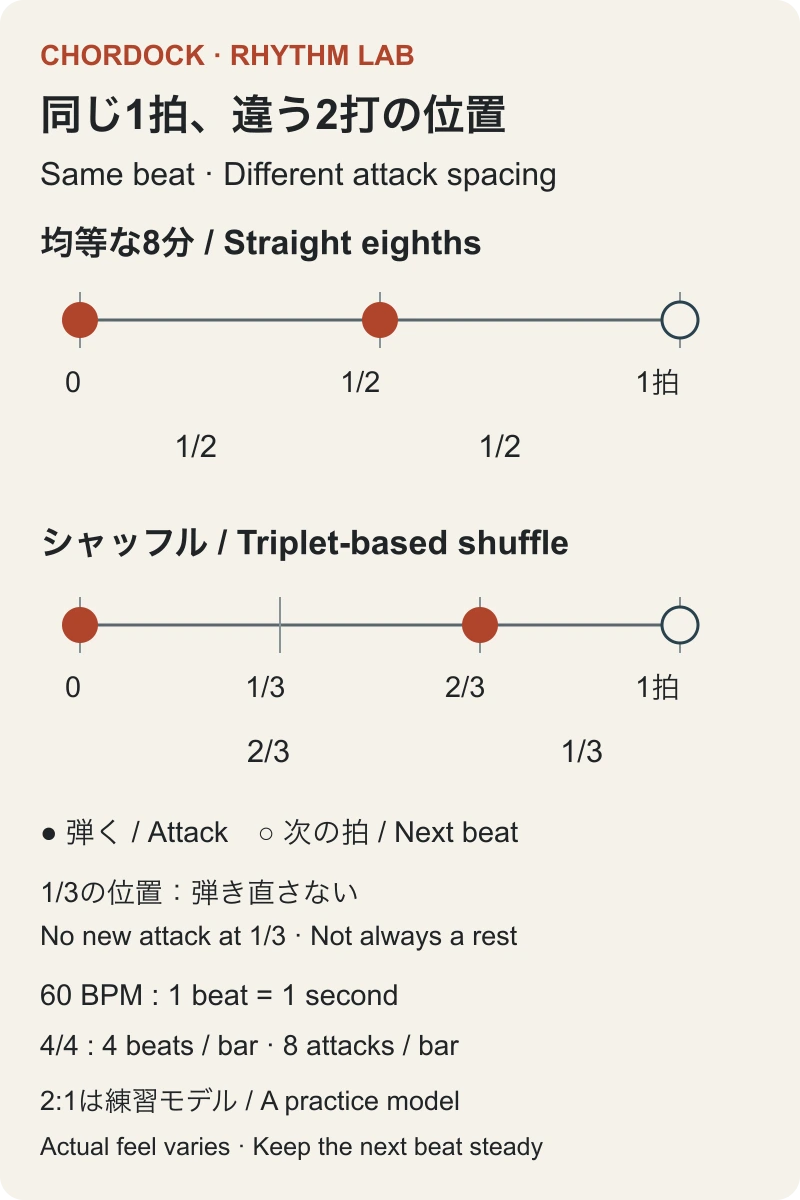
- Straight eighths divide a beat in half; today's shuffle uses gaps of 2/3 beat and 1/3 beat
- Do not re-pick the middle triplet position. That does not automatically mean stopping the existing sound there
- Keep beat length unchanged: eight attacks per 4/4 bar. The 2:1 model is a starting point, not a rule for every performance
1. Count three places, play the first and last
Put the guitar down and count evenly: 1-trip-let, 2-trip-let, 3-trip-let, 4-trip-let. The numbers mark the beats. Keep all three syllables in your voice while tapping your knee lightly only on the number and let. Do not create a new tap on trip. The second straight eighth would fall halfway through the beat; today's second shuffle attack falls two thirds of the way through. The gap from the first attack to the second is long, and the gap from the second to the following beat is short. Removing an attack must not remove its place in time.
2. Change the inner spacing, not the beat
Manually set the metronome to 60 BPM and 4/4, with one click representing a quarter-note beat. A beat lasts one second. Straight attacks fall at 0 and 0.5 seconds; our model puts them at 0 and about 0.667 seconds. In both cases the next beat begins at one second. These are attack positions, not a demand to sustain every note for an exact number of seconds. Leaving out the middle attack is not automatically a rest: articulation depends on the music. For this exercise, simply re-pick the same string without adding a special muting pattern. If waiting for the second attack makes you miss the next click, stop playing and realign your spoken numbers with the clicks.
3. Use one string before adding chords
On a guitar in standard tuning, use only the open third string. Try a small downstroke on the number and an upstroke on let, avoiding neighbouring strings. This picking choice belongs to today's drill, not every shuffle arrangement. Leave fretting and chord changes for later. Alternate one bar of evenly spaced eighths with one bar of long-short pairs; each bar still contains four clicks and eight attacks. Scores may show ordinary-looking eighth notes alongside a Shuffle or Swing instruction. Actual feel varies with the piece, tempo and player, so do not treat exactly 2:1 as the sole valid result. Listen to the performances in the linked teaching material as well as studying the grid.
Pio: If I remove the middle note, does the beat become shorter?
Dock-sensei: Keep its time even though you do not play a new note there. You place two attacks across the same three-part grid. The next beat stays put, including the short gap after your second attack.
An eight-minute session for today
- 2 minutes: put the guitar down and say 1-trip-let evenly without a click. Keep three syllables but tap your knee lightly only on 1 and let. Use your voice alone if coordinating both is difficult
- 2 minutes: manually choose 60 BPM and 4/4. Say 1, 2, 3, 4 on the clicks, spacing trip-let evenly between them. Tap only on the number and let. Stop and restart if the numbers drift
- 2 minutes: pick open string 3 down on the number and up on let, without re-picking trip. Play eight attacks over four beats, then gently touch the string to stop it and rest for the following bar. Repeat without tension
- 2 minutes: keep 60 BPM and compare one straight-eighth bar with one shuffle bar, two bars in total. Check the next downbeat and the final short gap. Return to counting alone if tired
Review and references
Last content review:
Manufacturer and teacher-authored lessons informed checks of attack positions and variable performance feel. Both languages were reviewed twice for attack gaps versus sustain, rests, 2:1 versus 3:1, the short gap into the next beat and manual tool settings. The diagram and eight-minute open-third-string routine are original editorial suggestions.
- The Difference Between Swing Time and Straight Time — Yamaha / Jerry Kovarsky
- Tips for Playing Rhythm Guitar — Yamaha / Robbie Calvo
- Blues Power - Shuffling On: Shuffle Rhythm Patterns — Guitar World / Keith Wyatt
References support the editorial review. They do not provide an individual diagnosis or guarantee compatibility with every instrument or model.
Häufig gestellte Fragen
Are triplets and shuffle the same picking pattern?
Our triplet preparation has three even attacks per beat; the shuffle uses only the first and third, making two. They share a three-part grid, not the same number of attacks.
Can I get shuffle just by making the second note louder?
Volume alone does not move the attack. Establish the long-short spacing first, then choose accents for the piece. The diagram does not prescribe dynamics.
Is this a dotted eighth followed by a sixteenth?
Played literally, that pair divides the beat 3:1, unlike today's triplet-based 2:1 model. Check the score and musical intention when applying the idea to a real song.
Must I mute the middle triplet position?
No. Omitting a fresh attack and stopping an existing sound are different actions. Use the articulation the music calls for rather than automatically inserting a rest.
Are Shuffle and Swing always exactly 2:1?
No. We use 2:1 to locate the attacks, but performance ratios and accents vary. Do not infer one exact feel from a genre name; listen to the example you are learning.
Does opening the metronome automatically play shuffle?
No. Manually choose 60 BPM and 4/4, then add your own long-short pairs to its evenly spaced clicks. This metronome does not grade your playing. Eight minutes includes rests and is a suggested session, not a learning deadline. Stop playing if there is pain.