Piano Beginner Roadmap: Playing with Both Hands
Trying to make both hands do different jobs immediately creates too many decisions. Learn the keyboard and each hand separately, then combine only one short bar.
Wichtige Funktionen und Optionen
- Find middle C and sit without tension
- Move each hand through five notes separately
- Add one left-hand root to a right-hand melody
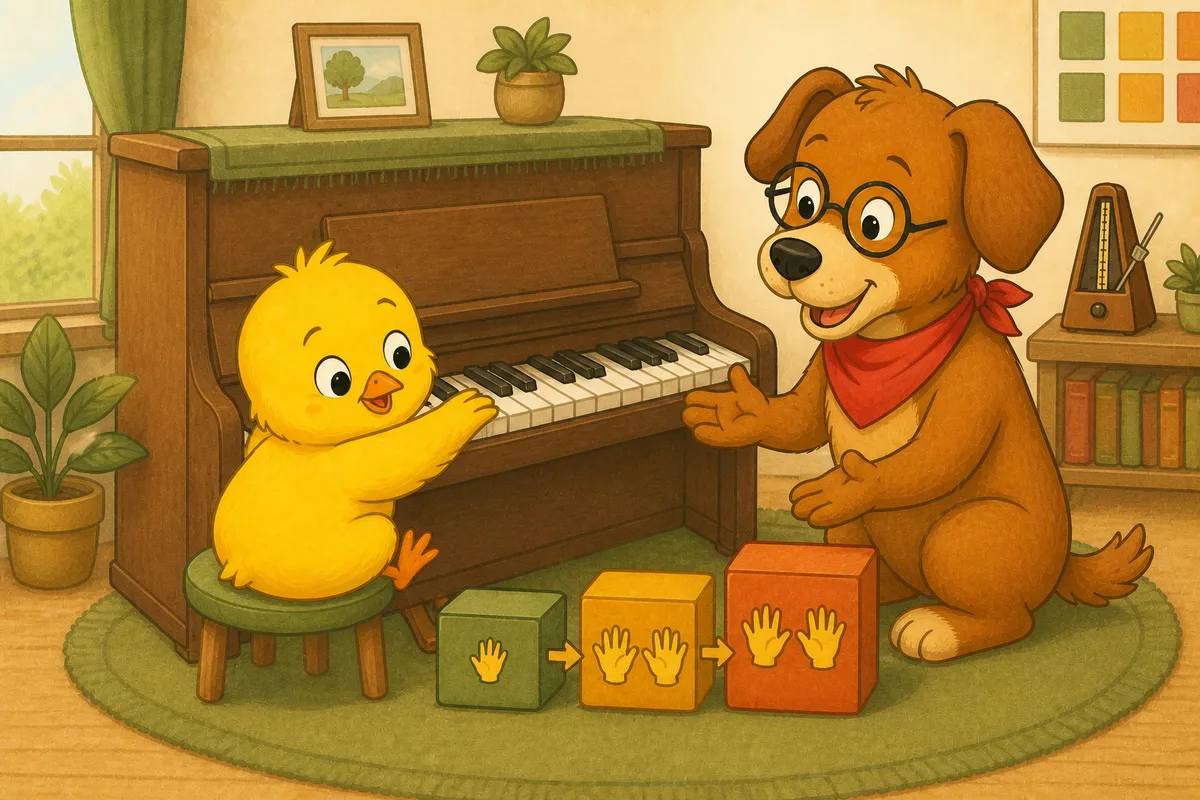
Month one: match keys and finger numbers
C is the white key immediately to the left of each pair of black keys. From a central C, play C–D–E–F–G with right-hand fingers one, two, three, four, and five; return with five, four, three, two, and one. For the left hand, ascend C–G with five, four, three, two, and one; descend with one, two, three, four, and five. Adjust the seat so the shoulders stay down and the wrist is neither deeply dropped nor raised. Aim for three relaxed up-and-down repetitions with each hand and no missing note or fingering pause.
Month two: give each hand a role and a pulse
Use a short melody within C–G for the right hand and single roots such as C or G for the left. Keep the same fingering while counting four beats, and isolate only the two to four notes before a stop. To identify the problem, say note names for a location error or tap the rhythm on a desk without notes for a timing error. Combine a short passage after each hand can repeat its part three times at the same tempo.
Month three: combine one bar
Circle the points where both hands sound together and tap both rhythms on a desk first. At the keyboard, add only one left-hand note at the start of the bar beneath the right-hand melody. If you stop, work on two beats around that point at roughly half speed instead of restarting. Add the next bar after three uninterrupted repetitions, and restore more left-hand notes only after the timing is stable.
Pio: Why do I lose notes that were easy with one hand?
Dock-sensei: That is normal. Reduce the left hand to one note and halve the right-hand speed. Fewer decisions let coordination grow.
Today's 15-minute session
- 3 minutes: check posture and play C–G three times—right hand 1–2–3–4–5 up and 5–4–3–2–1 down; left hand 5–4–3–2–1 up and 1–2–3–4–5 down
- 5 minutes: repeat each hand three times with the same four-beat count
- 7 minutes: mark coinciding notes and repeat one combined bar three times before adding another
Häufig gestellte Fragen
Do I need an 88-key piano immediately?
No. Beginner work fits on smaller keyboards. Choose later according to your repertoire, preferred key feel, and available space.
Can I begin without reading music?
Yes, with note names and simple rhythm. Add staff reading gradually so new pieces do not depend only on memorised key positions.
How do I know when to move to the next stage?
Repeat the current test three times with consistent fingering and pulse and without locking the shoulders or wrists. The month labels are guides; keep one lagging skill in your routine while trying a small amount of the next stage.
Both hands stop on the same beat every time. What should I do?
Isolate two beats around that point and identify where the hands coincide. If you can tap the rhythm three times but still stop on the keys, reduce the left hand to one note on the first beat.