R and L in Drum Music: Single Strokes for Beginners
Do the letters R and L in a drum lesson leave you wondering which drum to hit? In sticking notation, R specifies your right hand and L your left, not an instrument or a note length. Use just one practice-pad surface today to learn alternating single strokes and how to fit them to a click.
Main features and choices
- R means right hand and L means left hand, regardless of which hand is dominant
- Single strokes alternate one hit per hand: R L R L. Speed alone does not define the pattern
- At the same 60 BPM, one hit per beat and two hits per beat are different. Read the rhythm as well as the sticking
1. Letters choose the hand; notation gives the timing
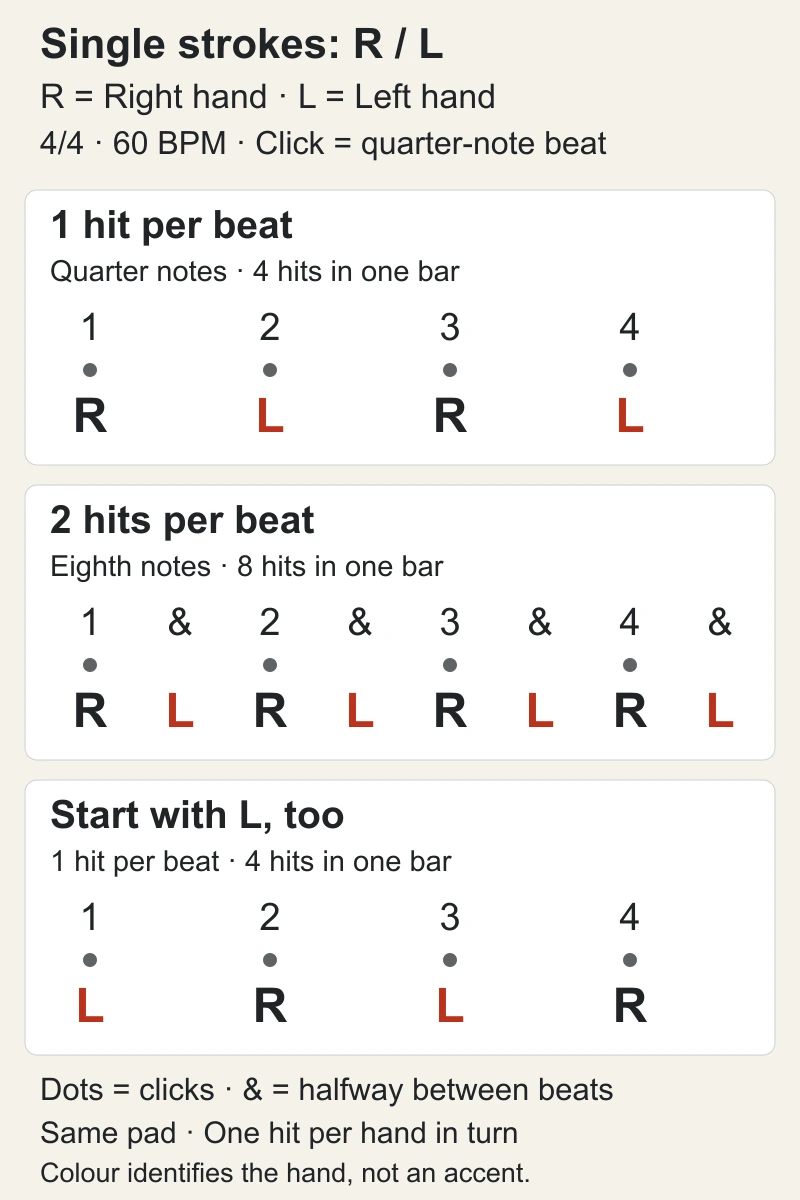
R stands for Right and L for Left. Play an R with your right hand and an L with your left. R does not mean ride cymbal, and L does not mean a drum on your left. This hand order is called sticking. Note values indicate timing, while staff positions and the score’s key help identify instruments. The letters R L alone specify neither a tempo nor a gap between hits. Our diagram uses one bar of 4/4: four quarter-note hits in the upper example and eight eighth-note hits in the middle example. Both alternate hands, but contain different numbers of hits per beat.
2. Alternate single hits on one surface
Place a practice pad securely and try only four hits without a click: right, left, right, left. Do not strike with both hands together or let one hand make several bounces before changing hands; give each hand one hit in turn. That is the starting point for single strokes. Distinguish this from double strokes such as R R L L, which use two consecutive hits per hand. For today’s unaccented exercise, use nearby striking spots and comfortable, low stick heights, and listen to the volume and spacing. If the left sounds softer, do not try to fix it just by squeezing harder. Check whether each stick can return naturally after a hit. Rest when tired and stop if you feel pain.
3. Keep 60 BPM and separate four hits from eight
Set the metronome manually to 60 BPM and 4/4, treating each click as a quarter-note beat. First place R L R L on 1, 2, 3, 4, one hit per click. When comfortable, stop and count 1-and-2-and-3-and-4-and, dividing every beat evenly in two. Now put R on each number and L on each and: eight hits over four clicks. Do not change the tempo to 120; add one hit halfway between the 60 BPM beats. Return to one hit per beat if the gaps become uneven. Starting L R L R is also single sticking. The bottom example shows this left-hand lead, which you can try separately with one hit per click.
Pio: Do I have to play R L fast for it to count as single strokes?
Dock-sensei: The key is one hit per hand in turn, not a speed target. Four slow hits are enough today. Compare changing hands on every click with using both hands within one click’s beat.
An eight-minute session for today
- 2 minutes: identify R as right and L as left. On a stable pad, try R L R L without a click in four-hit groups, resting between groups
- 2 minutes: set the metronome manually to 60 BPM and 4/4. Play R L R L for one bar at one hit per click, then rest for a bar. Repeat only as comfortable
- 2 minutes: keep 60 BPM and count 1-and-2-and-3-and-4-and. If ready, try one bar of R L R L R L R L at two hits per click, then stop and check. Otherwise repeat the earlier step
- 2 minutes: return to one hit per click and briefly try L R L R. Finish by noting the hand order and the number of hits per beat separately
Review and references
Last content review:
Alternation and sticking were checked against manufacturer-hosted lessons and reviewed twice in both languages. One versus two hits per beat, left-hand lead and click positions were verified in the diagram. The 60 BPM setting and eight-minute routine are editorial suggestions, not automatic hand-movement grading.
- Practice Exercises for the Beginning Drummer — Yamaha / Steve La Cerra
- A Fresh Approach to the Drumset: Lessons 1–2 (pp. 17–18) — Mark Wessels with Stanton Moore / Vic Firth
References support the editorial review. They do not provide an individual diagnosis or guarantee compatibility with every instrument or model.
Frequently asked questions
Should left-handed players reverse R and L?
No. R still names the right hand and L the left. Use L R L R when practising a left-hand lead. If you deliberately reverse a written sticking, keep that variation distinct from what the lesson specifies.
How many hits are in a single stroke roll?
The basic idea is one stroke per hand in alternation, not a name limited to four or eight hits. We use short groups here so a beginner can check them easily.
Does R always mean hi-hat and L always mean snare?
No: they specify hands. Both hands use the same pad in this lesson. On a kit, check staff positions, the score’s key and the lesson’s instructions separately to find the instruments.
Do eight hits at 60 BPM take eight clicks?
Not in today’s eighth-note example, which fits eight hits into four beats. Put one on the number and one halfway to the next number. At one hit per click, eight hits would take eight beats, so first identify which exercise you are playing.
Does the link automatically set 60 BPM or show R and L?
No. Open the metronome and set 60 BPM and 4/4 manually. This routine does not automatically supply and clicks or sticking prompts: you alternate your own hands against the beat. It does not automatically grade your hand movements either.
What if I have no pad, or eight minutes is too long?
Without sticks, simply point with the named hand and practise the counting. You do not need to strike a hard desk with sticks. Eight minutes is an editorial suggestion including pauses, not a speed or mastery promise. A shorter session is fine.