B7 Not Ringing on Guitar? Check Four Fingers and Open String 2
Does string 2 go silent in B7, or does adding your little finger upset the shape? Work on one standard-tuning, no-capo voicing today. Before changing chords quickly, separate where fingers belong from the string that needs to stay untouched.
Main features and choices
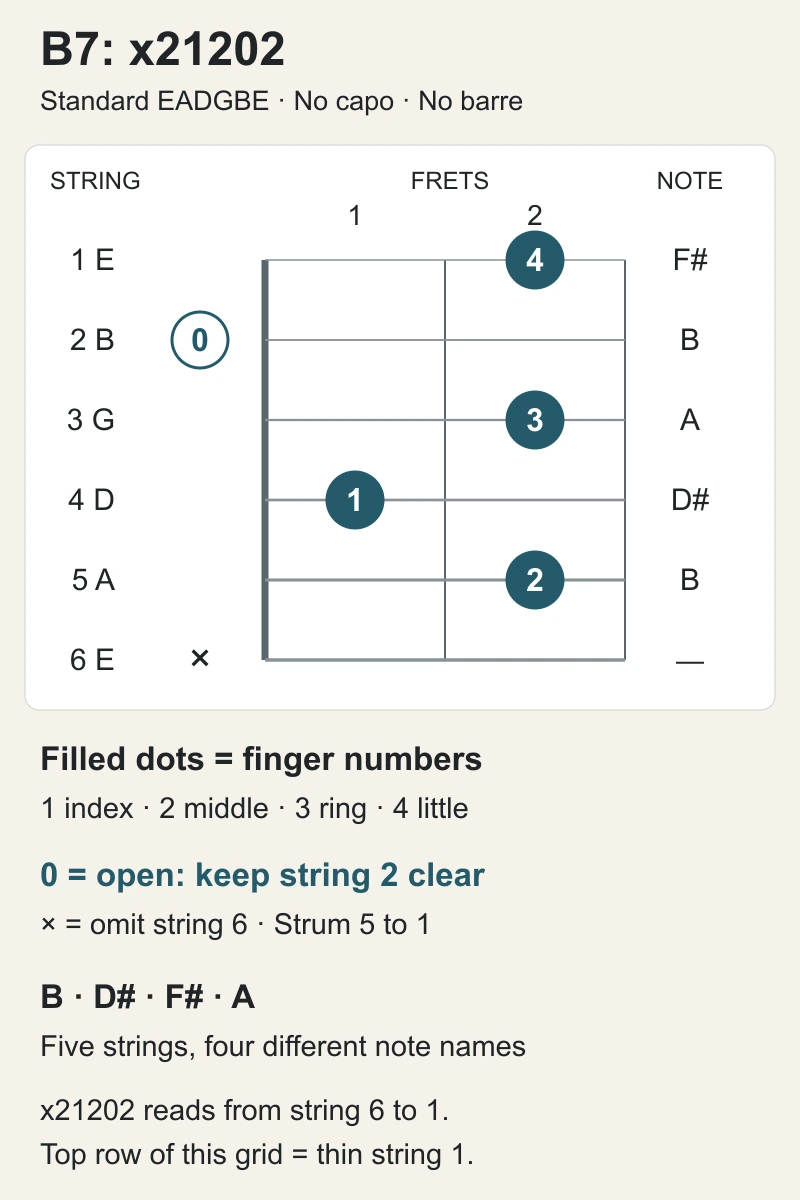
- This B7 is x21202, read from string 6 to 1: x means omit and 0 means open
- Index: string 4, fret 1. Middle, ring and little fingers: strings 5, 3 and 1 at fret 2
- Leave string 2 open. Play strings 5 to 1 and avoid thick string 6
1. Separate finger numbers from fret numbers
Place index on string 4 at fret 1, middle on string 5 at fret 2, ring on string 3 at fret 2 and little finger on string 1 at fret 2. Add them one at a time if needed; this shape needs no barre. Our horizontal diagram puts thin string 1 at the top. Filled dots show fingers: 1 index, 2 middle, 3 ring and 4 little. The 1 and 2 above the grid label frets, so the little finger's 4 does not mean fret 4. The white 0 marks open string 2; the cross omits string 6. Written x21202 runs from string 6 to 1, opposite to the diagram's top-to-bottom order.
2. Find what touches the open second string
Pick string 2 with no fingers on the neck, then pick it again while holding B7. If only the chord shape mutes it, inspect the sides of the ring finger on string 3 and little finger on string 1. Move one away slightly at a time and listen for the sound returning. Adjust fingertip angles gently to clear a path for string 2, then rebuild the shape. For fretted strings, place fingertips close behind the required fret wire, not on top of it. Avoid a sustained squeeze and stop if anything hurts. If the string stays silent with every finger removed, the chord shape may not be the cause.
3. Check five strings before strumming them
Pick strings 5, 4, 3, 2 and 1 individually, then strum that same range lightly. The notes from low to high are B, D♯, A, B and F♯. With B repeated, five strings produce four note names: B, D♯, F♯ and A. The 7 identifies a chord containing the minor seventh A, not seven fingers or fret 7. Open string 6 adds E, outside those four notes, so omit it here. If the little finger is difficult, opening string 1 to E does not complete the same voicing. Rest and retry that string on its own. B7, B, Bmaj7 and Bm7 are different chords; follow the symbol in your music.
Pio: Should I squeeze harder when string 2 is silent?
Dock-sensei: String 2 stays open. Pick it alone and see whether your ring or little finger touches it. Give the string room to vibrate before thinking about more force.
An eight-minute session
- 2 minutes: place the four fingers one at a time using the diagram. Index uses string 4, fret 1; the others use fret 2. Release and rest after each placement. Check that finger 4 has not become fret 4
- 2 minutes: pick open string 2 before and after placing B7. If it is muted, inspect ring-finger and little-finger contact separately. Do not solve it by squeezing harder
- 2 minutes: pick strings 5 to 1 slowly and revisit only the strings that fail to ring. Follow with one gentle five-string strum. Avoid string 6 and rest your hand between attempts
- 2 minutes: if comfortable, manually set 60 BPM and 4/4. Play B7 once on beat 1 of bar 1 and count 2, 3, 4. Gently stop the strings on beat 1 of bar 2 and rest for that whole bar. If needed, stop the click and return to individual-string checks
Review and references
Last content review:
Manufacturer and teaching references were checked in two editorial passes. Finger versus fret numbers, open versus omitted strings, five strings versus four note names, and B7 versus Bmaj7/Bm7 are distinguished. Diagram pitches were independently calculated from standard tuning. The contact checks and eight-minute routine with rests are editorial exercises, not automatic grading or a learning-time guarantee.
- How to Play the B7 Chord on Guitar — Fender / Ben Nemeroff
- How to Play B7 — ChordBank
- How to Read Guitar Chord Charts — Fender / Ben Nemeroff
References support the editorial review. They do not provide an individual diagnosis or guarantee compatibility with every instrument or model.
Frequently asked questions
Can I play B7 without a barre?
Yes. In x21202, four fingers each fret a separate string. None needs to hold several strings down. Other B7 voicings exist, but keep this practice focused on one shape.
Where do I press for the 0 on string 2?
Nowhere: play its open B. Zero means no fret is held, not a finger number. Check that neither hand accidentally touches the string.
Can I lift the little finger and play string 1 open?
That changes F♯ to E, so the notes no longer match the B7 shape taught here. Other arrangements without the little finger exist, but first check string 1 at fret 2 briefly on its own, then combine the fingers with rests.
Are B7, Bmaj7 and Bm7 the same?
No. B7 contains B, D♯, F♯ and A; Bmaj7 uses B, D♯, F♯ and A♯; Bm7 uses B, D, F♯ and A. Read the letters before 7 carefully rather than treating these symbols as interchangeable.
What if string 2 stays silent with every finger removed?
Check that your picking hand is not stopping it and that you are picking that string alone. If it still fails to ring or keeps buzzing strongly, string or instrument condition could contribute. Ask a teacher or guitar shop instead of forcing your grip or making uncertain adjustments.
Does the metronome grade my B7 automatically?
This exercise does not grade your playing. Set 60 BPM and 4/4 manually and compare the strings you hear with the diagram yourself. Eight minutes including rests is an editorial practice idea, not a promised learning time.