Piano Black Key Names: Sharps and Flats in Groups of 2 and 3
You recognise the white keys, but a black key makes you hesitate. Start with the groups of two and three instead of counting from the end of the keyboard. The black key between C and D can be called C♯ or D♭. Today’s goal is to choose a key from its name, not to learn every staff symbol at once.
Main features and choices
- C is the white key just left of a pair of black keys; F is just left of a group of three
- A sharp raises a note one semitone; a flat lowers it one semitone, counting both black and white keys
- C♯ and D♭ use the same piano key, but the spelling in a score still has a purpose
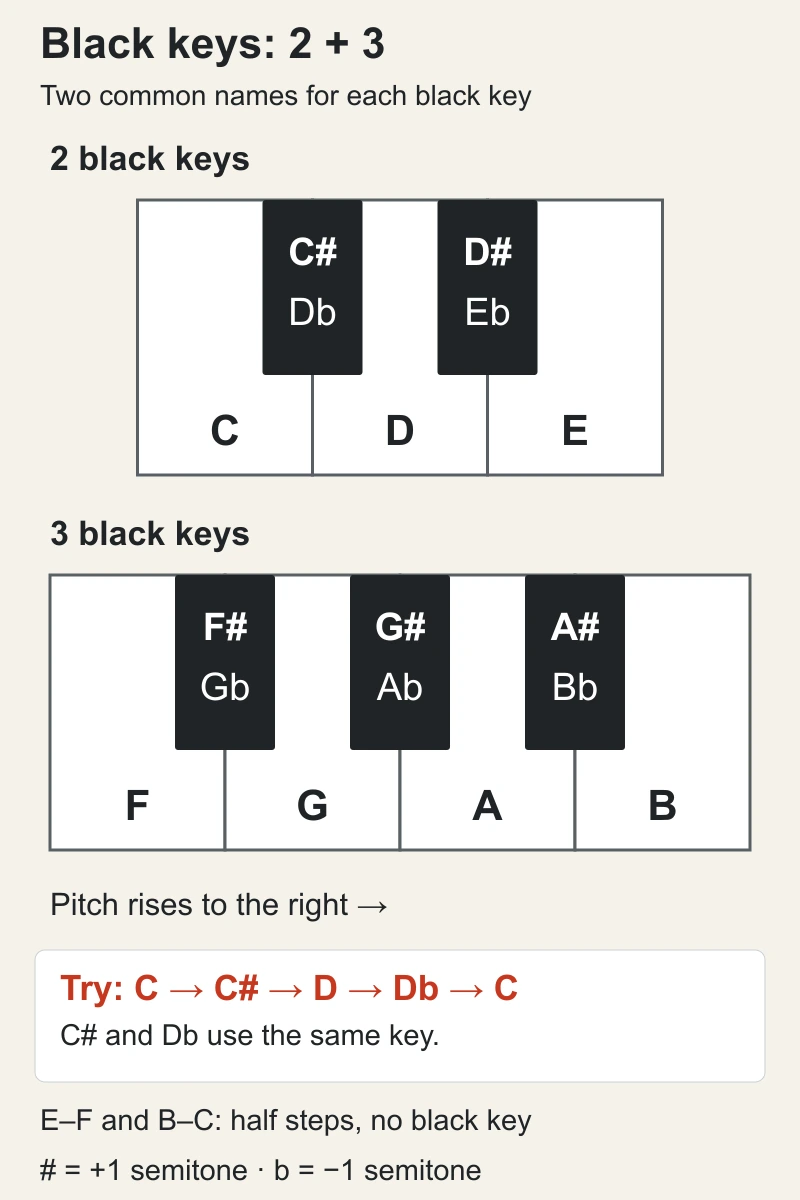
1. Use the two-and-three pattern as a landmark
From the player’s view, pitch rises to the right. Find a complete pair of black keys near the middle of the keyboard. The white keys around it are C, D and E; the black keys are C♯/D♭ and D♯/E♭, from left to right. Around the next group of three, the white keys are F, G, A and B. The black keys are F♯/G♭, G♯/A♭ and A♯/B♭. This layout repeats at different pitches. A group may be cut off at an instrument’s end, so begin with complete groups rather than assuming the leftmost key is C. The diagram enlarges the two groups on separate rows; it is not a picture of two stacked keyboards.
2. Sharp and flat describe a pitch change, not a key colour
A sharp (♯) raises a note by one semitone, or half step; a flat (♭) lowers it by one. On an ordinary piano, move to the immediately neighbouring pitch, including black keys. From C, the next black key to the right is C♯. From D, that same key to the left is D♭. Different names using the same piano key are enharmonic. Do not turn this into a rule that every sharp or flat is a black key. E–F and B–the next C have no black key between them and are already half steps. E♯ is played on F and B♯ on C; likewise, F♭ uses E and C♭ uses B.
3. Find one black key from both neighbouring white keys
Begin with C♯ and D♭ only. Play C–C♯–D one note at a time, then D–D♭–C. Look at the middle key and say its new name as you return: it is the same key. Leave the pedal alone and release each key before moving on so you can check your location. This is a naming exercise, not a fingering or legato test; use a comfortable finger and take your time. In written music, note spelling reflects the key or harmonic role. Read the written name instead of automatically replacing it with your preferred spelling. Sharing a key does not make every musical role interchangeable.
Pio: Do I have to learn the same black key twice, as C♯ and D♭?
Dock-sensei: The location is the same. Connect the view from C, a half step up, with the view from D, a half step down. Once one pair makes sense, use the neighbouring white keys to find the others.
An eight-minute session for today
- 2 minutes: point to a complete pair and a group of three. Name the white key to the left of each group C or F, then find them in another octave
- 2 minutes: play C–C♯–D, then D–D♭–C slowly. Check that the middle key is the same and say the names aloud
- 2 minutes: name the keys between F/G, G/A and A/B as F♯/G♭, G♯/A♭ and A♯/B♭. Finish by returning to D♯/E♭
- 2 minutes: play E–F and B–the next C, noticing the half steps without black keys. Hide the diagram and find C♯, D♭, F♯ and B♭ separately. Note only the names you hesitate over
Review and references
Last content review:
Keyboard layout, sharps and flats, E–F/B–C and enharmonic names were checked against manufacturer and university-hosted lessons, with both languages reviewed twice. The five paired names and diagram pitches were verified. The eight-minute routine is an editorial suggestion.
- Now, Let’s Play Some Notes! — Yamaha
- Half Steps, Whole Steps, and Accidentals — Chelsey Hamm / Roger Williams University Pressbooks
References support the editorial review. They do not provide an individual diagnosis or guarantee compatibility with every instrument or model.
Frequently asked questions
Are there only five black keys?
There are five between C and the next C, within one octave. That pattern repeats across the piano; five is not the total for the whole instrument.
Is moving to the next white key always a whole step?
No. C–D has a black key between and is a whole step, or two semitones. E–F and B–C are half steps. Check whether another key lies between the pitches instead of relying on colour alone.
Are enharmonic notes always identical on every instrument?
This lesson describes ordinary piano-keyboard positions. It is not a claim that every instrument or tuning system treats differently spelled notes identically.
Are B♭ and B the same?
Not in the English note-naming system used here. B is a white key; B♭ is the black key immediately to its left. Do not overlook the flat sign.
Can I practise without a piano?
You can point to the lesson diagram and say the names. The linked Piano, C, Major view helps locate the white keys; it does not label all five black keys or provide a playable keyboard. Use a real keyboard for the listening exercise.
Will eight minutes make me remember every name?
The timing is an editorial suggestion, not a learning guarantee. Finding just C♯ and D♭ without looking is useful progress. Rest when tired and stop if you experience pain.