G vs G7 on Ukulele: Compare the Shapes and Notes
G and G7 look similar, but changing between them can still tangle your fingers. Separate the fret positions from the fingers assigned to them. In these open shapes, only string 2 changes fret, from three to one. With the fingerings shown here, however, all three fretting fingers change position. Take your time with both shapes and listen for the F in G7.
Main features and choices
- G contains G, B and D; G7 adds F. The 7 does not mean fret seven
- Reading strings 4 to 1, G is 0232 and G7 is 0212; zero means an open string
- Only string 2 changes fret, but all three fingers are reset in these fingerings
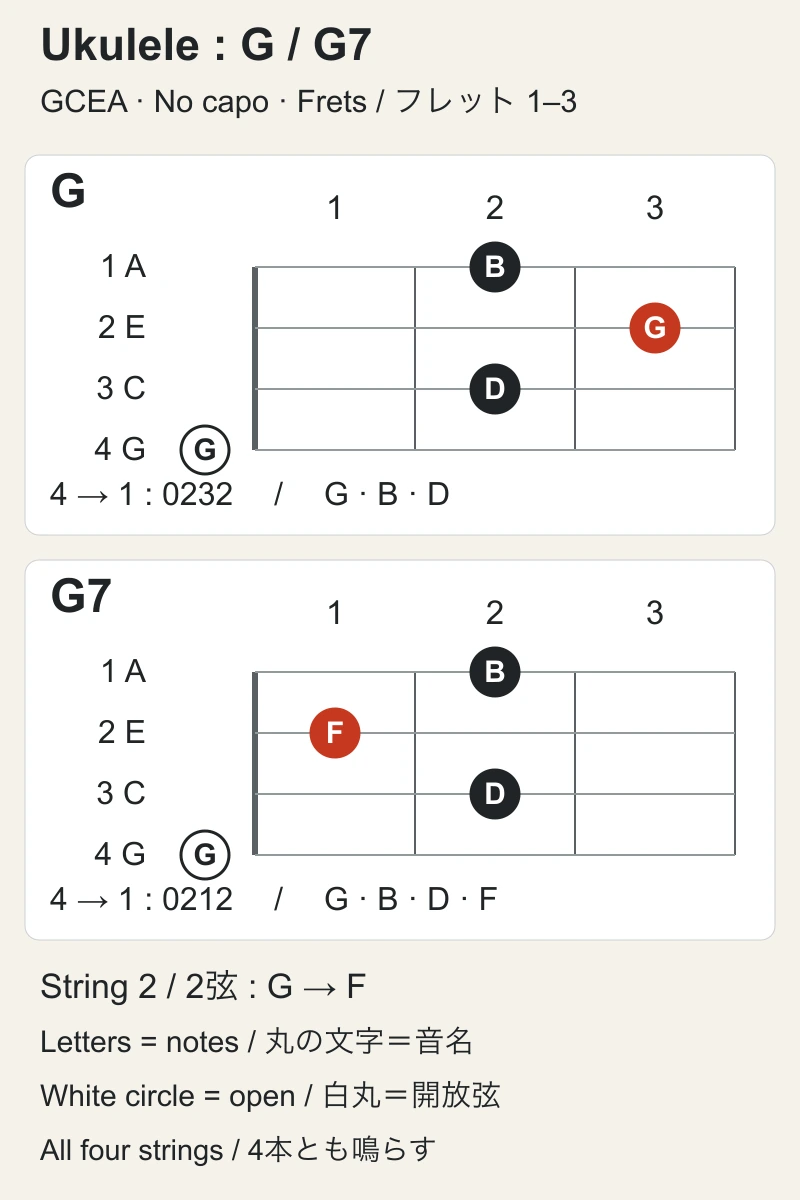
1. Hear the second-string G change to F
Use standard GCEA tuning with no capo. G major contains three note names: G, B and D. G7 contains four: G, B, D and F. In our shapes, the G on string 2 at fret three is replaced by F at fret one. The open fourth-string G remains, so the G7 shape still contains its root. First compare just those two second-string notes, playing them separately. Moving down two frets lowers the pitch by a whole step. G7 is also different from Gmaj7, whose seventh is F-sharp. Leave that other chord for later and focus on G and G7 today.
2. Separate fret numbers from finger choices
Our diagram places string 1, A, at the top and string 4, G, at the bottom. Letters inside circles are notes; the numbers above the grid are frets. For G, place the index on string 3 at fret two, middle on string 1 at fret two, and ring on string 2 at fret three. For G7, place the index on string 2 at fret one, middle on string 3 at fret two, and ring on string 1 at fret two. Leave string 4 open and play all four strings in both shapes. The sequences 0232 and 0212 give frets in string 4-to-1 order, not finger numbers. Strings 3 and 1 keep their frets but change fingers. Do not force those fingers to stay planted. Other fingerings are possible; for now, learn these two shapes separately.
3. Check four individual strings before adding speed
Set up G and lightly pick strings four, three, two and one in turn. Listen for any blocked string. Repeat with G7. Before squeezing harder, check for a fingertip touching a neighbouring string or sitting too far from the fret wire. Release the grip and try again just behind the fret. Once each shape is clear, set 60 BPM and 4/4. Strum G once on beat one, stop it on three, and use beats three and four to reset for G7 in the next bar. Repeat that timing with G7. These rests deliberately make room for movement; they are not a rule for how every song should be played. Rest when tired and stop if you feel pain.
Pio: If only string two changes, can I just move my ring finger?
Dock-sensei: Only that string changes its note, but today’s fingerings also swap the fingers used on strings one and three. Check the places and the fingers separately. It is fine to stop and reset.
An eight-minute session for today
- 2 minutes: check GCEA tuning and remove any capo. Play just string 2 at fret three, G, then fret one, F. Listen to the difference without holding a full chord
- 2 minutes: form G, 0232, and pick strings four through one separately. Relax the hand before finding the same positions again. Do not add a tempo yet
- 2 minutes: repeat for G7, 0212. Index goes on string 2, fret one; middle on string 3, fret two; ring on string 1, fret two. Leave string 4 open
- 2 minutes: manually set the metronome to 60 BPM and 4/4. Alternate one bar of G and one of G7. Strum once on one, gently touch the strings with the strumming hand to stop on three, and reset during three and four. Remove the click if the change feels rushed
Review and references
Last content review:
Notes and fingerings were checked against manufacturer and author lessons. Diagram pitches were calculated from GCEA tuning; fret positions versus fingers and high-G, low-G and baritone distinctions were reviewed twice in both languages. The 60 BPM, eight-minute routine is an editorial suggestion.
- How to Play the G Major Chord on Ukulele — Fender / Ben Nemeroff
- How To Play The G7 Ukulele Chord — Ukulele Tricks
- Introduction to Seventh Chords — University of Puget Sound
References support the editorial review. They do not provide an individual diagnosis or guarantee compatibility with every instrument or model.
Frequently asked questions
Are G and G7 the same chord?
No. G contains G, B and D; G7 contains G, B, D and F. Their similar shapes do not mean you can always substitute G7 when a song asks for G.
Does G7 mean play at fret seven?
No. The 7 identifies a chord type. This G7 shape uses only frets one and two plus an open string.
Which way do I read 0232 and 0212?
Here they run from string 4, G, through C and E to string 1, A. Zero means leave that string open. The diagram’s letters name notes; the text explains the fingers.
Do these shapes work with low G?
Yes, if the tuning is GCEA. The fourth-string G simply sounds an octave lower than high G. With baritone DGBE tuning, these positions do not give the same G and G7 chords.
May I leave a gap during the change?
In this exercise, beats three and four of every bar are deliberate rests for resetting. Find the correct places comfortably first, then work on the connection required by a particular song.
Does the linked tool grade my chords?
The metronome marks beats; it does not grade chords. Set 60 BPM and 4/4 manually. To inspect the notes in the chord finder, select Ukulele and G, then switch between Major and 7. The eight-minute routine is an editorial suggestion, not a deadline for mastering the change.