What Is a Drum Flam? Two Strokes, One Compact Sound
Both sticks land together, or the result sounds like two unrelated hits. A basic flam places a quiet grace note just before a main stroke played by the other hand. There are two contacts with the surface, but the aim is one compact, fuller sound rather than two evenly counted notes. Use one practice pad and check each lead hand separately today.
Funciones y opciones principales
- Soft grace note, then opposite-hand main stroke: not simultaneous landings or two even eighth notes
- l R means soft left before main right; r L reverses the roles. Name the flam after the main hand
- Place the main stroke on the beat. Do not add a beat or a fixed half-beat for the grace note
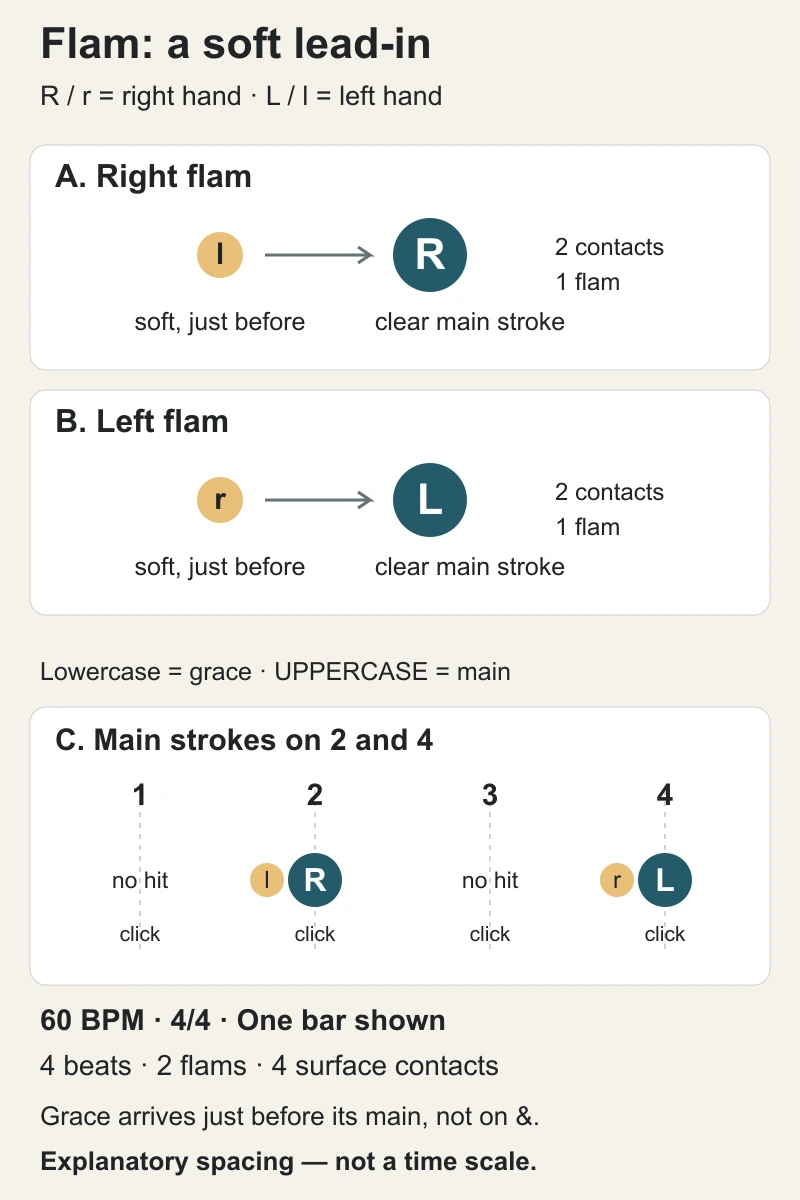
1. Two contacts make one compact flam
A small grace note precedes the normal-sized main note in notation. Our explanatory diagram uses lowercase l and r for grace notes and capitals R and L for main strokes. R and r both mean right; L and l both mean left. A right flam is l R, so the left hand touches first. This differs from a same-hand double stroke such as RR or LL. Do not read the grace note as an independent, evenly spaced eighth note. The gaps in our diagram are not a scale of seconds or note values.
2. Give the two hands different starting heights
Use a stable practice pad and try single right flams without a click. Prepare the left stick close to the surface and the right a little higher at a comfortable height. Let the left make a quiet contact just before the right. Keep the sticks clear of one another, avoid a rigid grip and allow them to return from the pad. If the grace note dominates, compare a lower left starting position. If the landings coincide, check their order; if the sounds are far apart, gradually bring them closer by listening. You do not need a forceful main stroke. Stop and reset between attempts, then reverse the roles for r L. Rest when tired and stop if there is pain.
3. Put the main stroke on the click
Manually choose 60 BPM and 4/4 and listen for one bar first. In C, make no new stroke on beat 1, play a right flam on 2, no new stroke on 3 and a left flam on 4. The main R and L meet the clicks; each grace note arrives just before its main. The bar still has four beats, with two flams and four surface contacts in total. The grace notes are not assigned to the preceding beat or the & subdivision. Try two bars, then stop and rest. If changing lead hands is difficult, use right flams on both 2 and 4, or return to isolated flams without a click.
Pio: Is left really first in a right-hand flam?
Dock-sensei: Yes. The main hand names the flam. A quiet left note decorates the main right stroke, so it is l R. Landing both sticks at exactly the same time is not today's target.
An eight-minute session
- 2 minutes: say l R for A and r L for B, pointing to the lowercase grace and uppercase main. Try quiet single-hand contacts on the pad, then rest
- 2 minutes: play isolated l R flams without a click. Reset each time. Choose only one issue to check: simultaneous landings, an oversized gap, or an overly loud grace note
- 2 minutes: repeat with r L. Compare the clarity of each main stroke. Do not rush continuous alternating flams; leave time to rest
- 2 minutes: manually set 60 BPM and 4/4 and listen for one bar. In C, play l R on beat 2 and r L on 4, placing each main stroke on its click. Stop after two bars and rest; use one lead hand or remove the click if needed
Review and references
Last content review:
Manufacturer and educator references informed two editorial passes. Surface contacts versus flam count, main hand versus first hand, explanatory spacing versus note values, and basic flams versus simultaneous hits are distinguished. The beats-2-and-4 diagram and eight-minute routine with rests are editorial exercises, not fixed timing gaps, automatic grading or mastery guarantees.
- Exercise 09: Flam Primer — Vic Firth
- Snare Drum Warm-Up, Part 4 — Yamaha / Dr. Dave Gerhart
- How to Play the Flam — Drum Beats Online
- Rudiments Around the Drums, Part 2 — TigerBill / Bill Meligari
References support the editorial review. They do not provide an individual diagnosis or guarantee compatibility with every instrument or model.
Preguntas frecuentes
How many beats is a flam?
That depends on the main note's written value and placement. The technique name alone does not specify a duration. Our exercise places mains on beats 2 and 4 without extending the bar for grace notes.
How many seconds early is the grace note?
We prescribe no fixed gap in seconds. Listen for a compact basic flam. The drawing is explanatory, not a half-beat or sixteenth-note timing grid.
Should both strokes have equal volume?
For this basic exercise, keep the grace quieter and the main clearer. That is a different goal from even-volume double strokes. The main need not be loud overall.
Why have I seen both hands land together?
Flat flams on different drums are another application. Today's scope is only the basic flam on one pad, with the grace before the main.
Can I start without a practice pad?
You can check hand order and main-beat placement without sticks. That does not test stick height, rebound or the audible gap. Do not hit a hard desk; use a stable, suitable surface for sounding practice.
Does CHORDOCK grade my flam spacing?
It does not automatically grade the exercise. Set 60 BPM and 4/4 manually and listen yourself. The diagram and eight-minute routine with rests are editorial suggestions, not a promise of mastery or speed gains in eight minutes.