What Should a Guitar Beginner Practise? A Three-Month Roadmap
You do not need to finish a full song immediately. Tune first, make one clean note, connect a few chords, and then keep a steady pulse.
Funciones y opciones principales
- Month one: posture, tuning, and single notes
- Month two: basic chords and slow changes
- Month three: short progressions with steady rhythm
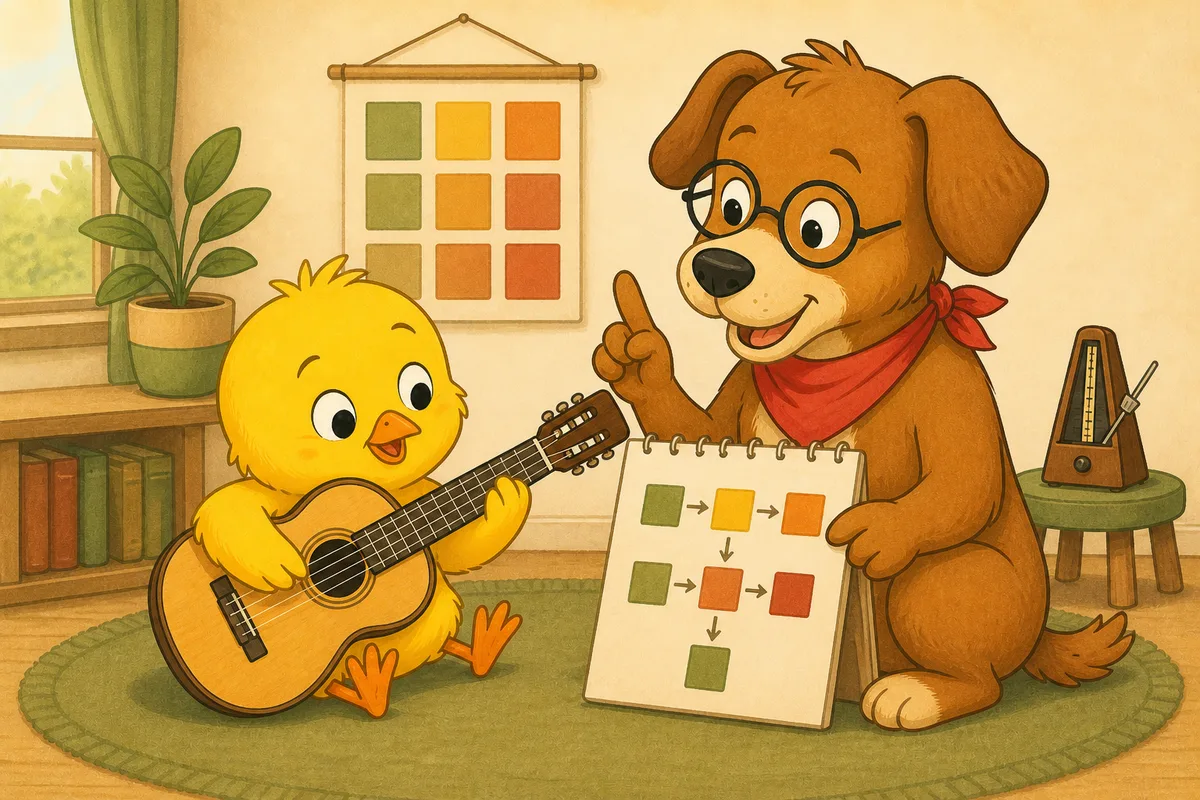
Month one: make clean notes
Tune at the start of every session and play all six open strings separately at a normal level. Then choose one string and fret it just behind the first-fret wire. If it buzzes, check the distance from the fret and contact with neighbouring strings before squeezing harder. Move on to chords when the tuner settles near each target and the chosen fretted note sounds clean three times without shoulder or wrist pain.
Month two: connect two chords
Choose only two shapes, such as C and G or Am and Em. Build each one, play every required string separately, and adjust only the finger next to a muted note. Make three slow round trips without a beat; when the same strings ring each time, try four beats per chord at 40–50 BPM. Look for a shared finger or a small path instead of lifting the whole hand far from the neck.
Month three: keep the rhythm moving
Play a two- to four-chord loop at 50–60 BPM, holding each chord for four beats. If a change is late, keep the down-up motion and counting moving, then rejoin on the next downbeat. When the source of a stop is unclear, mute the strings and test the strumming hand alone for four bars. After three complete loops without losing the count, add one chord or raise the tempo by 5 BPM.
Pio: Is it okay if I cannot finish everything today?
Dock-sensei: Absolutely. A short session you can repeat tomorrow is more useful than one exhausting session.
Today's 15-minute session
- 3 minutes: tune, check six open strings, and test one fretted note
- 5 minutes: check each string in two chords, then make three round trips
- 7 minutes: play three four-bar loops at 50–60 BPM and note one stopping point
Preguntas frecuentes
Must I practise every day?
No. Three to five short, repeatable sessions each week can build steady progress.
Do I need the F chord immediately?
No. Learn open chords and rhythm first, then add a barre when your hand position is ready.
How do I know when to move to the next month?
The calendar is only a guide. Move on when you can repeat the current test three times without sharp pain or strong tension. Return to an earlier step whenever the result is inconsistent.
My chords ring, but I stop during every change. What should I do?
Remove the beat and make three slow changes between only two shapes. Then try four beats per chord at 40–50 BPM, lowering the tempo or keeping a shared finger down if the stop returns.