Find the Fifth on Bass: Root-and-Fifth Positions
You can play roots, but where is the fifth you are supposed to add? On a standard EADG four-string bass, move to the next thinner string and add two to the fret number to find the perfect fifth above a root. Today’s A–E and D–A pairs give you two places to try, without confusing a fifth with an octave.
Fonctions et choix principaux
- From a root on string 4, 3 or 2, use the next thinner string and two higher frets
- A perfect fifth spans seven semitones; five is not a fret distance or finger number
- Alternate single notes, stopping the previous note and keeping unused strings quiet
1. Find E from an A root
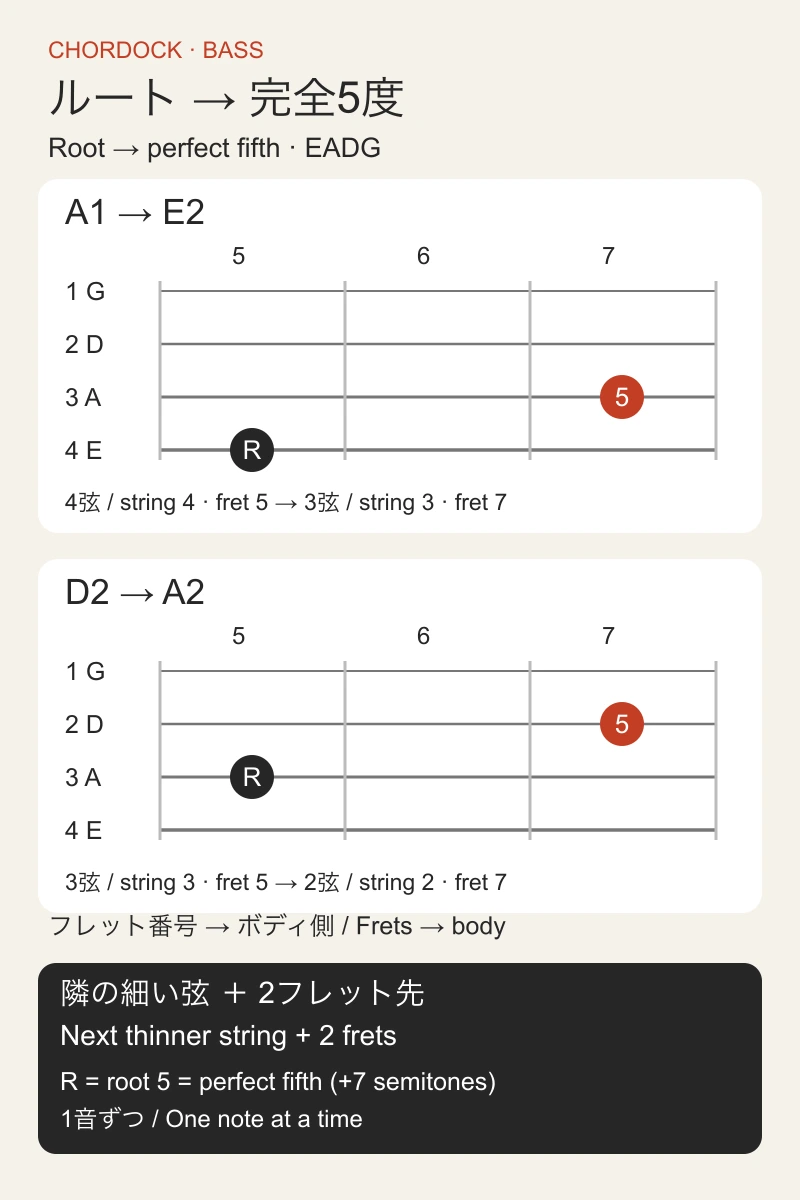
Use standard EADG tuning without a capo: string 4 E is the thickest, followed by 3 A, 2 D and 1 G. Play A at string 4, fret five, then stop it. E at string 3, fret seven is a perfect fifth above that A. In the diagram, string 1 is at the top and string 4 at the bottom. Higher fret numbers go right, towards the body. Horizontal lines are strings; vertical lines separate fret spaces, and circles mark where to fret. R means root and 5 means perfect fifth, not a finger number. Starting on string 1 leaves no thinner string, so this particular shape is unavailable there.
2. Tell a fifth from an octave
Count the letters A, B, C, D, E, including both ends: A to E is a fifth. This perfect fifth spans seven semitones, not five. In standard EADG, the same fret on the next thinner string is five semitones higher; adding two frets makes seven. From A at string 4, fret five, skipping a string to string 2, fret seven instead produces the higher A, twelve semitones away: an octave. A1–E2 and D2–A2 on the chart label sounding pitches. The small numbers are octave registers, not string numbers.
3. Repeat with D and A, listening to the ends of notes
Starting from D at string 3, fret five gives A at string 2, fret seven. Begin without a click and play one note at a time. Lightly touch the previous string to stop it before sounding the next. You do not need to hold both positions at once: stop the sound and move the whole hand if reaching is uncomfortable. Stop if there is pain. Once the positions are clear, use 4/4 and put the root on beat one and the fifth on three, holding each for two beats. This is a location-and-muting exercise, not a rule that every song must use this rhythm.
Pio: Does a fifth mean moving five frets from the root?
Dock-sensei: Five names the interval, not the fret distance. For today’s A and E, move to the next thinner string and two higher frets. Play the notes separately and connect each place to its name.
An eight-minute session for today
- 2 minutes: check EADG tuning and remove any capo. Point to A at string 4, fret five and E at string 3, fret seven, then play each. Distinguish the R and 5 labels from fret numbers
- 2 minutes: make four A–E round trips without a click. Stop the previous note before moving, and listen for unused strings. Use the remaining time to rest and check the positions
- 2 minutes: make four round trips between D at string 3, fret five and A at string 2, fret seven. Move the hand if needed rather than planting and stretching the fingers. Sound only one note at a time
- 2 minutes: manually set 60 BPM and 4/4. Play A on one and E on three, returning to A on the next one. Stop the previous string at each change. After four bars, mute on the following one and rest; try D and A if comfortable. Remove the click if you feel rushed
Review and references
Last content review:
String names, intervals and triad fifths were checked against primary lessons. Both languages were reviewed twice; A1–E2 and D2–A2 pitches, the diagram and the fifth–octave distinction were verified. The 60 BPM, eight-minute routine is an editorial suggestion.
- Roots and Fifths — StudyBass
- How to Play Bass Guitar: Tuning — Fender / Ben Nemeroff
- Introduction to Triads — University of Puget Sound
References support the editorial review. They do not provide an individual diagnosis or guarantee compatibility with every instrument or model.
Questions fréquentes
Does the same fifth work for a minor chord?
Major and minor triads both contain a perfect fifth above the root: A and Am both have E. Diminished and augmented triads alter the fifth, so do not apply the shape to every chord. Follow the bass notes or phrases specified by a particular song, too.
Can I find it on the same string?
A perfect fifth above is seven frets higher on the same string. A at string 4, fret five pairs with E at fret twelve. This is the same E pitch as today’s adjacent-string position, but it requires a different move.
Does the shape work in every tuning?
This article assumes a four-string bass in standard EADG with no capo. Drop D and other tunings can change the intervals between strings, so the same position pattern may no longer give a perfect fifth. Check the open-string notes first.
How is the octave shape different?
From A at string 4, fret five, the fifth is E on the adjacent string 3 at fret seven. The octave is A on string 2 at fret seven, skipping a string. Both add two frets, but they use different strings and make different intervals.
Must I hold both notes down?
No. This exercise alternates single notes. You may stop a note before shifting the hand to a comfortable position. At first, prioritise the correct places and quiet unused strings over eliminating every brief gap during a move.
Does the practice tool grade my notes?
The linked metronome marks beats; it does not grade bass pitch or fingering. Set 60 BPM and 4/4 manually. The eight-minute sequence is a CHORDOCK editorial suggestion, not a deadline or a guarantee of progress.