Bass Raking: When Can the Same Finger Play the Next String?
You learned to alternate index and middle, yet changing strings makes you want to use one finger twice. Is that always a mistake? Compare two approaches using only open G to D on a standard EADG four-string bass. This small next step is for beginners who can already alternate a short pattern on one string.
मुख्य सुविधाएँ और विकल्प
- Raking is one way to reuse a plucking finger when moving to the adjacent thicker string
- Here, string 1 G moves to string 2 D: index–middle for alternation versus index–index for raking
- Landing on the next string is not the cue to sound it. Keep the second note on its beat and stop the previous string
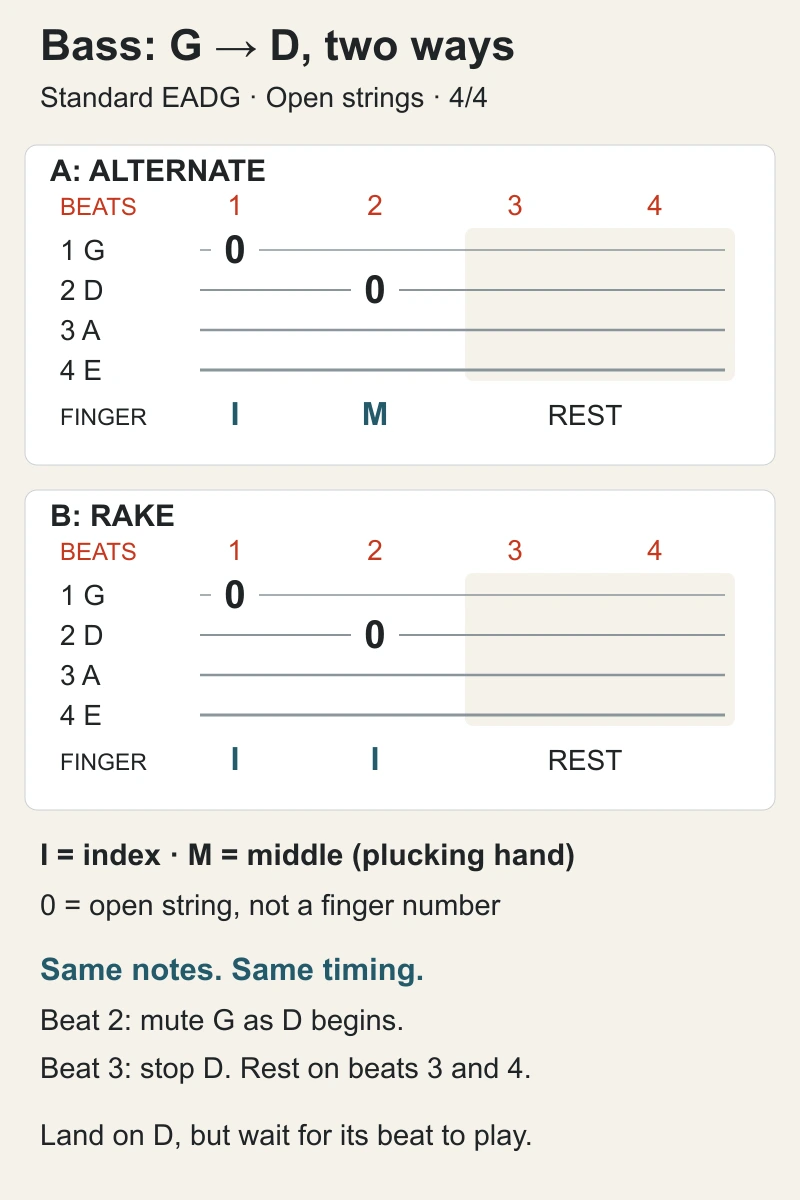
1. Two deliberate finger sequences
Alternating index and middle is an important foundation. When moving from a thinner string to its thicker neighbour, reusing the finger that just played gives another option: raking. We focus on open string 1 G moving down in pitch to open string 2 D. Identify strings and pitches rather than relying on what down looks like. Example A uses index then middle; B uses index twice. The notes are identical. I means plucking-hand index and M means middle. A zero on a string line means open, not a fretting-hand finger number.
2. Land on D, then wait for its turn
Without a click, pluck G gently with the index and let the fingertip finish by resting on adjacent D. Test whether you can land without sounding D. Next, pluck D with that same index finger already touching it. That is our two-note raking example. You need not swing the finger far back, but this is not a fast strum across two strings either. Resting on D also mutes it; distinguish that contact from moving through the string to sound the next note. Keep joints and wrist relaxed and stop if pain or strong tension appears.
3. Match timing and muting before judging the fingers
In our 4/4 comparison, play G on beat 1 and D on beat 2. Stop D on beat 3 and rest through beats 3 and 4. Stop G as D begins so the sounds do not overlap. Light contact from the pad of a fretting-hand finger can stop open G; check without a click that it does not also silence D. Keep unused A and E quiet with comfortable contact from either hand. At a low amplifier or headphone level, listen for an early second note, a sudden volume jump or ringing during the rest. Aim for the same musical result with either fingering. The reverse D-to-G move and string skips need separate attention, not an automatic copy of this motion.
Pio: When my index lands on D, should I play the next note straight away?
Dock-sensei: Landing and sounding are separate events. Today D belongs on beat 2. Go slowly enough to wait and keep the space between G and D even.
An eight-minute session
- 2 minutes: check standard EADG and locate string 1 G and string 2 D. Play A: G with index, D with middle. Stop and rest after the pair. If one-string alternation is still difficult, use the linked foundation lesson first
- 2 minutes: try B without a click. Play G with index and land on D without sounding it yet. Wait, then play D with that index. Stop and rest. Avoid digging in or locking the finger
- 2 minutes: compare A once and B once. Stop G when moving to D, and silence all strings at the end of each attempt. Listen for just one issue: an early second note, a volume jump or unwanted ringing
- 2 minutes: if comfortable, manually set 60 BPM and 4/4. Play A for one bar and B for one bar. In each, play G on beat 1 and D on beat 2, stop on beat 3 and rest through beats 3 and 4. If the pattern breaks down, stop the click and rest before checking again
Review and references
Last content review:
Manufacturer and bass-education references informed two editorial passes on technique, direction and alternation. Landing versus sounding, finger labels versus fret numbers, string thickness versus visual direction, and successive notes versus chords are distinguished. The G-to-D diagrams, timing and eight-minute routine are editorial exercises, not automatic grading or a ranking of techniques.
- Plucking: Dragging / Raking — StudyBass / Andrew Pouska
- Bass Trick: String Raking — Fender Play
- Improve Your Alternate Two Finger Picking — TalkingBass / Mark Smith
- String-Crossing — StudyBass / Andrew Pouska
References support the editorial review. They do not provide an individual diagnosis or guarantee compatibility with every instrument or model.
अक्सर पूछे जाने वाले प्रश्न
Is raking a mistake in alternate plucking?
Deliberately reusing a finger on the next thicker string is a technique. If it slips in unnoticed while you are specifically practising alternation, check the fingering. Decide which skill the exercise is testing.
Should I use only my index for every note?
That is not this lesson's recommendation. We compare only two adjacent strings, G to D. Keep practising alternation for repeated notes on one string too, so you can choose a sequence that suits a phrase.
Can I rake with my middle finger?
Yes. The idea of reusing a finger on the next thicker string can also use middle. Our exercise fixes the starting finger as index to make the comparison simple. Try another start after you can separate these two notes comfortably.
Do I slide the same finger from D back to G?
That moves toward a thinner string, the opposite direction. Reusing a finger may be possible in some passages, but it is not the same landing-based motion used here. Treat it as a separate crossing and first check it slowly with alternating fingers.
Why do G and D sound together?
This example asks for two successive notes, not a chord. Lightly touch G with your fretting hand as you play D to stop it. If D also disappears, inspect the contact one string at a time without a click.
Does CHORDOCK grade fingering or volume?
This exercise does not grade your playing. Set 60 BPM and 4/4 manually and check finger order and muting yourself. Examples A/B and the eight-minute plan with rests are editorial exercises, not speed targets or a mastery deadline.