Guitar Pickup Measures: How to Enter on Beat Four
The opening bar has only one quarter note. If three beats seem to be missing from 4/4, you may be looking at a pickup, or anacrusis: a beginning before the downbeat of the first complete bar. Today we use just a one-quarter-note pickup in 4/4. Call the first note four, then call the next bar's start one.
मुख्य सुविधाएँ और विकल्प
- Your first played note is not necessarily beat one. Today's entrance is four → one
- The diagram's preparatory one-two-three is a count-in, not three rests to add to the written pickup
- Pickups have different lengths. Beat four applies to today's one-beat pickup in 4/4, not every pickup
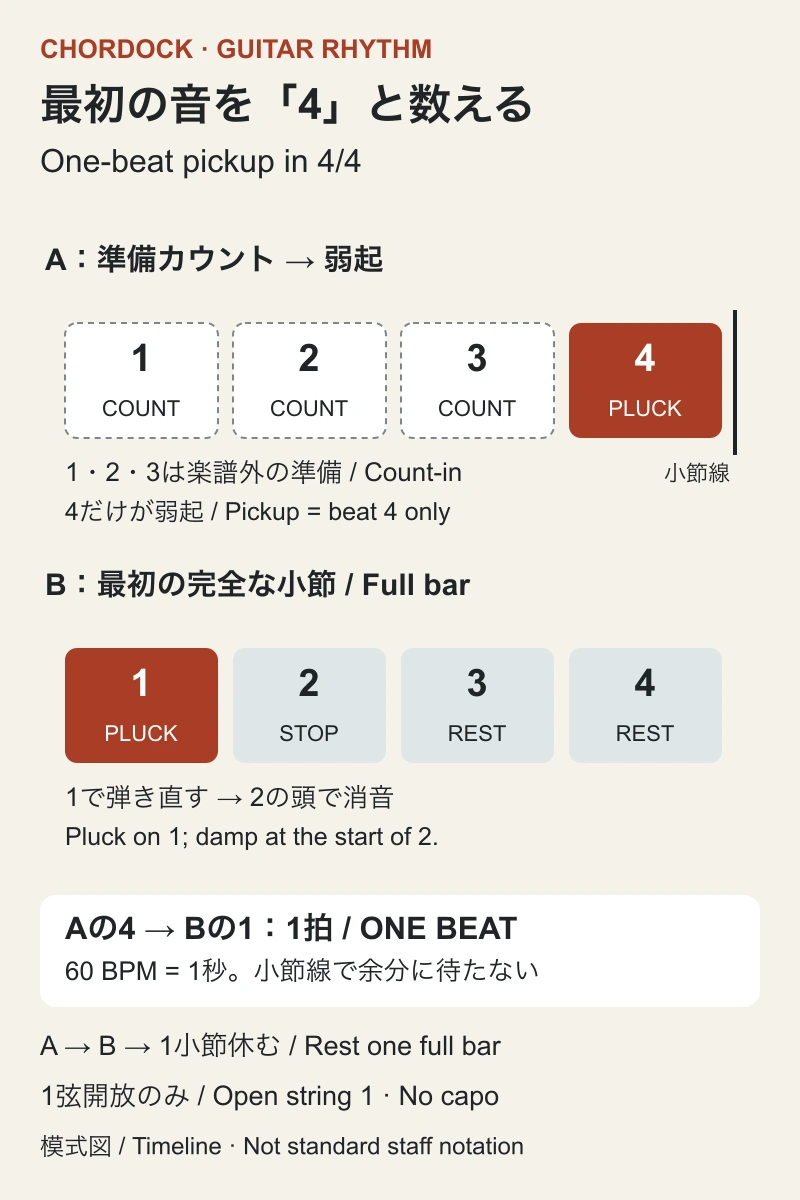
1. Do not add the missing beats to the score
A pickup, also called an anacrusis, is an incomplete bar at the start of a piece or section. In our example, the music before the first barline lasts one quarter note: one beat in 4/4. Count that note as four, then count one-two-three-four after the line. The meter has not changed to 1/4. The first three counts in diagram A prepare your entrance; they do not represent printed rests. By convention, bar numbering begins with the first complete bar, but focus first on the written durations and barline rather than the bar number.
2. Connect four to one without an extra gap
Use open string 1 in standard EADGBE tuning with no capo. In A, say one-two-three, then pluck at the start of four. Continue directly into B and pluck again on one. These are two attacks on the same pitch, with no tie. Do not pause at the barline or insert an extra beat. At 60 BPM with a quarter-note beat, four to the next one takes one second. At the start of B's two, gently touch the string with a picking-hand finger pad to damp it, counting two-three-four through the silence. This is our editorial entrance exercise, not a damping instruction for every piece with a pickup. Avoid forcing the wrist; stop if there is pain.
3. Separate the click's one from your first note
Manually set the metronome to 60 BPM and 4/4. Listen without playing for one bar to locate the accented one and the four-beat cycle. On the next cycle, count A's one-two-three, enter on four and continue into B's one. After B, count one whole silent bar, then begin A again on the next cycle. Renaming your first note one would misalign your count with the click's bar. If necessary, put the guitar down and lightly clap on four and the next one. The goal is to keep your place in the meter, not to play louder.
Pio: Why is my first note four instead of one?
Dock-sensei: This example begins one beat before the first complete bar. Prepare with one-two-three, play on four, and continue into the next one. Your first sound and the bar's first beat are different things.
An eight-minute session for today
- 2 minutes: count one-two-three-four | one-two-three-four evenly while looking at the diagram. Lightly clap on four and the next one, without adding a beat at the line. Try four times, then rest
- 2 minutes: without a click, try A → B on open string 1. Pluck on A's four and B's one, then damp at the start of B's two. Count through B's four before stopping to check that you called the first note four
- 2 minutes: manually set 60 BPM and 4/4. Listen for one bar → play A → play B → rest for one bar. Start A again on the next cycle; try four rounds. Listen to attack placement before worrying about lingering sound
- 2 minutes: try up to four more rounds. Listen for four and the next one on neighbouring clicks, then check damping on B's two. Return to clapping if needed; use the remaining time for rest and review
Review and references
Last content review:
Theory teaching material and official notation documentation informed two passes distinguishing first attack/downbeat, count-in/written rests, beat four/and of four, and meter/dynamics. The four-to-one interval was independently checked as one beat. The single-string pattern, damping point and eight-minute routine with rests are editorial, not instructions to alter a piece's final bar or promises of automatic grading or mastery.
- Notation of Rhythm: The Beat and the Measure — Ars Nova / Exploring Theory
- Anacrusis and Non-metered Bars — MuseScore Studio Handbook
References support the editorial review. They do not provide an individual diagnosis or guarantee compatibility with every instrument or model.
अक्सर पूछे जाने वाले प्रश्न
Does every pickup start on beat four?
No. It depends on the meter and the total duration of the pickup's notes and rests. Today's one-beat pickup in 4/4 starts on four. A half-beat pickup could start on the & of four. Do not decide from the number of notes alone.
Are the preparatory counts three beats of written rests?
Not in this diagram: they are spoken preparation outside the written pickup. A 4/4 bar containing three beats of written rests plus a quarter note totals four beats and is complete. Distinguish that from today's one-beat incomplete bar.
Are beat four and the & of four the same?
No. Today you play at the start of the numbered beat four. With an evenly divided beat, the & is halfway from four to the next one. At 60 BPM with a quarter-note beat, these positions are half a second apart.
Must a pickup be played quietly?
Its metrical position is not a blanket instruction to play softly. Follow the dynamics and phrasing in the score. Keep today's volume comfortable and concentrate on the interval between four and one.
Will the final bar also be shorter?
A common notation practice makes the pickup and final bar add up to one complete bar. Follow the actual ending in your score rather than removing beats yourself. Today's diagram is an entrance exercise, not the final bar of a complete composition.
Will CHORDOCK automatically grade my entrance?
This exercise has no automatic grading. Set 60 BPM and 4/4 manually and compare your attacks with the clicks by ear. The eight-minute routine, including rests, is an editorial suggestion rather than a guarantee of mastery in eight minutes.