Sixteenth Notes on Guitar: Count Four Notes in One Beat
Trying to squeeze four quick notes into a beat often makes the next beat arrive early. In 4/4 with a quarter-note beat, each sixteenth lasts a quarter of a beat: divide the same beat into four equal parts. Use your voice and open string 1 today, without a chord shape. The diagram's right edge marks the next beat, not a fifth sixteenth within the first beat.
मुख्य सुविधाएँ और विकल्प
- With a quarter-note beat, an eighth lasts half a beat and a sixteenth lasts a quarter of a beat
- Count four evenly spaced syllables: 1 e & a. The numbered beats line up with the clicks
- Leave a quarter-beat gap from a to the next number too; do not rush four attacks and wait out the leftover time
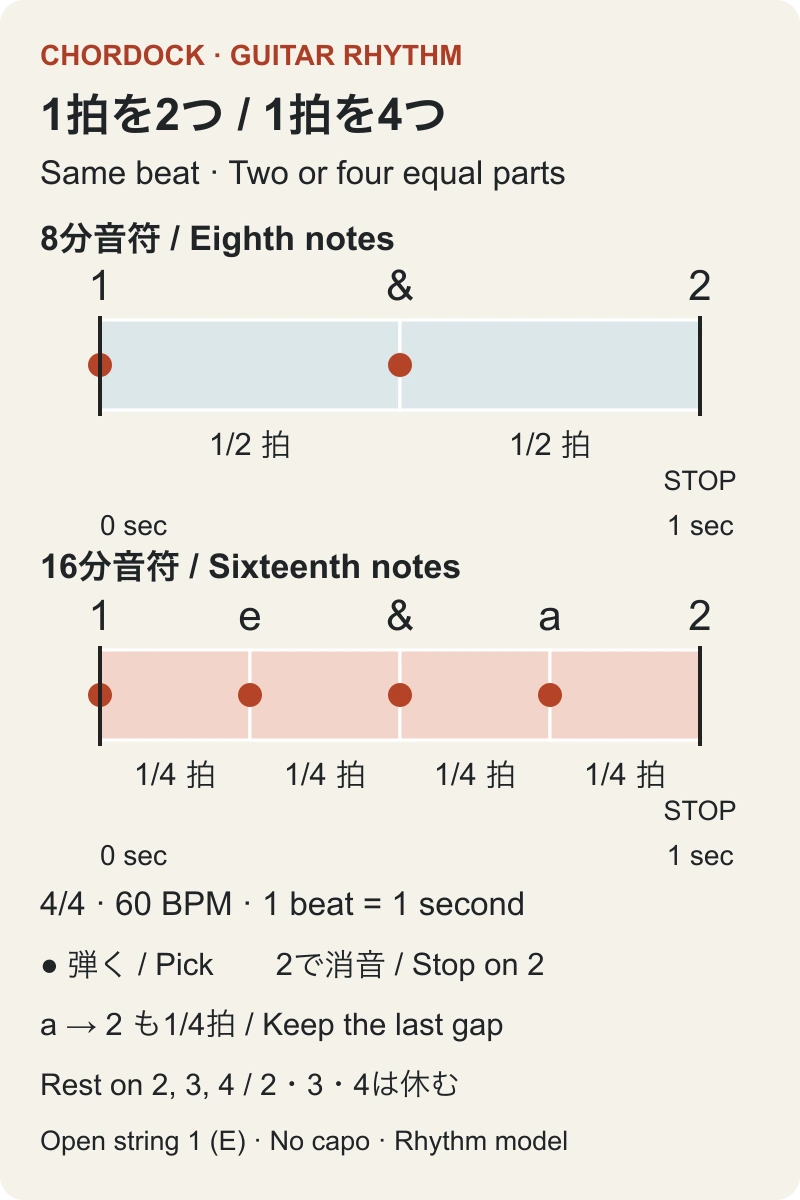
1. Compare two notes with four in the same beat
The top row shows two eighths; the bottom row shows four sixteenths. Both run from the beginning of beat 1 to the beginning of beat 2. Filling an entire 4/4 bar with sixteenths gives sixteen notes, but still four beats. A separate eighth note has one flag and a sixteenth has two. In basic beamed groups, eighths use one beam and sixteenths two. Sixteen does not mean sixteen beats. Nor is this the three-part division of an eighth-note triplet. This lesson deals only with straight, equal sixteenths and a quarter-note beat.
2. Count 1 e & a, including the last gap
One counting system uses 1 e & a, spoken one-ee-and-uh with four evenly spaced syllable starts. Continue with 2 e & a for the next beat. Here e and a are counting syllables, not pitch names, and & means and. At quarter note = 60 BPM, one beat lasts one second. Taking the start of beat 1 as zero, the attacks occur at 0, 0.25, 0.50 and 0.75 seconds; beat 2 starts at 1.00 second. There is still 0.25 second between a and 2. Keep the metronome at 60, not 240 BPM. Listen for the numbered beats and fill the spaces with your voice. Stretching a spoken syllable must not move the start of the next subdivision.
3. Play one beat, then reset over three rests
Use standard EADGBE tuning, no capo, and the thin first string open. Pick at the four dots in the lower row, then gently touch the string to stop its sound on the beat-2 click. Count 2, 3 and 4 without playing, then return to 1 in the next bar. With a pick, try small down-up-down-up strokes, or stay with speaking alone first. Check both even attacks and stopping on 2. If a lands on 2, your subdivisions have fallen behind. If the gap after a is noticeably longer, check whether you rushed the earlier attacks. When tension builds, stop playback and return to speaking. Do not repeat through pain.
Pio: After I pick four times, can I move straight to the next beat?
Dock-sensei: A quarter of a beat still remains after the fourth attack. Travel through the whole last cell before reaching 2 at the right edge. Listen to the gap before the next click, not only the four attacks.
An eight-minute session for today
- 2 minutes: trace the two eighth-note cells and four sixteenth-note cells in the diagram. Check that 2 at the right edge starts the next beat, outside the four cells
- 2 minutes: manually set 60 BPM and 4/4. Count in for one bar, then say 1 e & a on beat 1 and just 2, 3, 4 afterwards. Align each number with a click
- 2 minutes: pick the four attacks on open string 1 while counting. Stop the string on 2 and also rest on 3 and 4. Stop playback after every two bars to review whether you squeezed the last gap
- 2 minutes: alternate a bar using the top row's two attacks with a bar using the bottom row's four. Stop the string on 2 in both bars and keep 60 BPM unchanged. Return to speaking if needed
Review and references
Last content review:
Music education, guitar tuition and manufacturer lessons informed checks of note values, counting and 4/4. Both languages were reviewed twice for the beat-unit condition, final gap, syllables versus pitches and the distinction from triplets. The diagram and one-beat-at-a-time, 60 BPM, eight-minute routine are editorial suggestions.
- Note Duration — musictheory.net
- How to Count Sixteenth Notes on Guitar — MJP Guitar Tuition
- Understanding Time Signatures — Fender / Mike Duffy
References support the editorial review. They do not provide an individual diagnosis or guarantee compatibility with every instrument or model.
अक्सर पूछे जाने वाले प्रश्न
Is a sixteenth always a quarter of a beat?
Only when the beat unit is a quarter note. A different beat unit changes the fraction of a beat. The duration relationships remain: a sixteenth is half an eighth and a quarter of a quarter note.
Are sixteenths twice the tempo of eighths?
At a fixed tempo, they allow twice as many attacks in the same time, but the beat tempo itself stays unchanged. Both rows here use quarter note = 60 BPM.
Do e and a mean the guitar notes E and A?
Not in this count. They name positions within the beat, independently of pitch. The played note in this exercise remains open-string E.
What if the pick catches on upstrokes?
Check that the pick is not reaching too deeply past the string before trying to go faster. Use small movements on one string. If tension remains, put the guitar down and practise counting. You do not need to strum a whole chord here.
Are the dots TAB zeros or fret numbers?
No. Dots mark attack times; coloured cells show the duration until the next attack or the stop. The numbers 1 and 2 identify beats, and 1/2 and 1/4 identify beat lengths. None of them tells you where to fret.
Does the site automatically grade my sixteenths?
No automatic grading is provided. Set 60 BPM and 4/4 manually, listen to numbered beats and create the subdivisions yourself. This eight-minute editorial routine does not promise a mastery deadline. Recording would require a separate device feature or tool.