How to Play D7 on Guitar: What Changes from D?
Can you play D but lose your place when the D7 triangle appears? Separate note locations from finger numbers. In these open shapes, only string two changes fret: from fret three to fret one, lowering D to C. Yet the basic fingerings shown here require all three fingers to be reassigned. Use standard EADGBE without a capo and check four strings slowly before attempting a change.
Fitur dan pilihan utama
- D7 is xx0212 from string six to one: index on string two/fret one, middle on three/two, ring on one/two
- Sound strings four through one, starting with open D; omit strings five and six
- Only string two changes pitch from D to D7. One changed note does not mean moving only one finger
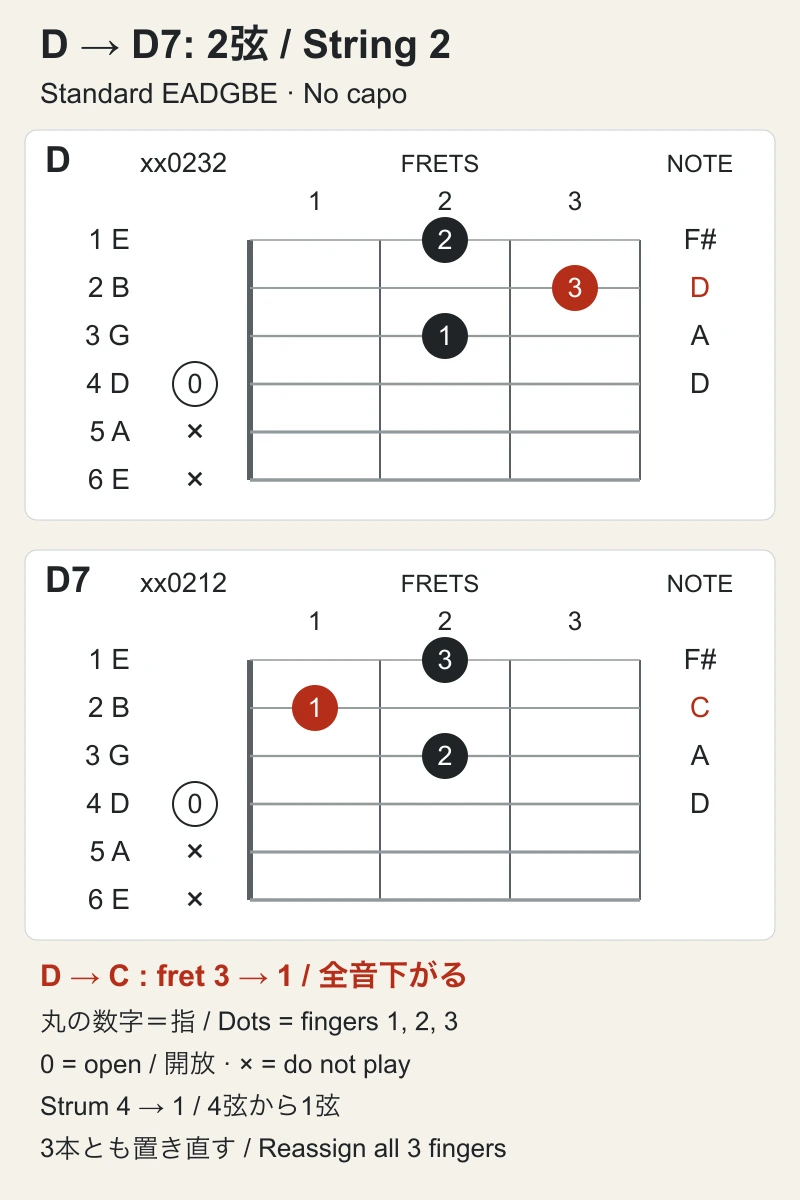
1. Separate string numbers, frets and fingers
Read xx0212 from string six to string one. X means do not sound that string; 0 means sound it open. The other digits are frets, not fingers. Put index finger 1 on string two/fret one, middle finger 2 on string three/fret two, and ring finger 3 on string one/fret two. Leave string four open. Place fingertips within the fret space, near the metal fret on the body side rather than directly on top of it. In our figure, numbers inside circles are fingers; numbers above the grid are frets. Pick strings four, three, two and one separately. If string two is blocked, inspect contact from neighboring fingers before adding pressure.
2. One changed pitch, but three reassigned fingers
Our D shape, xx0232, uses index on string three/fret two, ring on string two/fret three, and middle on string one/fret two. Compare frets with D7, xx0212: strings three and one stay at fret two and string four stays open. Only string two moves, from fret three to one: D drops a whole step, two frets, to C. With today's D7 fingering, however, index takes string two, middle takes string three and ring takes string one. All three have new jobs. Do not try to pin the other fingers down simply because those strings keep their pitches. Stop the sound and rebuild the shape first. This is not a ringing slide exercise. Other fingerings exist; today use the single pair shown.
3. The 7 names a chord type, not a fret
D contains D, F sharp and A. D7 includes C as well: a dominant seventh chord, with formula 1–3–5–flat 7. Relative to D, flat 7 means C, not C flat. From string four upward, these voicings sound D–A–D–F sharp and D–A–C–F sharp. Replacing a doubled D with C increases the number of distinct note names from three to four without adding a finger or a sounding string. Dmaj7 uses C sharp instead of C. Raising string two to fret two makes this shape xx0222, Dmaj7, so check that your D7 has C at fret one.
Pio: If only string two changes, can I just move one finger from D?
Dock-sensei: One note location changes, but this pair of basic fingerings reassigns all three fingers. Instead of chasing speed, check that both the second-string C and open fourth-string D sound clearly.
An eight-minute session for today
- 2 minutes: in standard tuning without a capo, build D7. Place index at string two/fret one, middle at three/two and ring at one/two. Say finger and fret numbers separately before playing, and rest the hand after a few attempts
- 2 minutes: check D7 one string at a time, four to one. Compare D, A, C and F sharp with the figure. Recheck position and contact only where a string fails. Keep your picking motion away from strings five and six
- 2 minutes: play the illustrated D once, gently touch the strings with the picking hand to stop them, relax and rebuild D7. Play D7 once and stop. Watch string two move from fret three to one; aim for three comfortable round trips
- 2 minutes: manually set 60 BPM and 4/4. Play D on beat one of bar one and stop on beat three. Rest throughout bar two while preparing D7. Play D7 on beat one of bar three and stop on beat three. Rest in bar four. Remove the click if it makes you rush
Review and references
Last content review:
Manufacturer, educator and university references informed two passes distinguishing changed pitches from reassigned fingers, frets from fingers, distinct tones from string count, and D7 from Dmaj7/D7-A. Diagram pitches were independently calculated from EADGBE. This is a position comparison, not a slide instruction. The eight-minute session with rests is editorial, not a mastery deadline or automatic grading.
- How to Play a D7 Guitar Chord — Fender / David Karalis
- D7 Chord — Guitar-chord.org
- Introduction to Seventh Chords — University of Puget Sound / Robert Hutchinson
References support the editorial review. They do not provide an individual diagnosis or guarantee compatibility with every instrument or model.
Pertanyaan umum
Which string starts D7?
For xx0212, start on string four and sound through string one. Open string five is A, a chord tone, but adding it puts A in the bass, making D7/A. First practise the illustrated shape with D as the lowest note.
Does string two use fret one or two?
D7 uses fret one, C. Fret two produces C sharp and turns this shape into Dmaj7. Both can ring clearly, but they are not the same chord.
Does 7 mean the seventh fret?
No. It identifies the chord type, not a fret or a string count. This open D7 uses frets one and two and sounds four strings.
Should I slide my finger from D to D7?
Not in this exercise. Stop the sound and rebuild the basic fingering. String two's 3-to-1 change compares note locations; it does not tell you to slide your ring finger while keeping pressure on the string.
Is it still D7 if string two does not sound?
With this voicing, omitting string two removes C. The remaining D, A and F sharp form D major. Since we are listening for D7's difference, check string two on its own rather than calling the missing note a finished D7. Stop if there is pain.
Will I master it in eight minutes?
Eight minutes with rests is an editorial practice suggestion, not a deadline. The metronome provides a manually set 60 BPM, 4/4 reference and does not grade your playing. Use only the first two minutes if needed; do not push through tension or pain.