G Chord on Guitar: Three Fingers or Four? Compare Two Shapes
You learned G, then another video added the little finger. Is one version wrong? In standard EADGBE with no capo, both shapes in this lesson are G, but they do not produce identical pitches on every string. Start with a shape that rings comfortably, then listen to the second string to find the difference.
Fitur dan pilihan utama
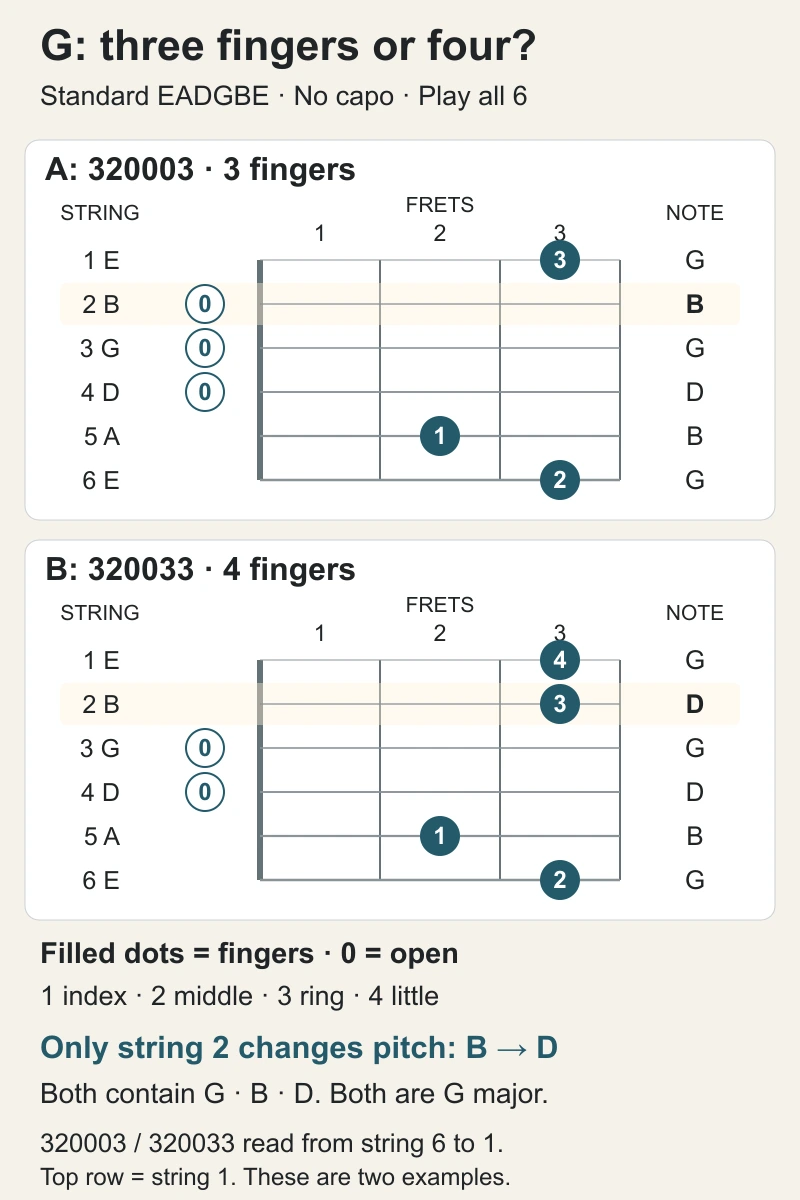
- A is 320003 and B is 320033. Both are G; these digits show frets from string 6 to 1, not finger numbers
- String 2 changes from open B to D at fret 3. Both shapes still contain the three note names G, B and D
- Four fingers are not automatically better. Choose for clear notes, comfort, the specified sound and the surrounding chord changes
1. Three fingers, or separate ring and little fingers
For A, use middle on string 6 fret 3, index on string 5 fret 2 and ring on string 1 fret 3. Strings 4, 3 and 2 remain open. For B, keep the same assignments on 6 and 5, put ring on string 2 fret 3 and little on string 1 fret 3. Only 4 and 3 stay open. Filled circles label fretting fingers: 1 index, 2 middle, 3 ring, 4 little. White zero circles mean open. Read fret numbers separately above the grid. Our horizontal diagrams put thin string 1 at the top, whereas the compact numbers run from string 6 to 1. These two examples use all six strings.
2. One more finger does not add a new chord tone
Calculating from standard tuning, A sounds G–B–D–G–B–G from string 6 to 1; B sounds G–B–D–G–D–G. Only string 2 changes, from open B to fret-3 D. B still has the note B on string 5, so G, B and D remain present. Six sounding strings, three or four fretting fingers, and three different note names are separate counts. A voicing is an arrangement of a chord's notes. Four fingers do not turn this into G7: both examples are G major. For our listening check, compare string 2 alone at a similar picking strength before hearing each full shape.
3. Choose one comfortable shape today
If a lesson specifies a fingering or voicing, first check what skill or sound it asks for. For simple accompaniment marked only G, a comfortably ringing shape can be your starting point. To reproduce an exact recording or TAB, however, respect the upper notes: changing shape changes the sound. If B's thin E string is blocked, check whether ring touches it and whether little has room to land. In A, also check that open string 2 stays clear. Adjust contact and how the instrument is supported before adding force; rest if anything hurts. Later, compare the moves into and out of neighbouring chords. Today's goal is not a fast switch.
Pio: Is four-finger G more advanced, so I always have to use it?
Dock-sensei: Finger count is not a ranking. Compare the second-string note and your comfort today. If the music specifies a shape, check its notes before choosing.
An eight-minute session
- 2 minutes: check standard EADGBE and remove the capo. Form A and pick each string from 6 to 1. Choose just one blocked note to investigate, then release your hand and rest
- 2 minutes: slowly form B, with ring on string 2 fret 3 and little on string 1 fret 3. Check those strings separately, then all six. Return to A or rest if there is pain or strong tension
- 2 minutes: play string 2 once in A and once in B. Hear B versus D, then lightly strum each full shape once. Do not rush alternation: relax and rebuild the hand position between attempts
- 2 minutes: choose the comfortable shape and manually set 60 BPM and 4/4. Strum once on beat 1 and count four beats. At the next bar, mute all strings and rest for that whole bar. If comfortable, try the other shape after the rest
Review and references
Last content review:
Manufacturer lessons and an educator's explanation informed two editorial passes. Fret sequences versus finger numbers, six strings versus three note names, fingering versus pitch changes, and G versus G7 are distinguished. Pitches were independently calculated from standard tuning. The diagrams and eight-minute routine with rests are editorial exercises, not a ranking or automatic grading.
- How to Play the G Chord on Guitar — Fender / Dan Macy
- The G Major Chord — D’Addario / Marty Schwartz
- Two Essential G Chord Shapes — Guitar World / Jimmy Brown
- How to Read a Chord Chart — Fender / Mike Duffy
References support the editorial review. They do not provide an individual diagnosis or guarantee compatibility with every instrument or model.
Pertanyaan umum
Do three-finger and four-finger G sound exactly alike?
They share a chord name and the same set of note names, but string 2 changes from B to D in our examples. The distribution changes. Follow a specified shape when reproducing detailed TAB or a recording.
Does the 3 in 320033 mean ring finger?
No. This compact sequence lists frets from string 6 to string 1; zero means open. Finger numbers appear separately inside filled circles: 3 is ring and 4 is little.
Is a three-finger G that uses the little finger wrong?
Not necessarily. Different fingers can fret the same 320003 shape without changing its pitches. We assign ring to string 1 in A to keep this comparison focused.
Does adding a fourth finger make G7?
No. 320033 contains G, B and D, but not the F required for G7. The 7 in a chord name is not a finger count.
Can I use three fingers if four feel awkward?
For this comparison, it is fine to finish with comfortable shape A. If A also hurts, rest and ask a teacher to check your position and contact. Forcing a stretch is not the goal.
Does CHORDOCK judge my fingering?
This exercise does not grade your playing. Set 60 BPM and 4/4 manually and check the notes and finger positions yourself. The comparison and eight-minute routine with rests are editorial exercises, not a learning-time guarantee.