Piano Staccato vs Legato: Separate or Connect the Notes
Trying to make notes short can accidentally make the whole phrase faster. Separate when a note starts from when you release its key. Staccato separates notes; legato connects them smoothly. Today, compare the same right-hand C–D–E–F at the same pace, without adding the left hand or pedal changes.
Fitur dan pilihan utama
- Staccato leaves space between notes; legato connects them smoothly
- Release sooner without starting the next note sooner: keep one note per beat here
- Dots above or below notes differ from duration dots to their right. Use the right hand only, without pedal
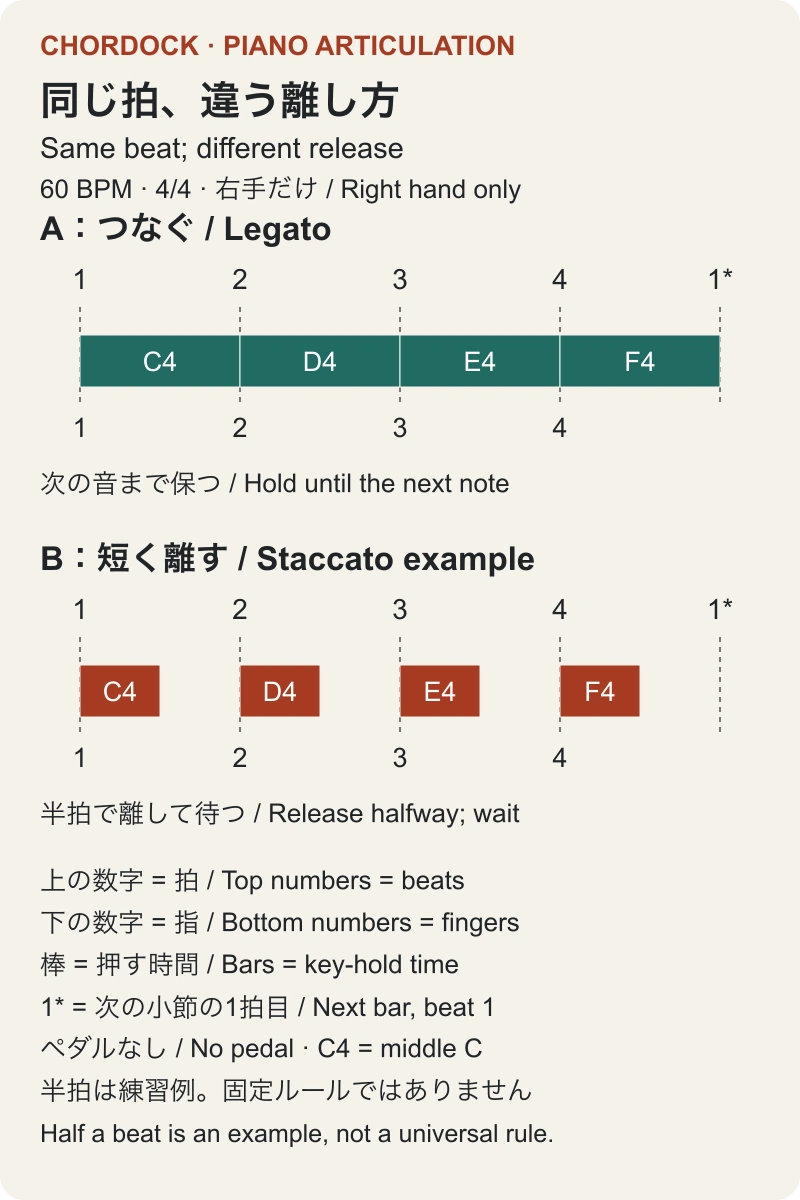
1. Shorten the sound, not the beat spacing
Staccato separates successive sounds. With quarter notes on each beat in 4/4, releasing early does not move the next note ahead of its beat. Legato aims for a smooth connection. Neither term alone sets loudness or tempo. Our chart shows key-hold time, not volume or an acoustic decay waveform. Its lower row uses a half-beat release to make the contrast easy to hear. This is an exercise, not a claim that every staccato must last exactly half its written value. Musical style and tempo affect the appropriate separation.
2. Pass C–D–E–F between fingers, without pedal
Use C4 for middle C. Play C4 with right-hand thumb 1, D4 with index 2, E4 with middle 3 and F4 with ring finger 4. For legato, coordinate releasing the old key with playing the next: listen for an unwanted gap or an old note lingering as a chord. Begin with just C–D. For staccato, release the key shortly after playing it and wait for the next beat. Aim for a small, comfortable movement, not high leaps or hard strikes. Leave the sustain pedal off because it can keep notes ringing after your fingers release. On an electronic instrument, choose a piano sound and reduce excessive reverb. Stop if there is pain or strain.
3. Check where the dot sits and what the curve does
A dot above or below a note, or the word staccato or stacc., normally indicates detached playing. A duration dot to the right adds half the original note value; a dotted quarter note in 4/4 lasts one and a half beats. Do not shorten every note that has any dot. Legato may be indicated by the word legato or a curved slur grouping notes. A tie instead connects notes of the same pitch into a combined duration. For our slurred C–D–E–F, play each new key: the curve does not mean to play C and omit D, E and F. Combined markings, such as dots under a slur, need musical context and fall outside this introductory comparison.
Pio: When I make the notes short, my C–D–E–F keeps speeding up! What should I do?
Dock-sensei: Count the waiting time too. The next note still starts on its beat. Small movements and listening for a gap or a smooth connection are enough for today.
An eight-minute session
- 2 minutes: find C4, D4, E4 and F4 with the right hand. Play each once slowly using fingers 1, 2, 3 and 4, without pedal. Listen to what changes when you release a key, then rest
- 2 minutes: without a click, connect C to D by coordinating the old key's release with the new attack. Extend to C–D–E–F if comfortable, then release and rest. Listen for gaps or old notes held as a chord
- 2 minutes: manually set the metronome to 60 BPM and 4/4. Play C–D–E–F on beats 1, 2, 3 and 4, releasing around the middle of each beat and waiting for the next click. Play one bar, rest one bar. The half-beat release is a listening exercise, not a fixed rule for every piece
- 2 minutes: at the same 60 BPM, play legato C–D–E–F in bar 1, rest throughout bar 2, play the detached version in bar 3, then rest throughout bar 4. Release the legato F at beat 1 of the following bar. Keep note starts and loudness similar while comparing the connections. Return to two notes or remove the click if needed
Review and references
Last content review:
Publisher, manufacturer and university materials informed two editorial passes in both languages. Key-hold time versus beat spacing, duration dots versus staccato, slurs versus ties and finger connections versus pedal are distinguished. The timing chart, half-beat release comparison and eight-minute plan with rests are editorial exercises, not universal duration ratios or automatic grading.
- How to Read Piano Sheet Music — Alfred Music
- Other Aspects of Notation — Open Music Theory / Mark Gotham and Chelsey Hamm
- Discovering Music through Listening: Glossary — The Open University
- How to Use Keyboard Pedals — Yamaha / Jerry Kovarsky
- Steps to Music Theory: Glossary — Texas A&M University Libraries
References support the editorial review. They do not provide an individual diagnosis or guarantee compatibility with every instrument or model.
Pertanyaan umum
Does staccato always mean exactly half the note's value?
No. The half-beat releases in our chart are a comparison exercise. Appropriate length depends on the tempo, style and other markings. Distinguish shortening a sound from bringing the next attack forward.
Does staccato mean hitting harder?
No. It concerns separation, not a required loudness. Practise quietly too. Do not compete to lift your fingers high; rest if you become tense.
Does legato always need pedal?
No. This adjacent-note exercise leaves the pedal off so you can hear the finger changes. Connecting widely spaced notes in a piece may involve pedal and is a separate task.
Should I shorten a note with a dot to its right?
A duration dot on the right lengthens the written value. It differs from the usual staccato dot above or below. Both can occur on the same note, so identify each marking before playing.
Can I keep one C key down to play repeated Cs legato?
The key needs a return movement to sound again. This lesson uses different adjacent keys, not repeated-note technique. A tie between repeated pitches instead tells you to combine their durations without a new attack.
Will CHORDOCK grade my articulation?
No automatic grading is provided here. Manually set 60 BPM and 4/4 and listen yourself. The eight-minute plan includes rests and is an editorial suggestion, not a deadline for mastery.