A Chord Fingers Too Crowded? Fit Three at Fret Two
Open A crowds three fingertips into fret two on strings 4, 3 and 2. You do not have to line them up perfectly: try small forward-and-back adjustments within that fret and listen. With standard EADGBE tuning and no capo, use x02220 to separate finger placement from the choice of strings to sound. This is not an exercise in holding a harder squeeze.
주요 기능과 선택 항목
- x02220 lists frets from string 6. Skip string 6 and sound open string 5 through string 1
- Strings 4, 3 and 2 all use fret two. Dot numbers 1, 2 and 3 mean index, middle and ring fingers
- Stagger fingertips slightly within the same fret and check five strings separately. Do not move to another fret just to make room
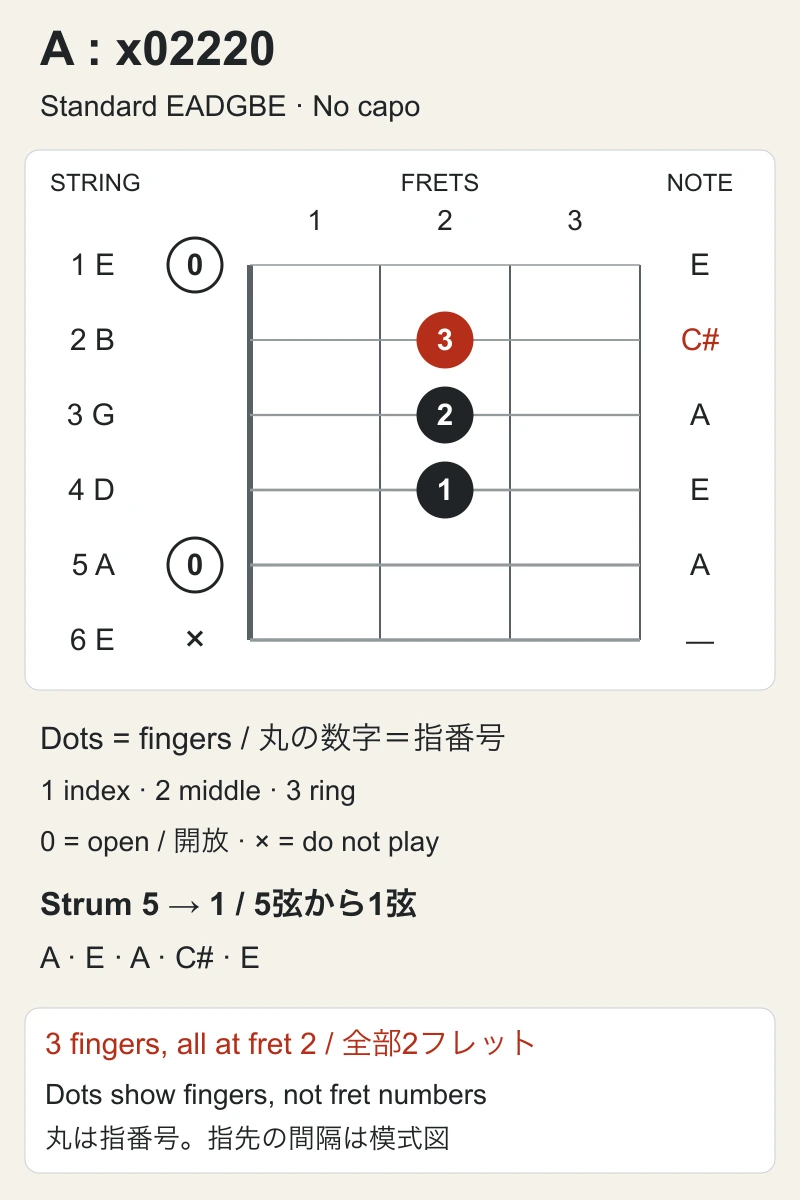
1. Dot numbers 1, 2 and 3 do not mean frets one, two and three
Today's fingering is index on string 4, middle on string 3 and ring on string 2, all at fret two. The finger numbers differ even though the fret is the same. Zeros on strings 5 and 1 mean open strings; x on string 6 means do not play it. The sequence x02220 starts at string six, but our horizontal diagram has string one at the top. A means A major, containing A, C-sharp and E. From string five, the sounding order is A, E, A, C-sharp, E: five strings but three note names. Adding open string 6 E gives A/E with E as the lowest note, so begin on the open fifth string today.
2. Stagger the three fingertips within fret two
Each contact point belongs between the first and second fret wires. Aim toward the second wire without resting on top of it, but do not demand that all three fingertips line up. The index may sit a little closer to the nut and the ring a little closer to the body. The dots illustrate string-and-fret assignments, not measured fingertip spacing. Pick strings 4, 3 and 2 separately first. For a dull note, release, check both the finger fretting that string and contact from its neighbors, then reposition. Crossing the second wire into fret three changes the pitch, so do not cross it to gain room. Avoid forcing a deep wrist bend or practising through pain.
3. Check open strings five and one, then choose a fingering
Once the three fretted strings sound, pick five through one in order. If open string one is dull, check the side of the finger on string two. Its E is also present on string four, so omitting string one still leaves the A chord tones, but today's x02220 includes all five strings. Distinguish a deliberately omitted string in another shape from an accidental muted note. If three fingers feel crowded, try middle, ring and little on strings 4, 3 and 2 at the same second fret. A one-finger barre is another option, but the treatment of string one needs separate attention; it is not required today. Choose by comfortable, clear intended notes, not by how few fingers you can use.
Pio: The dots say 1, 2, 3. Could I spread them across frets one, two and three?
Dock-sensei: Those are finger numbers. All three belong at fret two in this A shape. Stagger slightly without crossing the wire and listen string by string. You can try another fingering instead of forcing the fit.
An eight-minute session for today
- 2 minutes: check standard EADGBE tuning and remove any capo. Read x02220 from string six; strings 4, 3 and 2 all use fret two. Fret and sound each of those strings alone, releasing after every attempt
- 2 minutes: place index, middle and ring on strings 4, 3 and 2. Stagger them slightly within fret two and pick the three strings separately. Adjust only the unclear string's placement, then rest after each check
- 2 minutes: include open strings 5 and 1 and pick five through one. Check unwanted contact with string one. Only if crowded, compare middle, ring and little on strings 4, 3 and 2, then choose one comfortable fingering that rings
- 2 minutes: manually set 60 BPM and 4/4. Strum A once from string five on beat one, then count four beats. On beat one of the next bar, touch the strings lightly with the strumming hand to stop them and rest for that bar. Repeat this two-bar cycle; stop the click if you rush
Review and references
Last content review:
Manufacturer and educator references informed two editorial passes distinguishing fingers/frets, within-fret adjustments/pitch changes, intentional first-string omission/accidental contact, and A/Am/A-E bass. Diagram pitches were independently calculated from EADGBE; dot spacing does not prescribe physical fingertip distances. The eight-minute routine with rests is an editorial suggestion, not a request to endure pain, a mastery deadline or automatic grading.
- How to Play the A Chord on Guitar — Fender / Dan Macy
- A Major Chord — Guitar-chord.org
- A Guitar Chord — GuitarLessons.org / John Holloway
References support the editorial review. They do not provide an individual diagnosis or guarantee compatibility with every instrument or model.
자주 묻는 질문
Which string starts the A chord?
Today's x02220 sounds five strings, from open string 5 to string 1. Skip string 6. Including its open E gives A/E with a different lowest note; practise starting at five today.
Must the three fingertips be in a perfectly straight line?
No. Keep strings 4, 3 and 2 at fret two, but let contact points stagger slightly. Do not cross the second fret wire into fret three. Check the result by listening to each string.
Can I use middle, ring and little fingers instead?
Yes: the same second frets on strings 4, 3 and 2, with open strings 5 and 1, produce the same notes. Finger numbers do not define the chord. Do not force the little finger into an uncomfortable bend; choose by comfort and sound.
Is it no longer A if string one is silent?
String four also supplies E, so omitting string one still leaves A, C-sharp and E. However, x0222x and x02220 differ in sounding strings and voicing. Today's target is the latter, so investigate accidental contact that stops string one.
What if moving string two to fret one makes room?
x02210 changes C-sharp to C and makes Am, not A major. Adjust position within fret two or choose another fingering instead of changing a fret for space. If comfortable adjustments do not help, ask a teacher to check your hand and instrument together.
Does the metronome automatically grade my A chord?
It does not grade chords. Manually set 60 BPM and 4/4 as a beat reference and check your own notes. The eight-minute plan and rests are editorial suggestions, not a mastery deadline. Stop if there is pain.