Where Is Middle C? Find It on the Piano and Staff
Do the two written positions of middle C make you reach for different keys? They represent one pitch: a short line below the treble staff or above the bass staff. Connect those two spellings to a single keyboard location first. This lesson calls middle C C4 and assumes ordinary piano sound without transposition or an octave shift.
주요 기능과 선택 항목
- C is the white key immediately left of a pair of black keys. On a standard 88-key piano, middle C is the fourth C from the left
- One ledger line below treble or one above bass: both represent the same middle C
- We use C4. A device displaying C3 may be using a different octave-numbering convention
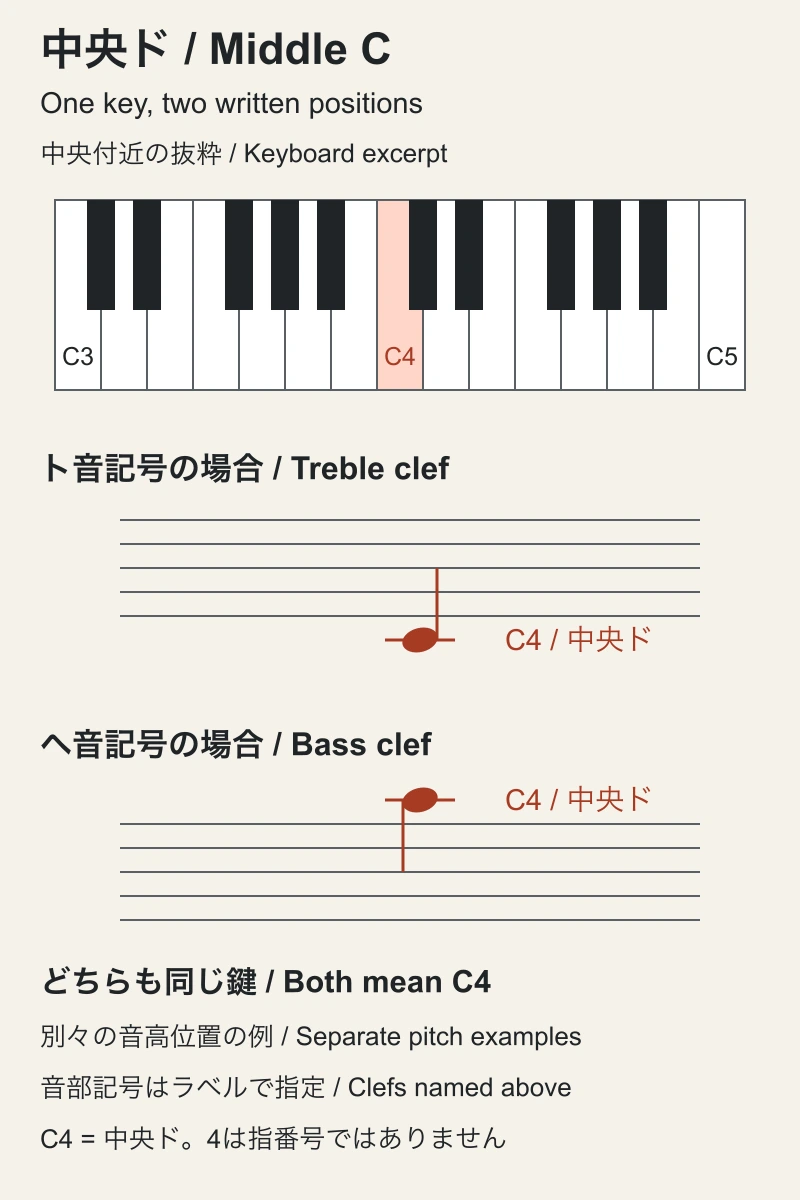
1. Use the two-black-key groups, then narrow down the register
Black keys repeat in groups of two and three. The white key immediately left of a two-key group is C. There are several such Cs, so finding a C does not automatically mean finding middle C. On a standard 88-key piano spanning A0 to C8, middle C is the fourth C from the left, or key 40 if you count every black and white key from the left end. It is not the exact physical midpoint. Smaller keyboards can have a different starting note and range; do not transfer the key-40 shortcut to them. Check the instrument's manual for middle C. Our picture is an excerpt around the middle, not a drawing of all 88 keys.
2. A ledger line extends the staff to reach middle C
In treble clef, the bottom staff line is E. The space just below is D, and one short added line below that holds middle C. In bass clef, the top line is A, the space above is B, and one short added line above that holds the same middle C. These extra short lines are ledger lines. Piano's paired staves form a grand staff; their spacing can be wide enough that the two written middle Cs do not align at the same height on the paper. Read the clef and ledger-line position rather than assuming that a higher-looking mark means another octave. Our two examples compare locations; they are not an instruction to play the two notes simultaneously.
3. Do not confuse C4/C3 labels with different sounding notes
Following scientific pitch notation, we call middle C C4, the C an octave below C3 and the one above C5. The 4 is not a finger number or a beat count. Some instrument documentation, including material for certain Yamaha models, calls middle C C3 instead. Mixing the two numbering conventions can make one pitch appear to be an octave apart. On an electronic instrument, check the manual's middle-C location and naming convention, plus transposition and octave-shift settings. Do not change a setting just to make the label match this page. Clefs also do not dictate hands: treble does not always mean right hand, nor bass always left. Test the same key with one hand at a time today, and follow fingering and hand instructions in a piece.
Pio: The upper and lower staves put C in different places. Should I play different Cs?
Dock-sensei: Both of today's one-ledger-line Cs are the same middle C. The direction in which we extend the staff is different. Look at either example and practise finding the same key again.
An eight-minute session for today
- 2 minutes: without pedal, find C to the left of a pair of black keys. On 88 keys use the fourth C from the left; on a smaller instrument confirm middle C in its manual. For an electronic keyboard, check piano sound, transposition and octave settings
- 2 minutes: look at the treble example and say 'one ledger line below'; look at the bass example and say 'one ledger line above'. Play and release the same middle-C key for either example, using one hand at a time and resting after each attempt
- 2 minutes: play the neighboring white D to the right, then return to middle C. Next play the neighboring white B to the left and return. Check that you return to the same C, not a distant one. Keep the hand comfortably near the keys
- 2 minutes: manually set 60 BPM and 4/4. Look at either example, play middle C on beat one and release on beat two. Rest for the remaining beats and the whole next bar. Use the other example next time and return to the same key. Remove the click if you rush
Review and references
Last content review:
University, educator and manufacturer references informed two editorial passes. We distinguish 88-key counting from smaller keyboards, printed position from pitch, C4 from device C3 labels, and octave numbers from fingers. The reference's 256-Hz wording is not adopted; this is not a frequency lesson. Key order, key 40 and ledger positions were checked independently. The eight-minute routine with rests is editorial, with no automatic identification or mastery guarantee.
- Middle C and Ledger Lines — The Open University / OpenLearn
- Middle C — Music Theory Academy / Ben Dunnett
- P-85 / P-95: How to Transpose (C3 naming example) — Yamaha
References support the editorial review. They do not provide an individual diagnosis or guarantee compatibility with every instrument or model.
자주 묻는 질문
Is middle C exactly at the keyboard's center?
No. On a standard 88-key piano it is key 40 from the left, not the mathematical midpoint. Combine the fourth-C-from-the-left check with the two-black-key pattern.
Is middle C key 40 on a 61-key keyboard too?
Do not use that shortcut. Key 40 here assumes the standard 88-key range beginning on A0. Starting note and settings matter as well as key count; check a smaller keyboard's manual.
Are the treble and bass middle Cs an octave apart?
No. In ordinary piano notation, C one ledger line below treble and C one ledger line above bass are the same pitch. Our figure has no accidentals or octave-transposition instructions.
Is a display reading C3 wrong?
The label alone cannot establish an error. Some devices call middle C C3. Distinguish their convention from this page's C4 and check the manual's keyboard location and register settings.
Must I use my thumb for middle C?
No. The 4 in C4 is an octave number, not a finger number. Use a comfortable finger, one hand at a time today. In pieces, follow the written fingering and surrounding movements. You need not press the same key with both hands at once.
Will CHORDOCK automatically identify middle C?
Not in this exercise. The metronome provides a manually set 60 BPM, 4/4 beat reference; check the key yourself. The eight-minute routine and rests are editorial suggestions. Stop if there is pain or uncomfortable tension.