Do You Play the X in Guitar TAB? Muted Notes vs Rests
An X replaces a fret number in your TAB. Do you pick or stay silent? When it marks a muted note, touch the string to damp it and pick a short, percussive sound. An X at the edge of a chord diagram usually means leave that string out of the chord instead. Start by identifying the kind of notation in front of you.
Principais recursos e opções
- An X in TAB can mark a muted attack; do not treat it as a rest
- An X at the end of a string in a chord diagram usually marks a string to omit
- Use only string 6 today: maintain light contact while picking a short sound rather than a clear pitch
1. Check whether the X is in TAB or a chord diagram
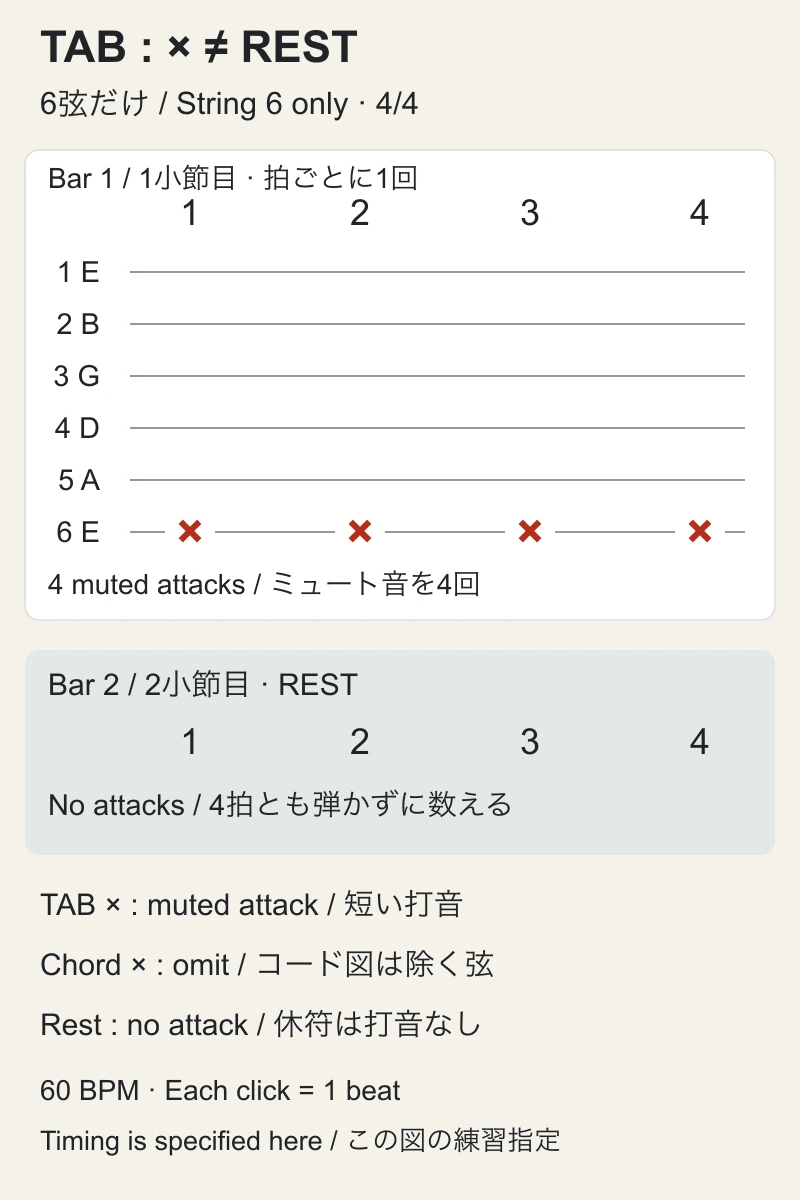
TAB places string 1 at the top and string 6 at the bottom. If X marks replace numbers on the lines and the legend identifies muted or dead notes, damp those strings and pick them. X is not fret ten or a mistake mark. Our original exercise puts four X marks on string 6, one attack on each of beats 1, 2, 3 and 4. The counts above them specify the timing: X alone does not tell you a duration. In a song, check the rhythm notation too. An X at the edge of a chord diagram selects a string to leave out; it does not require a percussive attack each time. Conventions vary, so follow the source legend.
2. Touch string 6 lightly and pick once
Use standard EADGBE tuning with no capo. Pick the open sixth string once, then stop it. Rest the pads of the fretting-hand index and middle fingers lightly on string 6 around fret three without pressing it to the fingerboard. Keep that contact and pick only string 6 once with a small motion. Aim for a short click, not a slap against the body or fingerboard. If the open note rings, check for insufficient contact; if you hear a fretted note, check that you are not pressing down. A clear, high chime may be a natural harmonic. Before using more pressure, shift the contact slightly and check that both finger pads touch the string. Do not lock the wrist or fingers into an awkward position. Rest when tired and stop if there is pain.
3. Separate four attacks from a silent bar
A short sound is still an event to place in time. Manually set the metronome to 60 BPM and 4/4. In the first bar, pick string 6 once per numbered beat, four attacks in total. Keep contact with the string for the entire next bar but do not pick; count its four beats. Let the muted sounds decay naturally. This exercise specifies attack times, not a requirement to sustain each sound for a full beat. Avoid tapping the string with the pick or fingers during the silent bar. Repeat the two-bar cycle slowly and listen for agreement between your count and picking motion. Today's aim differs from palm muting near the bridge, where a shortened note can retain a recognizable pitch.
Pio: I avoid an X in a chord diagram, but sometimes pick an X in TAB?
Dock-sensei: Yes. A chord diagram marks a string to leave out; today's TAB marks a short muted attack. Check the location and legend. During a rest, count without adding even that percussive sound.
An eight-minute session for today
- 2 minutes: compare the X in TAB, an X in a chord diagram and a rest. Identify the bottom TAB line as string 6. Say the plan aloud: four attacks in bar one, four silent beats in bar two
- 2 minutes: pick the open sixth string and stop it. Lightly rest the index and middle finger pads on it, then pick only that string once. Find a short sound without pressing down
- 2 minutes: try four small downstrokes without a click, then relax and rest. Recheck contact if a pitch rings or a high chime appears. Do not hit harder
- 2 minutes: manually set 60 BPM and 4/4. Play four X attacks on beats 1, 2, 3 and 4 in bar one. Maintain string contact but play nothing for the next four beats. If rushed, stop the click and return to one attack at a time
Review and references
Last content review:
Manufacturer and education-service materials informed the notation checks. Both languages were reviewed twice for TAB versus chord-diagram X marks, zero, rests, varied uses of ghost note, and attack timing versus sustain. The diagram, single-string contact check and 60 BPM eight-minute routine are editorial exercises.
- How to Read Guitar Tabs — Seymour Duncan / Dave Eichenberger
- Ghost Notes — What Are They? — Guitar Tricks
- How to Read Guitar Chord Charts — Fender / Ben Nemeroff
References support the editorial review. They do not provide an individual diagnosis or guarantee compatibility with every instrument or model.
Perguntas frequentes
Does every X mean pick a muted note?
No. On a TAB line it often indicates a muted attack, while at the edge of a chord diagram it marks an omitted string. Follow the notation's legend and technique instructions.
How is X different from zero?
Zero means play the open string. Today's X means pick while lightly touching the string to damp its ringing. Neither requires pressing to the fingerboard, but the contact with the string differs.
Which fret should I use for X?
X does not specify a fret number. For this exercise, touch string 6 lightly around fret three and adjust contact by listening. You are not fretting a G at that position.
Is this a ghost note?
Some lessons call this kind of muted sound a ghost note. The term can also describe quiet or parenthesized notes in other contexts. Use the symbol and the source's explanation rather than the name alone.
Does this work on acoustic, and should I hit all six strings?
You can try it on acoustic or electric, though the instrument and settings affect the sound. Pick only string 6 today. A stack of X marks is a different example; do not turn this into a forceful six-string strum.
Will the metronome judge my muting?
It does not automatically grade your playing. Set 60 BPM and 4/4 manually, and listen to the contact and decay yourself. The eight-minute plan and silent bar are editorial practice suggestions, not a mastery deadline or a rule for every song.