Guitar Harmonics Not Ringing? Try the 12th Fret
Does your attempt at a 12th-fret harmonic produce only a dull thud? Before picking harder, check where you touch, how much pressure you use and when you lift off. A natural harmonic brings out an overtone without fretting the string. Today, start on string 6 near the 12th fret, in standard EADGBE tuning with no capo.
Основные функции и параметры
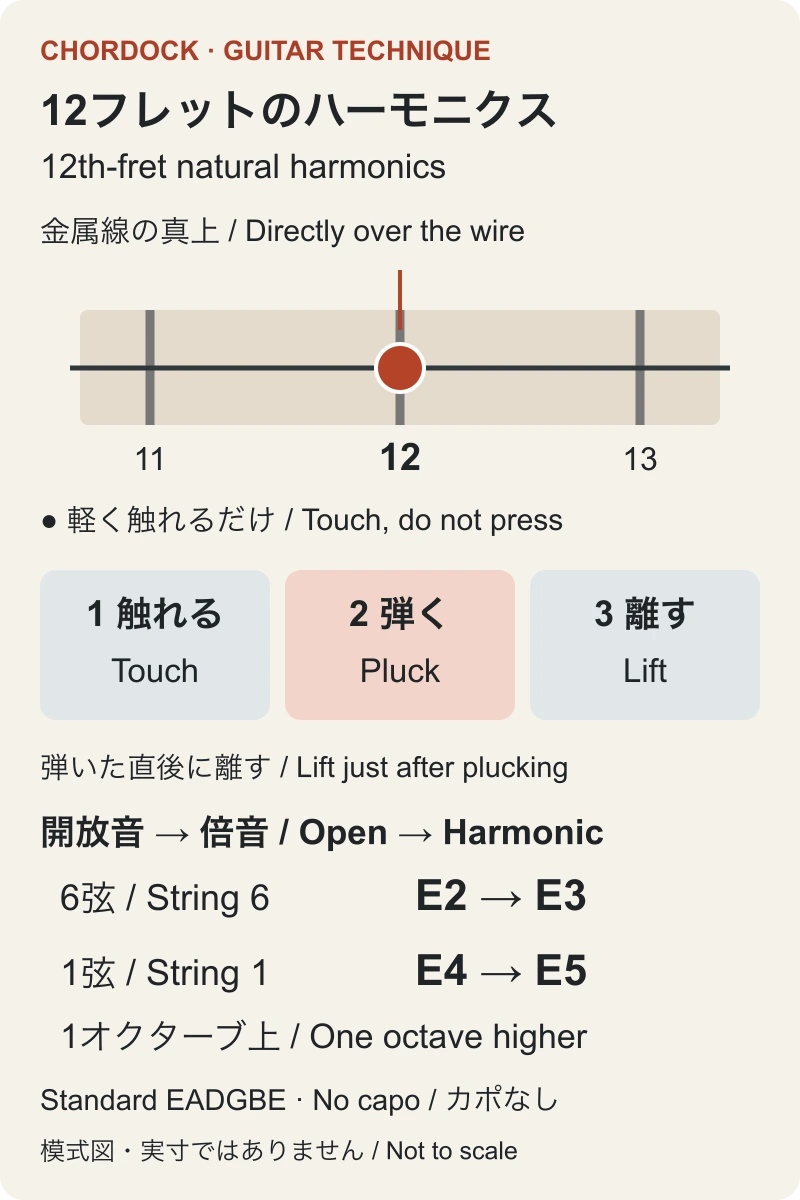
- Touch directly above the 12th-fret wire, not at the usual fretting spot or on the position-marker dots
- Make light contact without pressing down to the metal; pluck, then promptly lift the touching finger
- The 12th-fret harmonic is an octave above the open string. Compare its tone with the normally fretted 12th-fret note
1. Find the metal wire, not the marker dots
To play a normal 12th-fret note, you press between fret wires 11 and 12, close to 12 on its nut side. For this harmonic, move the contact point directly above wire 12 and only touch the string. The double dots on many guitars help you locate the area, but they are not the contact point. Near fret 12 is roughly halfway along the open string's vibrating length; light contact there brings out an overtone one octave higher. On string 6, open E2 becomes harmonic E3; on string 1, open E4 becomes E5. These numbers name sounding octaves, not strings. Use only string 6 to find the touch today.
2. Separate touch, pluck and lift
Rest the pad of a comfortable fretting-hand finger, such as your index, on string 6. Do not press the string onto the fret. Pluck once from your usual picking position, then promptly lift the touching finger and listen to the sustain. Lifting before the pluck can give an ordinary open note; pressing down can produce a normal fretted note or a dull sound. Hold the position steady and reduce pressure first. If that does not help, adjust the release timing in small steps. Change one thing at a time rather than picking harder or turning the amp up. Adjust your posture if the wrist feels strained, and stop if there is pain.
3. Listen separately for pitch and tone
Compare open string 6, its normally fretted 12th-fret note and its 12th-fret harmonic, one at a time. On a well-adjusted guitar, the last two are close to the same pitch, but the harmonic has a clear, bell-like tone. A high note alone is not proof: also check that you did not fret it. For a short thud, revisit position and pressure; for a low open note, check whether you lifted too early. Use a quiet clean amp sound on electric, or a quiet room for acoustic or classical guitar. A failed harmonic alone does not establish an instrument fault. Leave adjustment screws alone and check the technique first.
Pio: Will pressing harder than usual at fret 12 make it ring?
Dock-sensei: This time, do the opposite. Touch lightly over the wire, pluck and lift. The finger has a different job from fretting a normal note.
An eight-minute session for today
- 2 minutes: in standard EADGBE tuning with no capo, check open string 6. Identify the 12th-fret wire and the adjacent space used for normal fretting. Do not add a pulse yet
- 2 minutes: directly above fret 12 on string 6, touch, pluck once, then promptly lift. Stop the sound before each fresh attempt. Hold the location steady while changing pressure a little at a time
- 2 minutes: play open E2, the normally fretted E3 at fret 12, then harmonic E3. Compare pitch and tone, and try the sequence three times. Do not compensate for a quiet note by hitting harder
- 2 minutes: if the harmonic is ringing, manually set 60 BPM and 4/4. Sound it on one and lift the touching finger; listen on two, stop it with a picking-hand finger on three, and prepare on four. Try four bars at a time; remove the pulse if needed
Review and references
Last content review:
Performer and manufacturer lessons informed checks of contact, pressure and release order. Both languages were reviewed twice, and string 6 E2–E3 and string 1 E4–E5 pitches and the diagram were verified. Fretting, pinch harmonics and fault diagnosis are distinguished. The 60 BPM, eight-minute routine is an editorial suggestion.
- Lesson: Harmonics on the Classical Guitar — This is Classical Guitar / Bradford Werner
- Get a Bell-Like Tone—Learn to Play Natural Harmonics — Acoustic Guitar / Alex de Grassi
- Intonation 101 — Fender / Jeff Owens
References support the editorial review. They do not provide an individual diagnosis or guarantee compatibility with every instrument or model.
Частые вопросы
Is it the same note as normally fretting the 12th fret?
On an adjusted guitar, the pitches are close, but the tone and technique differ. On string 6, both are around E3, an octave above open E2. For the harmonic, do not press the string onto the fret.
Is it wrong if the harmonic rings while I keep touching?
A harmonic can sound with a finger still touching lightly. That is not automatically wrong, but today practise lifting just after the pluck to help the note sustain. Lifting before the pluck can produce the open note instead.
Can I do the same thing at every fret?
No. Open-string natural harmonics have particular locations where they speak readily. Do not assume the 12th-fret result transfers to every fret. Stay at fret 12 today without adding a capo or altered tuning.
Does this work on acoustic guitar?
Yes: try it on steel-string acoustic, nylon-string classical or electric guitar. Audibility and sustain vary with the instrument, strings and room. You do not need to buy an amp or effects pedal for this exercise; start with one string in a quiet setting.
If the fretted note and harmonic differ, does the guitar need repair?
The comparison is also used to check intonation, but one mismatch does not establish a fault. First check open-string tuning and whether you are pulling the fretted string sideways. If a noticeable difference persists, ask a guitar shop for advice. Adjusting screws by guesswork is not part of this beginner exercise.
Will CHORDOCK automatically grade my harmonics?
This lesson does not grade them. Only for the final exercise, manually set the metronome to 60 BPM and 4/4, then use your ears to assess the note and sustain. Pinch harmonics are a different technique. The eight-minute routine is an editorial suggestion, not a deadline for mastering it.