Weak Second Hit in Double Strokes? Practise Even RRLL
You intend to play right-right, left-left, but the second hit disappears or arrives too soon. Pause the fast roll and listen to each same-hand pair separately. Today, use one pad to check the number of hits, volume and spacing in that order. Squeezing harder or forcing two sounds from one motion is not the starting goal.
ฟังก์ชันและตัวเลือกหลัก
- The basic order is R R L L: two right hits, then two left hits, not simultaneous hands
- Check second-hit volume and the gap between hits separately
- At 60 BPM, one hit per click differs from two. Begin with one
1. Separate a quiet second hit from a rushed one
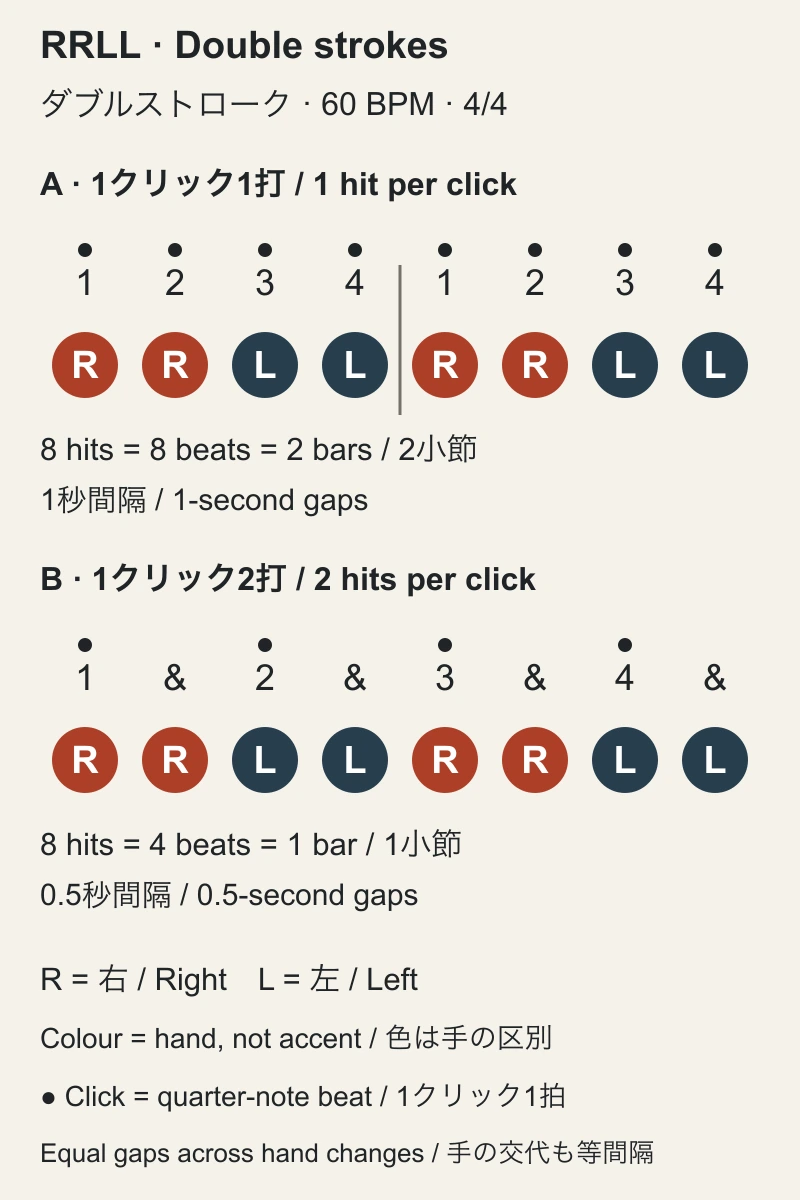
R means right hand and L means left. A basic double stroke roll repeats R R L L. Its sticking differs from alternating R L R L singles and the R L R R L R L L paradiddle. Play two right-hand hits, pause, then two left-hand hits. Decide whether the second sound is quieter or too early; increasing its volume will not fix early timing. Our diagram leaves out accents so you can compare similar volume and even spacing.
2. Control slow pairs without trapping the rebound
Use a stable practice pad and small movements from a comfortable low height without raising your shoulders. At this slow pace, guide the second hit yourself and allow the stick to return from the surface. Do not compensate for a weak second hit by making only the first one louder. Compare hand and stick heights as you listen to each pair. Faster techniques can combine rebound with finger control, but different surfaces respond differently. One wrist motion does not automatically produce two suitable hits at every tempo. Avoid a rigid grip or throwing the stick; rest when tired and stop if there is pain.
3. Establish diagram A before trying diagram B
Manually select 60 BPM and 4/4. Diagram A places one hit per click: R R L L | R R L L. Eight hits occupy eight beats, or two bars, with one second between attacks. Diagram B places the same eight hits on 1 & 2 & 3 & 4 &: two hits per click, four beats, one bar. Attacks are 0.5 seconds apart, including the final & to the next 1. Do not rush only the RR pair or add a pause after it. If B falls apart, keep the tempo unchanged and return to A. It need not sound like a fast roll today; keeping the second hit and equal gaps is enough.
Pio: Should I hit the first note harder to get a louder second one?
Dock-sensei: Slow down and check the second sound on its own first. Making only the first louder can increase the difference. Today, aim to hear both hits with equal spacing before chasing speed.
An eight-minute session for today
- 2 minutes: without a click, play two right hits, pause, two left hits, pause. Choose one thing to check: is the second hit quiet or early?
- 2 minutes: manually set 60 BPM and 4/4. Count in for one bar, then play diagram A at one hit per click. Eight hits take two bars. Stop, rest and review each same-hand pair
- 2 minutes: only if A feels comfortable, try B. Fit RRLL RRLL into one bar on 1 & 2 & 3 & 4 &. Try two bars, stop and review the gaps. Otherwise, stay with A
- 2 minutes: start with L L R R instead. Keep the meanings of R and L unchanged and return to one hit per click if helpful. Note one observation about volume or timing, then rest your hands
Review and references
Last content review:
Manufacturer and music-education materials were checked, with two editorial passes in both languages. Sticking versus note value, volume versus spacing, and slow controlled practice versus faster rebound techniques are distinguished. Diagrams A/B and the eight-minute plan are editorial exercises, without automatic grading or a speed guarantee.
- 06: Double Stroke (Open) Roll — Vic Firth / John Wooton
- How To Play A Double Stroke Roll — Drumeo
- 5 Important Beginner Drumming Techniques — Drumeo / Mike Michalkow
References support the editorial review. They do not provide an individual diagnosis or guarantee compatibility with every instrument or model.
คำถามที่พบบ่อย
Does double mean both hands hit together?
No. Play two consecutive hits with one hand, then two with the other. The four letters RRLL represent four separate attacks.
Must both hits come from a single rebound?
No. Wrist, finger and rebound contributions depend on the tempo and surface. This is a slow preparatory exercise controlling each hit, not an exercise in uncontrolled multiple bounces.
Why do some exercises accent the second hit?
Deliberately emphasising the second hit is another practice approach. Today's diagram specifies no accents. Start with similar volume and do not mix in a different lesson's dynamic instructions.
Must RRLL use sixteenth notes?
Sticking alone does not determine note value. A uses quarter notes and B uses eighth notes. With a quarter-note beat in 4/4, four RRLL hits take four beats in A and two beats in B.
Should I use a hard desk if I have no pad?
You do not need to hit a hard desk with sticks. Check the right-right, left-left order without sticks instead. Learning the order is different from practising stick rebound; try actual strokes on a stable, suitable playing surface.
Does the site measure my second-hit volume?
It does not automatically grade your playing or show the sticking. Set 60 BPM and 4/4 manually and listen yourself. Diagrams A and B and the eight-minute plan are editorial practice suggestions, not promises of mastery or speed within eight minutes.