Guitar Repeat Signs: How to Read First and Second Endings
You can read the notes or frets, but a repeat sign makes you lose your place. Before playing, work out the route through the score. This lesson covers ordinary repeat barlines and first and second endings. Separate measure numbers from ending numbers, trace the route, then keep the pulse using only open string 1.
ฟังก์ชันและตัวเลือกหลัก
- Return from the end repeat to the start repeat; without a start repeat, return to the beginning of the piece
- Unless another count is specified, play the section twice in total—not twice more after the first pass
- Use the first ending on pass one; skip it and use the second ending on pass two. Do not add silence for the skipped bars
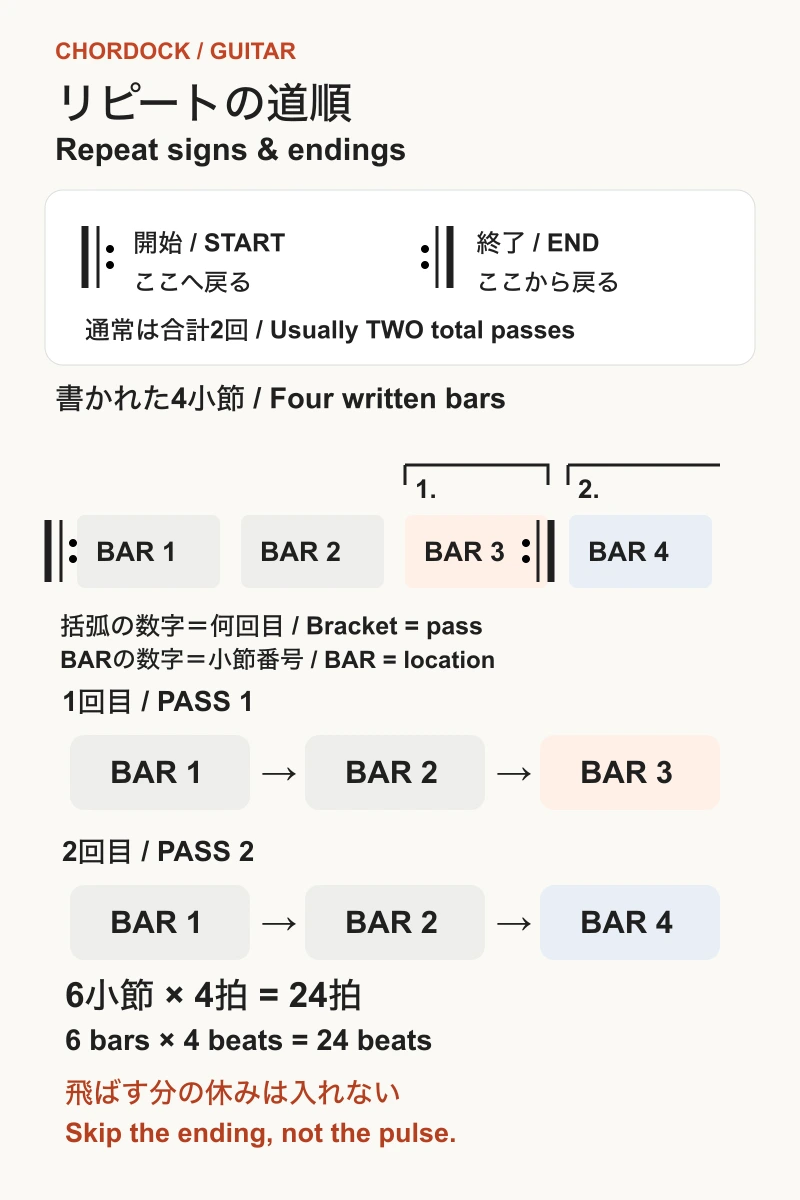
1. Find the return point and the play count
Look for vertical barlines with two dots. A start repeat has dots to the right of the lines; an end repeat has dots to the left, facing into the repeated section. Play to the end repeat, then return to its matching start. In a basic repeat without a start sign, return to the beginning of the piece. With no different count specified, play once, go back and play again: two passes in total. Continue beyond the section after the second pass. If the score also uses D.C., D.S. or other navigation instructions, read those too rather than applying this simple example to the whole piece.
2. Ending numbers tell you which pass to play
In the diagram, bars 1 and 2 are shared material. Bar 3 has the first-ending bracket; bar 4 has the second. On pass one, play bars 1→2→3. The end repeat at bar 3 sends you to bar 1. On pass two, play 1→2→4. The complete route is 1→2→3→1→2→4, not another visit to bar 3 before bar 4. Bracket numbers refer to passes, not frets or beats. BAR 1–4 labels show measure locations. An ending can cover more than one measure, so follow the bracket's full length rather than looking only at its number.
3. Keep four beats moving through each jump
Put the guitar down and trace the diagram while saying the bar numbers: one, two, three, one, two, four. Then give each bar four beats in 4/4. When moving from bar 3 back to 1, or from bar 2 to 4, beat four is followed immediately by beat one of the next played bar. Do not wait four beats for the skipped bar 3. Once the route is clear, use standard EADGBE tuning with no capo and pluck open string 1 once per beat. This example lasts six performed bars, or 24 beats. At 60 BPM with a quarter-note beat, the exercise itself lasts 24 seconds, excluding the count-in. If you lose your place, stop the click and trace the route again.
Pio: On the second pass, do I play the first ending before the second?
Dock-sensei: Skip the first ending on pass two and go to the second. Today's bar numbers are one-two-three, then one-two-four. Trace them first so that changing location does not add extra beats.
An eight-minute session for today
- 2 minutes: without the guitar, point to the start and end repeat signs and both ending brackets. Distinguish BAR labels from ending numbers
- 2 minutes: manually set 60 BPM and 4/4, but leave playback stopped. Trace bars 1→2→3→1→2→4 three times. If you make a mistake, check the return point separately
- 2 minutes: start the click and count in for one bar. Count four beats at each location while tracing the six-bar route. Stop afterwards and check that you did not add four beats for the skipped bar
- 2 minutes: if comfortable, pluck open string 1 once per beat while following the same six bars. Review the route after finishing. Return to tracing without the guitar if necessary; do not increase the tempo
Review and references
Last content review:
University teaching and official notation documentation informed checks of repeats and endings. Both languages were reviewed twice for total versus additional passes, bar versus ending numbers and the six-bar, 24-beat route. The diagram and 60 BPM, eight-minute routine are original editorial exercises.
- Introduction to Music Theory and Rudiments: Repeats — MacEwan University / Devin Hart
- MuseScore Studio Handbook: Repeat signs — MuseScore
- MuseScore Studio Handbook: Voltas — MuseScore
References support the editorial review. They do not provide an individual diagnosis or guarantee compatibility with every instrument or model.
คำถามที่พบบ่อย
Do I repeat twice after the first play-through?
Normally the total is two passes, including the first. Follow any different written count or navigation instruction, rather than treating two passes as a rule without exceptions.
What if there is no start repeat sign?
In a basic repeat with the start sign omitted, return to the beginning of the piece. D.S. directs you to a segno sign and D.C. to the beginning; these are separate instructions, not interchangeable labels.
Should I rest while skipping the first ending?
No. On pass two here, beat four of bar 2 leads straight to beat one of bar 4. Remove bar 3 from the playing order rather than treating it as a bar of rest. Any rests actually written in the music still keep their duration.
Are the bracket's 1 and 2 fret numbers?
No. They identify the passes on which to play that ending. Numbers on TAB lines identify frets, while BAR 1–4 in this diagram identify measure locations. Keep these three uses of numbers separate.
What if the first ending covers two bars?
On pass two, skip both bars under that bracket and go to the second ending. Each bracket in this diagram covers one bar for clarity, but real scores may use longer endings.
Does the metronome follow the diagram automatically?
No automatic tracking or grading is provided. Set 60 BPM and 4/4 manually and follow the route yourself. The eight-minute routine is an editorial suggestion, not a promise of mastery in eight minutes.