Are C-Sharp and D-Flat the Same on Guitar?
One lesson says D♭ and another says C♯. Before looking for two different places, check what each name means. On a conventional fretted guitar in standard EADGBE tuning without a capo, string 2 at fret 2 can be called either C♯ or D♭. Today we are naming single notes. Chord shapes and counting half versus whole steps are separate topics in the related guides.
Temel özellikler ve seçenekler
- ♯ means a semitone above that letter's natural note; ♭ means a semitone below it. Do not start from the previous note
- String 2, fret 2 is C♯ = D♭. In this example two names identify one position and pitch
- ♮ returns to that letter's natural note. It does not always mean move down or play an open string
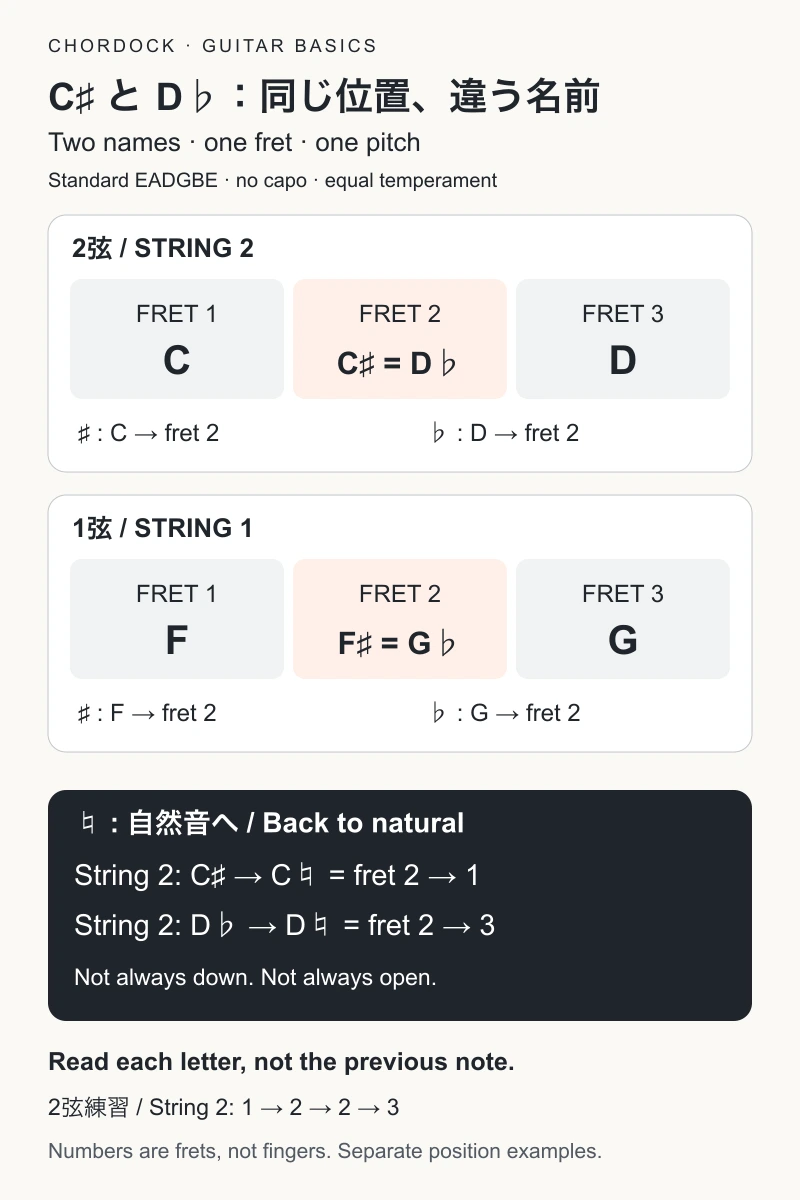
1. Up from C or down from D
Read ♯ as sharp and ♭ as flat. Here, a natural note is a letter A–G without a sharp or flat. On the same string, moving one fret towards the body raises pitch a semitone; moving towards the nut lowers it a semitone. C at string 2, fret 1 becomes C♯ at fret 2. D at string 2, fret 3 becomes D♭ at fret 2. If D♭ follows C♯, do not move down another fret: the flat refers to natural D, not the note you just played. These numbers identify frets, not fingers.
2. Two spellings, one pitch
In ordinary twelve-tone equal temperament, different spellings such as C♯ and D♭ can describe the same pitch: they are enharmonic. The diagram puts both names at one location, string 2, fret 2. On string 1, raising F at fret 1 or lowering G at fret 3 also reaches a shared position: F♯ or G♭ at fret 2. Spelling helps communicate a note's role and key, so keep the notation used in your lesson rather than changing everything to sharps. Octaves still matter. Here, sameness means the same string and fret in the diagram, not every C♯ across the entire neck having the same pitch.
3. Natural does not mean always down
A natural sign, ♮, cancels a sharp or flat and specifies the natural form of that letter. On string 2, C♯ to C♮ goes down from fret 2 to 1, while D♭ to D♮ goes up from fret 2 to 3. Neither destination is an open string. A 2 in ordinary TAB already gives the fret to play on that string; do not add another fret because an accompanying staff note has a sharp. In actual staff notation, key signatures and earlier accidentals also matter. Today's diagram is a comparison of explicitly named positions, not a rule for deciding how long an accidental lasts in a piece.
Pio: If D♭ comes after C♯, do I move down from where I am?
Dock-sensei: Not here: both are string 2, fret 2. D♭ means a semitone below natural D, not below the last note. Read the letter first and use its natural note as the reference.
Eight minutes: say the name, then play
- 2 minutes: check standard EADGBE tuning and remove the capo. Locate frets 1, 2 and 3 on string 2. Say C, C♯/D♭, D and pick each once with light fretting pressure and no sideways bend
- 2 minutes: play C → C♯ → D♭ → D♮ on string 2 as 1 → 2 → 2 → 3. Pick the shared fret twice. When comfortable, manually set the metronome to 60 BPM and 4/4: one note per click, four notes in one bar. If rushed, stop it and return to locating each note
- 2 minutes: stop the click and try C♯ → C♮ as 2 → 1, then D♭ → D♮ as 2 → 3 separately. Stop the sound and rest between pairs. Notice that natural sends you in opposite directions in these two examples
- 2 minutes: on string 1, play F → F♯ → G♭ → G♮ as 1 → 2 → 2 → 3. Hide the diagram and explain why C♯ and D♭ share a position. Rest if tired and stop for pain. Eight minutes is not a memorisation deadline
Review and references
Last content review:
Manufacturer, publisher and university lessons informed checks of semitone movement, enharmonic spelling and naturals. Both languages were reviewed twice for previous-note versus natural-letter reference, octaves, single notes versus chords and double-counting accidentals in TAB. Six diagram pitches were independently checked against standard tuning. The diagram and eight-minute routine with breaks are editorial suggestions, not a staff example teaching accidental scope.
- Sharps, Flats and Naturals (page 51) — Alfred Music / Nathaniel Gunod, L. C. Harnsberger, Ron Manus
- Why Do the Spaces Between Frets Grow Narrower Down the Neck? — Yamaha
- Enharmonic Notes — University of Puget Sound / Robert Hutchinson
- An Introduction to Music Theory: Accidentals — The Open University
References support the editorial review. They do not provide an individual diagnosis or guarantee compatibility with every instrument or model.
Sık sorulan sorular
Are C♯ and D♭ different frets?
In this standard-tuning example both are string 2, fret 2. They are enharmonic names for the same pitch. Compare within the same octave shown in the diagram.
Does natural always lower a note?
No. C♯ to C♮ goes down, but D♭ to D♮ goes up. The destination is that letter's natural note, not necessarily an open string.
Do E♯ and B♯ exist?
Yes, as note names. In equal temperament E♯ sounds like F and B♯ like C. Having no intermediate fret between E–F or B–C does not prohibit those spellings. Start with the C♯/D♭ example today.
Do I add a fret to a TAB number for a sharp?
Not in ordinary TAB. Play the stated fret on the indicated string. Do not raise it again for a sharp in the accompanying staff notation. Consult the lesson's legend for any special notation.
Does a C♯ chord symbol mean one note?
No. In a chord chart C♯ normally means a C♯ major chord. Today C♯ is a single-note name. Distinguish chord symbols, staff notes and TAB numbers by where they appear.
Will the metronome identify C♯ and D♭?
No. It marks time, not note names or finger positions. There is no automatic pitch grading. The 60 BPM setting and eight-minute routine are editorial suggestions: locate notes with the click stopped first and use a pace that stays comfortable.