Why Is a Ukulele's Fourth String High? High G vs Low G
If you expect the string nearest your face to be the lowest, the ukulele's fourth-string G can be surprising: it may sound higher than the third-string C. A common standard setup for soprano, concert, and tenor ukuleles is high-G GCEA, with the fourth string at G4. This is re-entrant tuning, in which the open strings are not arranged from low to high. It does not automatically mean that the instrument or string is wrong. Check the octave with a tuner before turning a peg a long way.
Temel özellikler ve seçenekler
- Standard high G uses G4, C4, E4, and A4 from strings four to one, so C4 is the lowest open note
- Low G uses a compatible fourth string tuned to G3, one octave below high G
- Do not simply loosen a high-G string by an octave; choose a compatible low-G string if you want to change
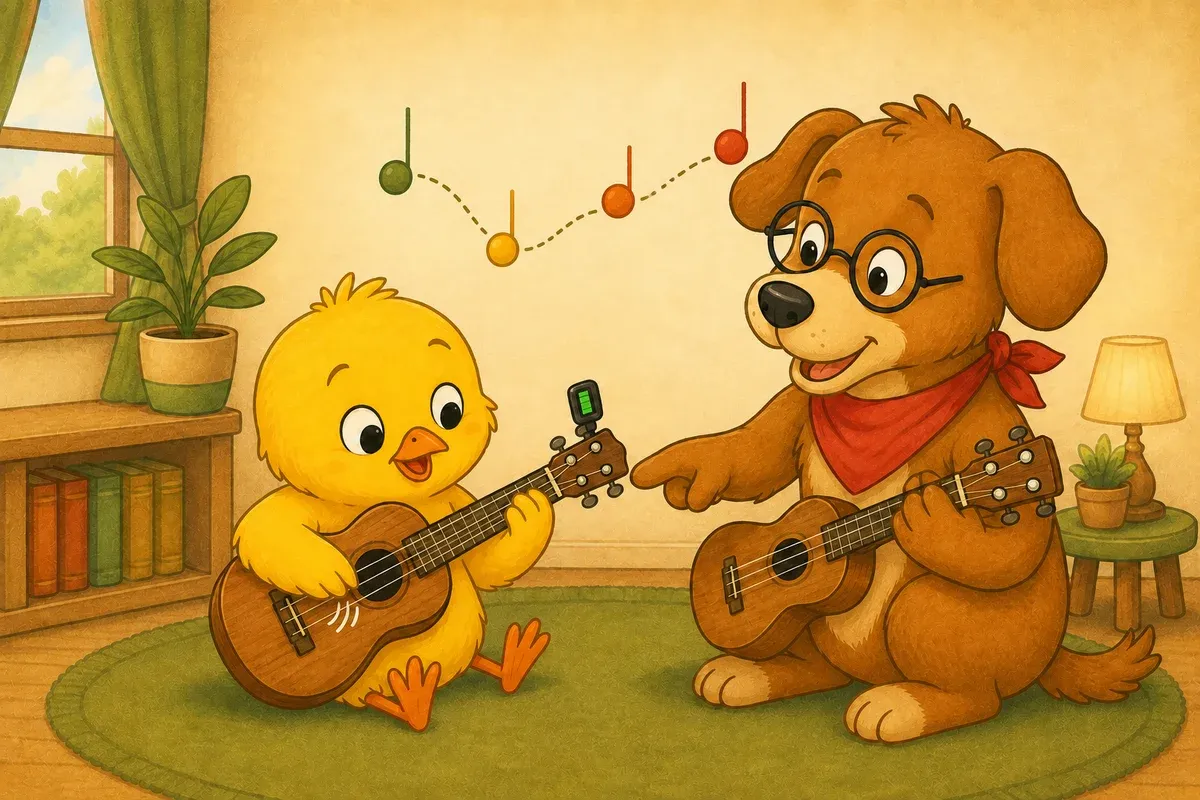
A fourth string higher in pitch than the third can be correct
On a common right-handed ukulele in playing position, the floor-side A is string one, followed by E on string two, C on string three, and G on string four nearest your face. If you reverse an instrument for left-handed playing, do not rely on floor side or face side alone; check how the strings are actually installed and how the lesson numbers them. A common high-G setup tunes those strings to G4, C4, E4, and A4 from four to one. G4 is higher than C4 and a whole step below A4, so the pitch drops when you move from open string four to string three. That re-entrant order contributes to the familiar bright ukulele sound. Some resources write high G as lowercase gCEA and low G as uppercase GCEA, but notation is not perfectly uniform; G3 versus G4 is the clearer check.
Check G4, C4, E4, and A4 one string at a time
Mute the other strings lightly and pluck only the fourth string. For standard high G, aim for G4, then check C4 on string three, E4 on string two, and A4 on string one. Move each tuning peg in small steps: increasing string tension raises pitch and reducing tension lowers it. If a tuner displays only the note name, compare open string-four G with the G at string three, fret seven. They should be nearly the same pitch in high-G tuning. If you do not know which way to turn or the note seems far away, stop instead of tightening hard enough to break the string, then check the instrument instructions or ask a music shop.
Choose low G for range, not because high G is wrong
Low-G tuning uses a compatible fourth string tuned to G3, placing the open strings in ascending G3-C4-E4-A4 order and extending the range downward. It can support lower melodies and a fuller lower register. Because the note letter remains G, common chord shapes usually remain usable, but the lowest note and exact voicing change, and melody TAB or arpeggios written for high G can sound different. Use a low-G string or set made for your ukulele's size and setup rather than detuning the current high-G string by an octave. If the replacement binds in the nut slot, buzzes severely, or does not fit as specified, do not file the instrument yourself; check the string maker's instructions or ask a repair professional.
Pio: The fourth string is nearest my face. Shouldn't it be the lowest?
Dock-sensei: Not in standard high-G tuning. The fourth string is G4, so it should sit above the third-string C4. Confirm G4 with the tuner. If you later want G3, use a low-G string instead of loosening this one by a whole octave.
Today's seven-minute high-G check
- 1 minute: in playing position, point from the floor side to string one A, string two E, string three C, and string four G
- 2 minutes: mute the unused strings and slowly check string four at G4 and string three at C4
- 2 minutes: check string two at E4 and string one at A4, then play all four as G4-C4-E4-A4
- 2 minutes: alternate open string-four G4 with the G at string three, fret seven, and listen for nearly the same pitch
Sık sorulan sorular
Does a high fourth string mean my ukulele is broken?
Usually not. High G is a standard setup on many soprano, concert, and tenor ukuleles. Treat damage, unusual rattling, or a slipping tuner as separate problems.
Do chord shapes change between high G and low G?
Common shapes usually stay the same because the fourth string is still a G note, but its octave can change which pitch is lowest, as well as the voicing, arpeggio contour, and overall sound.
Can I detune my current high-G string to G3?
It will normally become too slack and unstable. Fit a compatible low-G string or set for the ukulele's size and follow the maker's instructions.
What if my tuner displays only G without an octave number?
Compare open string-four G with the G at string three, fret seven. Nearly the same pitch identifies high G. If they sound an octave apart, check the installed string and intended tuning before turning the peg further.
Is a baritone ukulele tuned GCEA?
A common baritone setup is DGBE, unlike the standard GCEA used on many soprano, concert, and tenor ukuleles. Check the instrument type before buying strings or following a lesson.
Is high G or low G better for a beginner?
High G is the simplest match for many GCEA beginner resources and the played notes in CHORDOCK's current ukulele diagrams. Low G is useful when you want its lower range and have matching strings and material. Neither is universally better.