How to Read Bass TAB: Four Lines, Frets and Open Strings
Is the top line the thick string? Does 2 mean your middle finger? Read the string, fret and timing as separate pieces of information. This lesson uses a standard EADG four-string bass without a capo. Start with the line order and open-string symbol, then try an original four-note example to connect the page with your instrument.
Tính năng và lựa chọn chính
- Top to bottom: string 1 G, 2 D, 3 A, 4 E. The thick, low string is the bottom line
- Numbers on lines are frets. A 0 tells you to play an open string, not to rest
- Read left to right and check rhythmic notation or counts. Do not infer exact timing from spacing alone
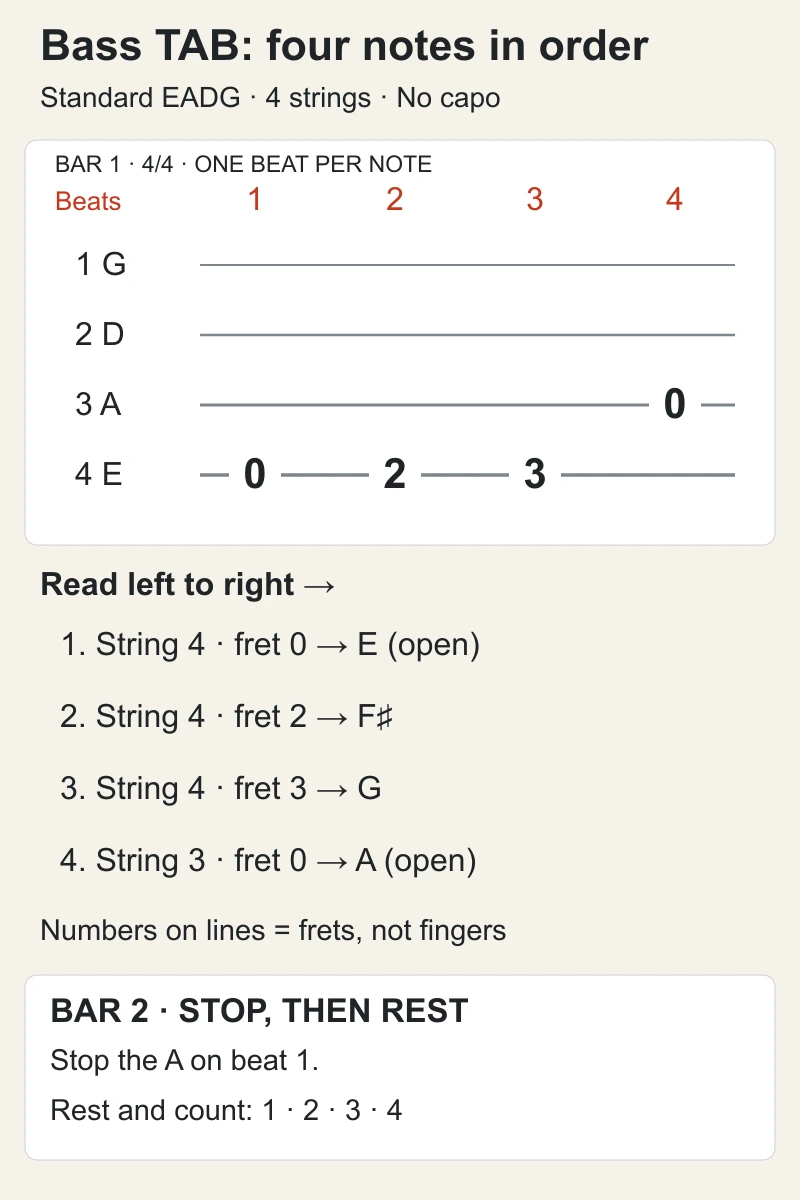
1. Use the line for the string and the number for the fret
The horizontal lines represent strings. In standard four-string TAB, G–D–A–E runs from top to bottom: thin string 1 at the top, thick string 4 at the bottom. This reverses the low-to-high tuning order EADG. Do not confuse these four lines with six-string guitar TAB or a five-line staff. A 2 on the E line means string 4, fret 2; a 2 on the A line means string 3, fret 2. The same number on another line selects another string and pitch. It does not identify a fretting finger. Left-handed players also read TAB from left to right.
2. Play the zeros: read four notes in order
A 0 means pick that string without fretting it. Our example reads string 4 fret 0, string 4 fret 2, string 4 fret 3, then string 3 fret 0. In standard tuning, these sound E, F♯, G and A. Say the string and fret before playing each note. At first, stop after each sound and find the next position without trying to match durations. For a fretted note, press in the space just behind the specified metal fret, on its headstock side. Move your hand if needed rather than forcing a fixed stretch. Rest if you feel pain.
3. Separate note order from timing
Numbers-only TAB may not specify exact durations or rests. If note stems, beams, counts or standard notation accompany it, read those too: TAB does not always lack rhythm. Do not convert the width of a gap directly into seconds; consult the legend and recording as needed. Our exercise explicitly specifies 4/4 and one beat per note. Play the four notes on beats 1, 2, 3 and 4 of bar 1, each lasting until the next beat. Stop the final A on beat 1 of bar 2 and rest for that entire four-beat bar. When changing strings, lightly touch the previous string to stop it ringing. This rhythm belongs to our exercise, not to every TAB.
Pio: Doesn't a zero mean I do nothing and rest?
Dock-sensei: A zero is still a note to play: sound the open string without fretting it. Rests need their own indication. Compare the zero on string 4 with the zero on string 3 and hear the difference.
An eight-minute session
- 2 minutes: point to the chart and name string 1 G, 2 D, 3 A and 4 E from top to bottom. Find the actual strings too. Do not turn tuning pegs merely to identify their names
- 2 minutes: without a click, read and play string 4 frets 0, 2, 3, then string 3 fret 0. Leave a zero unfretted but sound it. Stop and rest after each note while finding the next position
- 2 minutes: follow the diagram through all four notes. Stop string 4 when moving to string 3. If lost, say the string and fret first, relax your hand and try again
- 2 minutes: if comfortable, manually set 60 BPM and 4/4. Play E, F♯, G and A, one note per beat, in bar 1. Stop the sound on beat 1 of bar 2 and rest for all four beats. Repeat the two-bar pattern after the break. Remove the click if you need more time
Review and references
Last content review:
Bass-teaching and manufacturer sources informed checks of string order, fret numbers and zero. Both languages were reviewed twice for finger numbers, two-digit frets, gaps versus rests and TAB with rhythmic notation. The E–F♯–G–A diagram and eight-minute routine with breaks are original editorial suggestions.
- How to Read Bass Tab — StudyBass
- How to Read Tabs — Fender / Kristin Bigness
- A Bassist’s Guide to Reading Sheet Music and Tablature — Yamaha / E.E. Bradman
References support the editorial review. They do not provide an individual diagnosis or guarantee compatibility with every instrument or model.
Câu hỏi thường gặp
Which string is at the top of bass TAB?
In this standard four-string example it is thin string 1, G. Thick string 4, E, is at the bottom. For five- or six-string basses or altered tuning, check the line count and opening string labels again.
Does 2 mean my middle finger?
No. A 2 on a line selects fret 2 on that string. Fingering is separate information. If finger numbers appear elsewhere in a score, consult its legend.
Does 10 mean fret 1 followed by an open string?
No. Written as one number, 10 means the tenth fret, not two notes numbered 1 and 0. If a text TAB is hard to read, check its original layout and other notation.
What if numbers appear directly above one another?
Numbers vertically aligned at the same time normally ask for those strings together. Our example has four horizontally separated notes, played in sequence. Check any additional technique markings too.
Is every gap without a number a rest?
Not necessarily. It could be a sustained note, display spacing or a rest; bare numbers may not settle that question. Check durations, rests, counts or a recording. Our second bar is explicitly four beats of rest.
Will CHORDOCK play or grade the TAB automatically?
This diagram does not play or grade the exercise. Manually set 60 BPM and 4/4 in the linked tool and check strings and frets yourself. Eight minutes including breaks is an editorial practice suggestion, not a promise of mastery.