D.C. vs D.S. on Guitar: Where to Return and Stop at Fine
You see Fine, but there are more bars after it. Where should the music end? Compare just two instructions today: D.C. al Fine and D.S. al Fine. Before playing, find both the return point and the stopping point after the return. These four-bar route exercises are separate from ordinary repeat barlines and numbered endings.
Tính năng và lựa chọn chính
- D.C. returns to the beginning; D.S. returns to the segno sign
- With al Fine here, stop at Fine after returning—not on the initial pass
- Numbers identify bars. Keep four beats per bar and add no extra rest for the jump
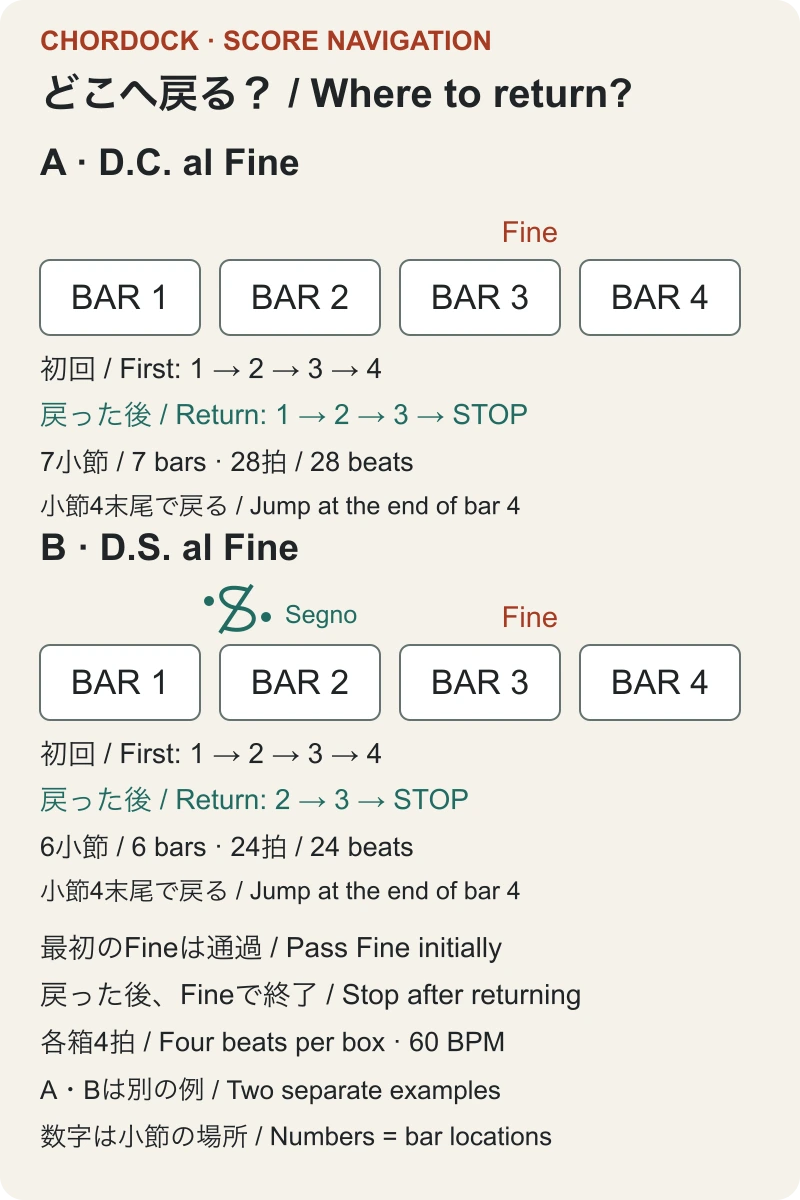
1. D.C. and D.S. have different destinations
D.C. abbreviates Da Capo: return to the beginning. D.S. abbreviates Dal Segno: return to the segno sign, which resembles an S with a diagonal stroke and dots. In example B it marks the start of bar 2, but its location varies between scores. Do not jump in the middle of a bar merely because you notice the instruction; play to its indicated position. In our chart the jump happens at the end of bar 4. These abbreviations describe navigation through music, not chord names or guitar techniques.
2. Read Fine as the stopping point after returning
Both al Fine examples place Fine at the end of bar 3. First play 1→2→3→4, passing Fine without stopping. Then follow the instruction at the end of bar 4. For A, D.C. al Fine sends you to bar 1: play 1→2→3 and finish at Fine. The complete order is 1→2→3→4→1→2→3. For B, D.S. al Fine sends you to the segno at bar 2: play 2→3 and finish. The complete order is 1→2→3→4→2→3. After returning, stop at Fine instead of continuing to bar 4 and looping forever. A and B are separate exercises, not two consecutive commands in one piece.
3. Trace the route before adding the guitar
BAR 1–4 labels identify locations, not frets or beats. Point to the boxes while saying the bar numbers. Then treat each box as one bar of 4/4 and count one-two-three-four. Beat four of bar 4 leads directly to beat one at the return point; do not insert a blank bar for travel. When comfortable, use standard EADGBE tuning, no capo, and pluck open string 1 once per beat. A contains seven performed bars, or 28 beats; B contains six, or 24 beats. At 60 BPM with a quarter-note beat, those routes last 28 and 24 seconds, excluding the count-in. Finish all four beats of the final bar 3 before stopping the sound. If you lose your place, stop the click and trace again without playing.
Pio: So I can pass Fine without stopping the first time?
Dock-sensei: In today's al Fine examples, yes. Reach the instruction at bar 4 first, return, then finish at Fine. Keep the destinations separate: D.C. goes to 1; D.S. goes to the segno at 2.
An eight-minute session for today
- 2 minutes: put the guitar down. Point to A's beginning, B's segno, Fine at the end of bar 3 and the jump at the end of bar 4. Check that A and B are separate examples
- 2 minutes: without a click, trace A's 1→2→3→4→1→2→3 and B's 1→2→3→4→2→3. Pass Fine initially; stop there after returning
- 2 minutes: manually set 60 BPM and 4/4. Count in for one bar, then trace A with four beats per box. Stop and rest afterwards. If comfortable, pluck open string 1 once per beat
- 2 minutes: try B at the same setting. Move from bar 4 to bar 2 without adding beats, then complete four beats in bar 3 and finish. Stop, rest and check that you played six bars. Return to pointing instead of increasing tempo if uncertain
Review and references
Last content review:
University material and official notation-software references informed two editorial passes in both languages. The initial pass versus the final stop, beginning versus segno, and bar numbers versus frets are distinguished. The two four-bar examples, beat calculations and eight-minute routine are original editorial exercises, not instructions for complex nested repeats or automatic tracking.
- Introduction to Music Theory and Rudiments: Repeats — MacEwan University / Devin Hart
- MuseScore Studio Handbook: Jumps and Markers — MuseScore
- D.C., D.S. and Coda Repeats — StaffPad
References support the editorial review. They do not provide an individual diagnosis or guarantee compatibility with every instrument or model.
Câu hỏi thường gặp
Does D.S. also mean back to the very beginning?
Return to the segno. If it is partway through the piece, do not go to the beginning. If the sign is missing, check earlier pages or omitted material rather than guessing its location.
Must I always stop the first time I see Fine?
Not in these D.C. al Fine and D.S. al Fine examples: pass it initially and stop there after returning. Read Fine together with the complete navigation instructions, not in isolation.
Does al Coda also mean stop at Fine?
No. After returning, al Coda leads to a jump from To Coda into the concluding coda section. There is no coda in today's diagram, so that route is outside this exercise. Segno and coda signs are different too.
Should I take ordinary repeats again after the jump?
Today's examples contain no repeat barlines or numbered endings. If these occur together in a piece, check its repeat instructions and arrangement notes. Do not use this simple route to decide every repeat count in a complex score.
Are the numbers in the diagram frets?
No. BAR numbers label measure locations. In the open-string exercise, every note stays at fret 0 with no left-hand fretting. Only the order of the bars changes.
Will the metronome guide the jumps automatically?
There is no automatic tracking or grading here. Set 60 BPM and 4/4 manually and follow the chart yourself. The eight-minute routine includes rests and is an editorial suggestion, not a promise of mastery in eight minutes.