Guitar String Names: Match Strings 6 to 1 with EADGBE
Which string should you play when a lesson says low E rather than high E? On a standard six-string guitar, the open notes run E A D G B E from thick string 6 to thin string 1. Pair each name with its number instead of memorising letters alone. Remove the capo and leave the frets unpressed for today's slow exercise matching position, name and pitch.
Tính năng và lựa chọn chính
- From thick string 6 to thin string 1: E A D G B E. In reverse: E B G D A E
- Strings 1 and 6 share the name E, not the same pitch. String 1 is two octaves higher in standard tuning
- A string number identifies position; an open note names its unfretted pitch. Neither is a finger or fret number
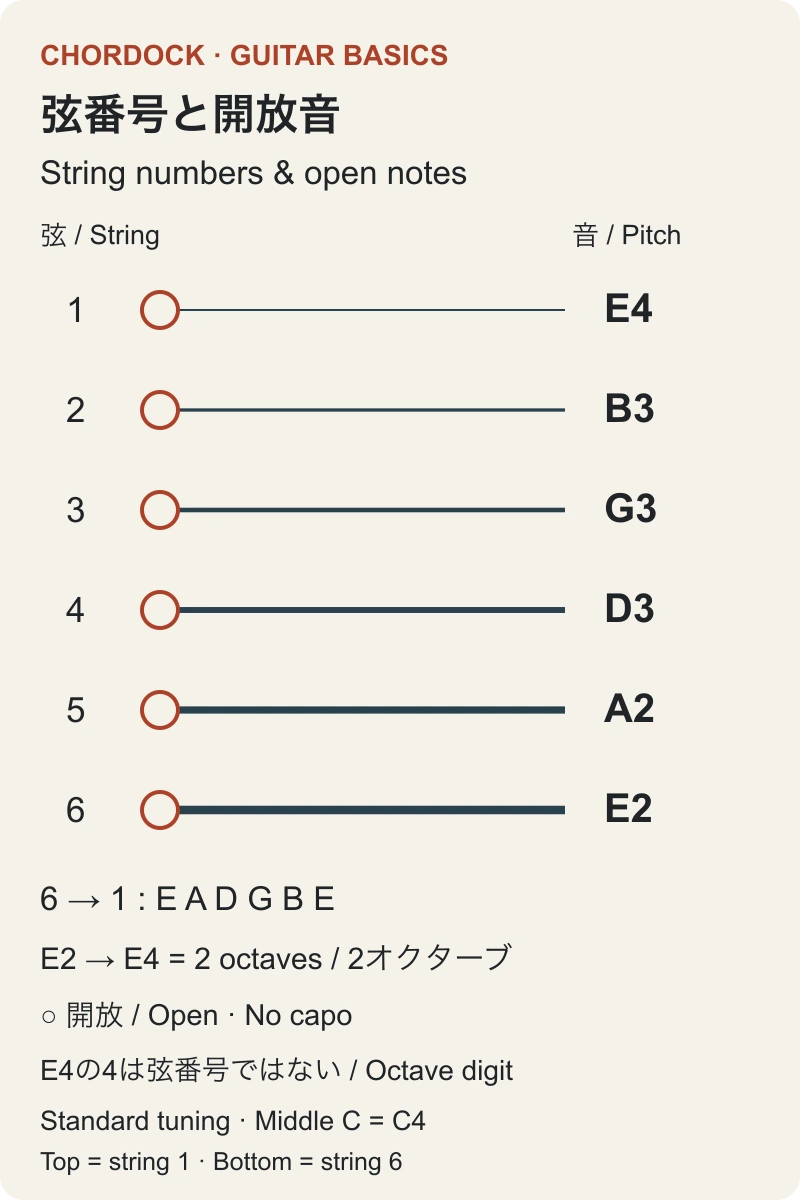
1. Find thick string 6 and thin string 1 first
This lesson assumes an ordinary six-string electric, acoustic or classical guitar in standard tuning. The thick, low side is string 6; the thin, high side is string 1. Read each pair: 6 E, 5 A, 4 D, 3 G, 2 B, 1 E. Reverse it as 1 E, 2 B, 3 G, 4 D, 5 A, 6 E. One way to learn the low-to-high sequence is to practise EAD and GBE separately, then join them. Instead of racing through the alphabet, ask yourself which note belongs to string 5 and point to it. You are learning positions, not restringing or retuning the instrument: there is no need to turn a tuning peg for this recall exercise.
2. The two E strings share a name, not a pitch
Using scientific pitch notation with middle C labelled C4, the sounding open notes from string 6 are E2, A2, D3, G3, B3 and E4. The numbers beside these letters identify octave registers, not strings or frets. From low E2 to high E4 is two octaves. Do not try to tune those strings to the same height. Open here means no capo and no fret pressed. Fretting string 5 changes its note, but its position is still string 5. Keep memorisation separate from tuning adjustments. If a string is far from the expected pitch and you are unsure what to do, stop rather than winding it tighter and ask a teacher or guitar technician.
3. Use string numbers rather than the top of the picture
Our horizontal diagram puts string 1, E4, at the top and string 6, E2, at the bottom. Guitar TAB normally uses the same high-string-on-top layout. The view of the guitar in your lap may look different; upright chord diagrams place the strings side by side. Whenever you change diagrams or look at a photograph, first find the labels for strings 1 and 6. On a conventionally strung left-handed guitar, the thin high string is still called string 1. Special arrangements, such as turning an unchanged right-handed guitar over, need a separate check. Line thickness in this diagram helps distinguish strings; it is not a scale drawing of their gauges.
Pio: The top line says E. Does that mean the thick sixth string?
Dock-sensei: In this diagram the top line is string 1, high E. Check the number as well as the letter. The two E strings share a note name but sound at different heights.
An eight-minute session for today
- 2 minutes: remove the capo and point to thick string 6 and thin string 1. With the diagram, say 6 E, 5 A, 4 D, then 3 G, 2 B, 1 E. Leave the tuning pegs alone
- 2 minutes: without fretting, gently pick one string at a time from 6 to 1. Touch the previous string to stop it before moving on, and say its number and note name
- 2 minutes: hide the diagram and point to 5 A, 2 B and 4 D in that order, then check. Revisit only the pairs you missed. Listen to the different heights of strings 1 E and 6 E
- 2 minutes: if comfortable, manually select 60 BPM and 4/4. Play strings 6 through 1, one per click, then mute and rest for two clicks. Eight clicks make two bars. Stop the click and return to your own pace if needed
Review and references
Last content review:
Manufacturer and guitar-teaching sources were checked for string order. Both languages were reviewed twice for standard tuning without a capo, string versus octave numbers, the two-octave E gap, diagram orientation, left-handed use and avoiding excessive tightening. Source mnemonics were not reproduced; the diagram and eight-minute recall routine are editorial suggestions.
- Standard Tuning: How EADGBE Came to Be — Fender / Jeff Owens
- The 6 Guitar String Notes — D’Addario
- Names of the Open Strings — Next Level Guitar
References support the editorial review. They do not provide an individual diagnosis or guarantee compatibility with every instrument or model.
Câu hỏi thường gặp
Which way does EADGBE run?
In standard tuning it runs from thick string 6 to thin string 1. Reading from string 1 gives E B G D A E instead. Use numbered labels rather than assuming every picture runs in the same direction.
How does this relate to do, re, mi?
In fixed-do naming, the low-to-high sequence is mi, la, re, sol, ti or si, mi. This article uses letter names to match common tuners and chord lessons. Movable-do systems instead assign syllables by musical context.
Should the two E strings have the same pitch?
No. Standard string 1 is E4, two octaves above string 6 at E2. Do not keep tightening a string merely to make an E label appear without checking its register and target.
Does this chart work with a capo or other tunings?
String numbers remain position labels, but the sounding notes change. The chart assumes standard EADGBE with no capo on a six-string guitar. Do not directly apply it to drop D, half-step-down tuning, seven strings, a typical four-string bass or a ukulele.
Does knowing the names mean the guitar is in tune?
No. Recall and accurate pitch are different things. Check tuning before playing. This lesson is not an adjustment procedure prescribing a universal peg direction or number of turns.
Does the linked tool grade string names?
No. The metronome spaces events with clicks; it does not grade string numbers or note names. Select 60 BPM and 4/4 manually. Eight minutes includes rests and is an editorial suggestion, not a deadline for memorisation. Stop playing if there is pain.