Single Paradiddle for Beginners: Learn RLRR LRLL on One Pad
Alternating hands feels manageable, but a paradiddle makes you lose the next hand. Instead of memorising eight letters at once, separate R L R R from L R L L. A single paradiddle combines two alternating strokes with two strokes on the same hand. Today, use one pad to check the order and spacing before adding speed or moving around a drum kit.
主要功能與選項
- R is right hand and L is left. The basic continuous order is R L R R followed by L R L L
- RR and LL each require two separate hits by one hand. Keep the second hit and its spacing intact
- Sticking and note value are different. Today's diagram uses eighth notes in 4/4: eight hits over four beats
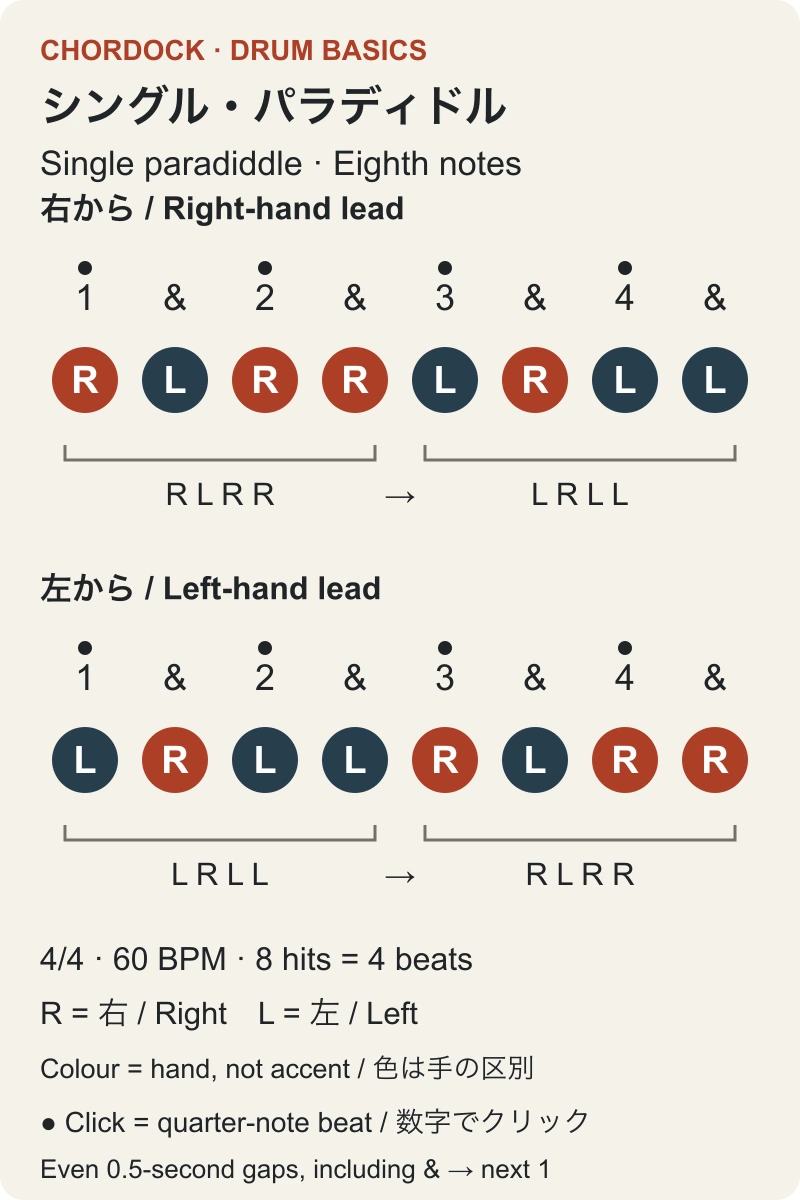
1. Read two alternating hits, then two on one hand
The first R L means one right and one left hit. Add R R for two right-hand hits to form R L R R. Reverse the hands for the next group: L R followed by L L makes L R L L. Together they form R L R R L R L L. The leading hand of each four-hit group changes from right to left and back again. Unlike the all-alternating R L R L single stroke pattern, hits 3–4 and 7–8 here use the same hand. Single in this rudiment's name does not mean every hit alternates. R and L retain their meanings for left-handed players. To lead with the left instead, use L R L L R L R R.
2. Keep the same-hand pairs apart on one surface
Secure the pad and start without a click, playing four hits and then pausing. Check R L R R, then practise L R L L separately. You do not have to squeeze two quick rebounds out of one movement for the same-hand pair. At today's slow pace, control each hit and allow the stick to return naturally. If the second hit is weak or the pair bunches together, revisit small movements before increasing your grip pressure. Leave accents out of this introductory exercise. Use similar, comfortable stick heights for both hands and prioritise order and spacing over force. Rest when tired and stop if there is pain.
3. Fit eight hits into four beats, without pausing at the join
For the diagram, manually set 60 BPM and 4/4, with each click representing a quarter-note beat. Count 1 & 2 & 3 & 4 &, placing one hit on each count: R L R R across 1 & 2 &, then L R L L across 3 & 4 &. RR falls on 2 and its following &, and LL on 4 and its following &. Two hits per click means eight hits occupy four beats: one bar. At 60 BPM, attack starts are 0.5 seconds apart, including the final & to the next 1. Do not insert an extra pause between four-hit groups. If you first try the same eight hits at one hit per click, they occupy eight beats, or two bars. The sticking stays the same while the note value changes, so distinguish the two exercises.
Pio: After RR, do I start with the right hand again?
Dock-sensei: Start the next group with the left. Right-left-right-right, then left-right-left-left. Ending with two on the same hand leaves the other hand ready to lead the next group.
An eight-minute session for today
- 2 minutes: without a click, read R L R R, play four hits and pause. Try L R L L too. Check that you keep the second hit in each RR or LL pair
- 2 minutes: manually set 60 BPM and 4/4. Count in for one bar, then play R L R R L R L L at one hit per click. Eight hits take two bars. Stop and review the hand order
- 2 minutes: if comfortable, use the diagram's eighth notes. Fit eight hits into one bar on 1 & 2 & 3 & 4 &, then repeat on the next 1. Stop playback after two bars and check for compressed same-hand pairs
- 2 minutes: separately try the lower row's left-hand lead, L R L L R L R R. Return to one hit per click if needed. Keep the tempo unchanged and finish by noting one place where you lost the order
Review and references
Last content review:
Percussion society, manufacturer and teacher materials informed checks of sticking and changing leads. Both languages were reviewed twice for same-hand pairs, handedness, note value versus sticking and eight hits over four versus eight beats. The diagram and unaccented 60 BPM, eight-minute routine are editorial introductory exercises.
- Paradiddles: The Whole Story in a Nutshell — Percussive Arts Society / Joel Rothman
- 40 Essential Rudiments: Single Paradiddle — Vic Firth
- Single Paradiddle — DrumLessons / Lionel Duperron
References support the editorial review. They do not provide an individual diagnosis or guarantee compatibility with every instrument or model.
常見問題
Is this the same as single strokes?
No. Single strokes alternate every hit, R L R L. The basic single paradiddle, R L R R L R L L, includes pairs played by the same hand.
Must a paradiddle use sixteenth notes?
The sticking itself does not specify a note value. Sixteenth-note examples are common, but this diagram uses eighths. With a quarter-note beat, its eight hits occupy four beats; as sixteenths, the same eight hits would occupy two beats.
Should left-handed players swap the meanings of R and L?
No. R still means right and L means left. Use L R L L R L R R to start with the left hand, treating it as a left-led version rather than relabelling your hands.
Must each double come entirely from rebound?
Not necessarily. How rebound is used depends on speed and technique. This slow exercise asks you to control each hit, keep the count correct and space the hits evenly. It is not an uncontrolled multiple-bounce exercise.
Do the diagram's colours mean accents?
No: they identify the hands, not loudness. Aim for even volume here. Accenting the first hit or distributing hits around different drums can be studied separately.
Can I start without a pad, and is there automatic grading?
Without sticks, point with each named hand to learn the order. You do not need to hit a hard desk with sticks. The site does not automatically show the sticking or grade your hands: set 60 BPM and 4/4 manually and check the sequence yourself. Eight minutes includes pauses and is a suggestion, not a mastery deadline.