Can't Remember Guitar Chords? Three Recall Exercises
You can hold a chord while the chart is visible, then lose every finger position when the screen disappears. That is a common beginner experience. It does not mean you have a bad memory; you may simply need more practice recalling and building the shape without looking. Work with only two chords today.
主要功能與選項
- Limit one session to two chords
- Look at the chart, hide it, and build the shape from memory
- Remember the required strings and sound as well as the finger shape
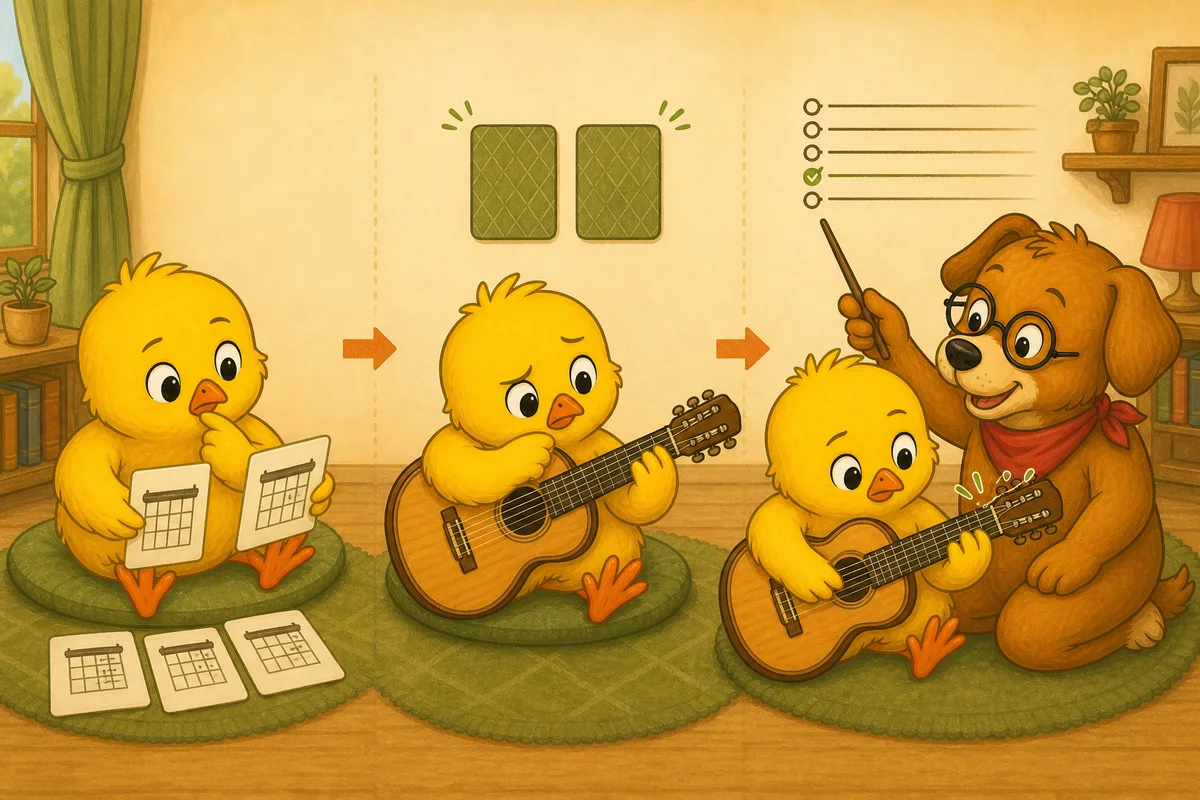
Reduce the session to two chords
A list may show eight beginner chords, but you do not need to memorise all eight in one day. Choose two, such as Em and Am or C and Am. If you are learning a song, use two shapes that appear next to each other. Read the chart in a fixed order: fretted strings, fret numbers, suggested fingers, open strings, and strings that should not sound. Build one finger at a time rather than trying to photograph the whole shape mentally. Alternative fingerings exist, but using one beginner fingering consistently reduces confusion at first.
Repeat look, hide, place, and compare
Instead of holding a chord ten times with the chart open, study it for about five seconds, remove the fretting hand, hide the chart, and place the fingers without looking. Play every required string separately, then reveal the chart and compare. If only the ring finger was wrong, correct that one detail before releasing the hand and trying again. Do not stay stuck for a long time; if the shape does not return after a few seconds, look again and make the next recall attempt short and accurate.
Connect the shape with its strings and sound
A purely visual memory can be flipped or moved to the wrong string. Before strumming the whole chord, play from the lowest required string to the highest and separate fretted notes, open strings, and strings the chord omits. Then listen to the full chord. Connecting the shape to its string range and sound makes an error easier to notice during music. Speed can wait. First aim to land slowly in the correct place without the chart.
Pio: I can hold the chord while I see the chart, but everything disappears when I look away. What if I remember it incorrectly?
Dock-sensei: Keeping the chart open only practises recognising it. Look briefly, hide it, then compare immediately after your attempt. You do not need to rebuild everything—correct the one finger that was misplaced and try again.
An eight-minute chord-memory exercise
- Minute 1: tune from the sixth string to E, A, D, G, B, E
- Minutes 2–3: choose two chords and build each one finger at a time with the chart visible
- Minutes 4–6: look for five seconds, hide, place, check each string, and compare; repeat each chord three times
- Minutes 7–8: count four slow beats and alternate the two chords every four counts
常見問題
How many chords should a beginner learn in one day?
Two is enough for a first session. There is no required number, but recalling and alternating two shapes is usually more useful than briefly viewing many shapes.
Why do I forget the chords the next day?
That is not unusual early on. Recall the same two shapes once on the next day and review only the finger positions that were missing.
Does drawing chord diagrams help?
It can organise the relationship between strings and frets. Follow the drawing by placing the fingers and checking each string so the exercise also reaches the instrument.
Can I use different fingers from the chart?
Alternative fingerings exist, but changing fingers on every attempt can prevent a stable shape from forming. Begin with one suitable fingering and explore alternatives later.
Must I memorise every guitar chord before playing songs?
No. Start with the chords in the song you want to play. Common shapes become familiar as you use them repeatedly in music.