Which Strings Should You Strum for Each Guitar Chord?
Holding a chord does not always mean strumming all six strings. Common open C and D shapes begin on different bass strings, and an unused low string can make the result sound heavier than intended. Read every X and O, then start the picking hand on the lowest string that belongs to the displayed shape.
主要功能與選項
- X means do not sound the string; O means play it open
- In common open shapes, begin C, A, and Am on string five; D and Dm on string four; and E, Em, and G on string six
- Read the displayed shape every time because another voicing of the same chord can use different strings
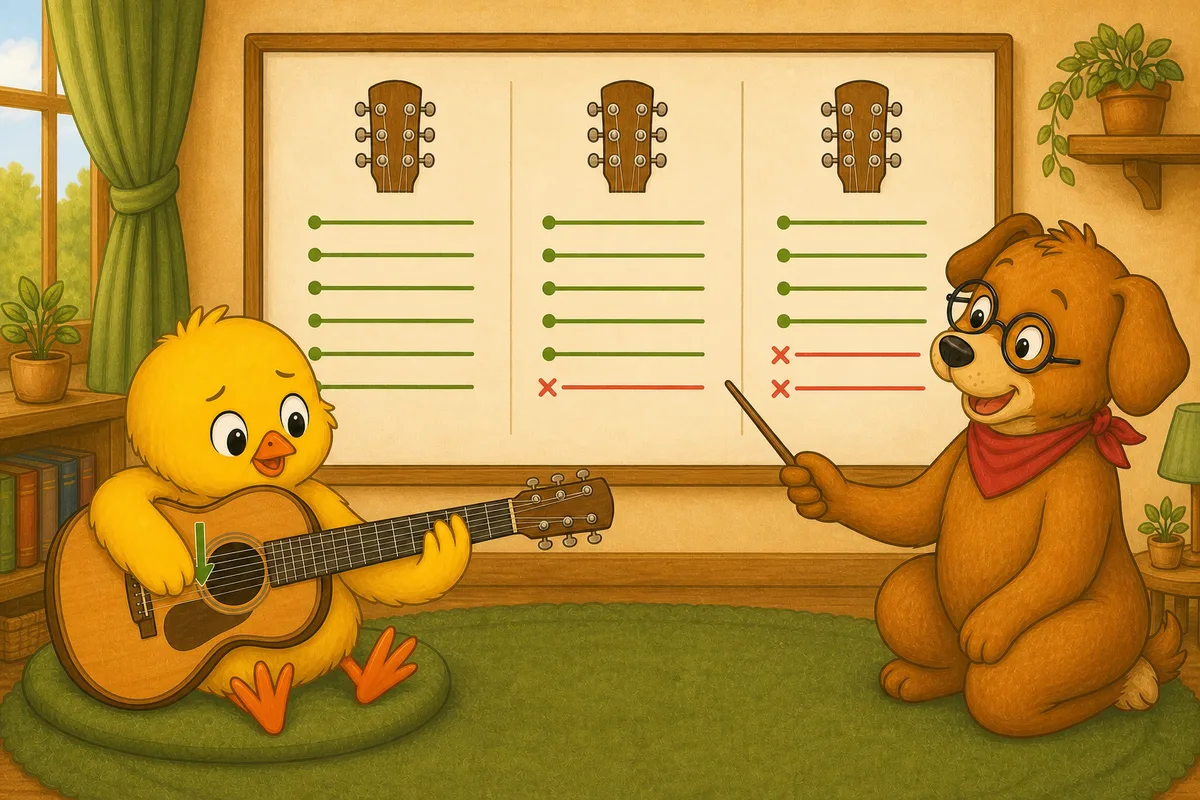
Read string numbers, X marks, and open circles
When you hold the guitar, the thick string nearest your face is string six, low E, and the thin string nearest the floor is string one, high E. CHORDOCK diagrams place string one at the top of the screen and string six at the bottom, so the visual top and bottom differ from the instrument in playing position. Say the numbers while touching the strings until the relationship is familiar. The X and O marks appear to the left of each string in CHORDOCK. An X means that string should not sound. An O means the string sounds open, without a fretting finger. The finger dots alone do not define the picking-hand range; X and O marks complete the instruction.
Begin C and A on string five, D on four, and E and G on six
For the standard open shapes shown by CHORDOCK, C (x32010), A (x02220), and Am (x02210) omit string six and use strings five through one. D (xx0232) and Dm (xx0231) omit strings six and five and use strings four through one. E (022100), Em (022000), and G (320003) use all six strings. In this compact notation, x means omitted and 0 means open. These are specific open voicings, not permanent rules attached to the chord names. Barre shapes and other voicings can choose a different bass string, so always follow the current diagram.
Use one small downstroke, then inspect each string
A large first strum can easily catch a bass string that the chord omits. For C, place the picking hand just above string five; for D, begin just above string four. Make one small downstroke instead of a wide rhythmic motion. Next, play every required string separately from low to high and listen for a clear fretted or open note. Avoiding the X string with the picking hand is the main beginner skill. If a comfortable fingering lets the thumb or a nearby fingertip touch that string lightly, it can provide extra muting, but do not twist the wrist to force it. Accurate starting position comes first.
Pio: I strum all six strings even for C. Aren't chords supposed to use every string?
Dock-sensei: Each shape chooses its own strings. For the common open C, let the X-marked sixth string rest and begin on string five. Use one slow, small stroke before adding a full rhythm.
A seven-minute starting-string exercise
- Minute 1: touch the real strings and say six, five, four, three, two, one from thickest to thinnest
- Minutes 2–3: read the X and O marks, then give C and A one slow downstroke from string five
- Minutes 4–5: begin D and Dm on string four and inspect all four required strings separately
- Minutes 6–7: at 60 BPM, play C, G, D, and Am for four beats each while changing the picking-hand starting point
Review and references
Last content review:
The meaning of X and O was checked against publisher and manufacturer lessons, and their left-of-string position in CHORDOCK was clarified.
References support the editorial review. They do not provide an individual diagnosis or guarantee compatibility with every instrument or model.
常見問題
Why omit the low E string from C when E belongs to a C chord?
E is a chord tone, but putting low E at the bottom changes the weight and bass relationship. The common beginner open C begins on string five so C, the root, is the lowest note. A brief accidental touch does not instantly create a completely unrelated chord, but learning the basic voicing gives you a clear reference sound.
Should I skip an X string with the picking hand or mute it with the fretting hand?
Players use both methods. First learn to begin the stroke on the correct string. Add light fretting-hand contact as backup only when the shape allows it without strain.
Must an upstroke return across every low string?
No. Upstrokes often brush mainly the higher strings. You can keep the rhythmic motion without forcing the pick across unused bass strings.
Does a capo change which string begins the chord?
The string numbers normally stay the same when you keep the same shape. A capo changes the sounding pitch, while the diagram's X and O marks still describe the strings used by that shape.
Why does another C diagram include string six?
A chord can have several voicings and fingerings with different bass notes and string ranges. Follow the X, O, and fret positions in the diagram you are currently using instead of relying only on the chord name.
Why is the chord still muddy when I avoid every X string?
Inspect the fretting hand as well. Play each required string separately and check whether a fingertip touches its neighbour or sits too far from the fret wire.