D vs Dm on Ukulele: Shapes and the One-Note Difference
What changes when a small m appears after D? In these shapes for GCEA tuning with no capo, move string 2 from fret two to fret one. F-sharp becomes F, a half step lower. Before resetting a whole chord, compare those two notes on their own.
主要功能與選項
- D contains D, F-sharp and A; Dm contains D, F and A. The m means minor
- Reading strings 4 to 1, D is 2220 and Dm is 2210; the final zero is open string 1
- Today the index plays string 2 in both shapes. Learn each separately without forcing other fingers to stay planted
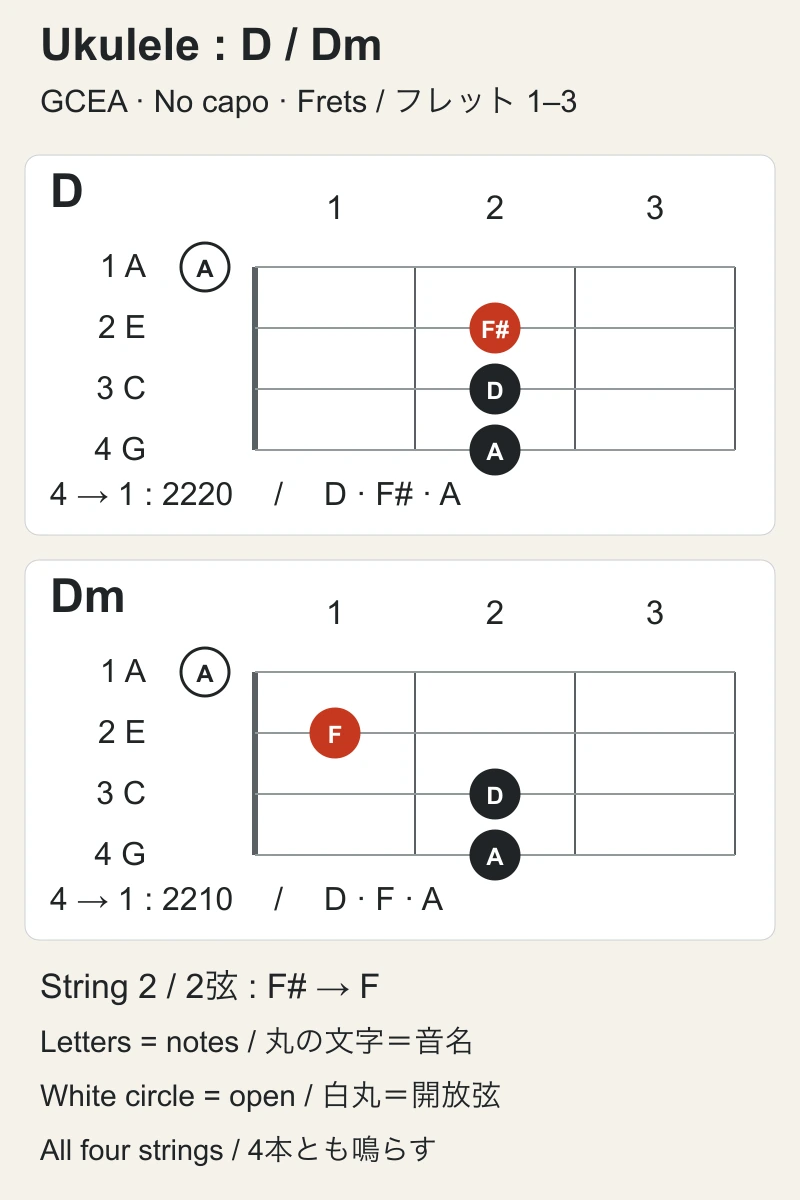
1. Hear F-sharp become F
D major contains D, F-sharp and A; D minor contains D, F and A. The root D and fifth A stay the same, while the major third becomes a minor third. Here that change happens on string 2, from fret two to fret one. Do not loosen the string or change its tuning. Play each chord once at a similar volume and listen for the difference. Descriptions such as bright or dark can be useful impressions, but they are not fixed emotions for every song. Identifying the changed note is enough for today.
2. Turn 2220 and 2210 into string positions
The digits run from string 4 G through 3 C and 2 E to 1 A. Our diagram puts string 1 at the top, so do not read the digit sequence down the drawing. For D, put middle on string 4, ring on string 3 and index on string 2, all at fret two. For Dm, the middle and ring keep their positions while the index goes to string 2, fret one. Leave string 1 open and sound all four strings. Another D fingering places index, middle and ring on strings 4, 3 and 2; that version requires changing finger assignments for Dm. The circles label notes, while 2220 and 2210 label frets, not fingers. Treat today's fingering as one option.
3. Keep the open A clear and allow time to reset
Crowding three fingers into fret two can put the side of the index against the open first string. Before strumming, pick strings four through one separately and check that the final A rings. If it does not, relax and adjust the fingertip rather than squeezing harder. Fret just behind the metal wire and avoid forcing the wrist into an awkward bend. Check Dm the same way before alternating the shapes. Lifting the middle or ring finger is not a failure: stop the sound and reset the whole shape if needed. Rest when tired and stop if there is pain.
Pio: Does the little m tell me to play more quietly?
Dock-sensei: It names a chord type, minor, rather than a volume. Here F-sharp changes to F. Keep a similar volume for both chords so you can hear the note change itself.
An eight-minute session for today
- 2 minutes: check GCEA tuning and remove any capo. Alternate string 2 at fret two, F-sharp, and fret one, F. Listen to the half-step change
- 2 minutes: form D, 2220, and pick strings four through one slowly. If the final open A is blocked, release the grip and reposition
- 2 minutes: check Dm, 2210, the same way. Alternate the chords without a click, stopping each before changing. You need not keep the two shared fingers planted
- 2 minutes: manually set 60 BPM and 4/4. Alternate one bar of D with one of Dm, strumming once on beat one. Gently touch the strings with the strumming hand to stop on three, and use beats three and four to reset. Turn off the click if you feel rushed
Review and references
Last content review:
Manufacturer and university lessons informed checks of notes, fingerings and thirds. Both languages were reviewed twice for digit order, the half step, open string 1, alternate fingerings and tuning assumptions. The diagram and 60 BPM, eight-minute routine are editorial suggestions.
- How to Play the D Major Chord on Ukulele — Fender / Ben Nemeroff
- How to Play the D minor Chord on Ukulele — Fender / Ben Nemeroff
- Introduction to Triads — University of Puget Sound
References support the editorial review. They do not provide an individual diagnosis or guarantee compatibility with every instrument or model.
常見問題
Can I freely swap D and Dm?
Not always: they contain different notes. Follow the chord named in a song first. We alternate them here to hear the difference, not as a universal substitution rule.
Does zero in 2220 mean skip that string?
Zero means sound the open string without fretting it. In both of these shapes, that is string 1, A. Do not confuse it with an X indicating a string that should not sound.
Must I move only the index finger?
Today's assignments allow the index on string 2 to change from fret two to one without swapping fingers. You do not have to keep the other fingers planted, though. Other D fingerings require resetting. Choose clear notes and comfortable movement over rigid positioning.
Do the shapes work for low G or baritone?
They give D and Dm in low-G GCEA too, with string 4 sounding an octave lower than high G. The same positions do not have the same chord names in baritone DGBE tuning.
Why play four strings for a three-note chord?
From string 4, these shapes sound A, D, F-sharp, A for D and A, D, F, A for Dm. The note name A appears twice, leaving three distinct note names across four strings. The chord name does not mean the fourth string is its root.
Will the tool grade my chords?
The linked metronome marks beats; it does not automatically grade chords. Set 60 BPM and 4/4 manually. The eight-minute routine and its pauses are editorial practice suggestions, not a mastery deadline or a rule to pause in every song.