Ukulele B Flat Not Ringing? Check the Two-String Barre
Does one string give a dull thud when you play B flat? Release the shape and start with strings one and two under your index finger. This lesson breaks 3211 in GCEA tuning with no capo into a short barre and two additional fingers. Aim to identify the silent string and the finger touching it, rather than simply squeezing harder.
الميزات والخيارات الرئيسية
- 3211 lists frets from string 4 to string 1, not finger numbers
- Index bars strings 1 and 2 at fret one; middle takes string 3, fret two; ring takes string 4, fret three
- Test strings 1 and 2 individually before adding fingers. The complete shape sounds all four strings, with none open
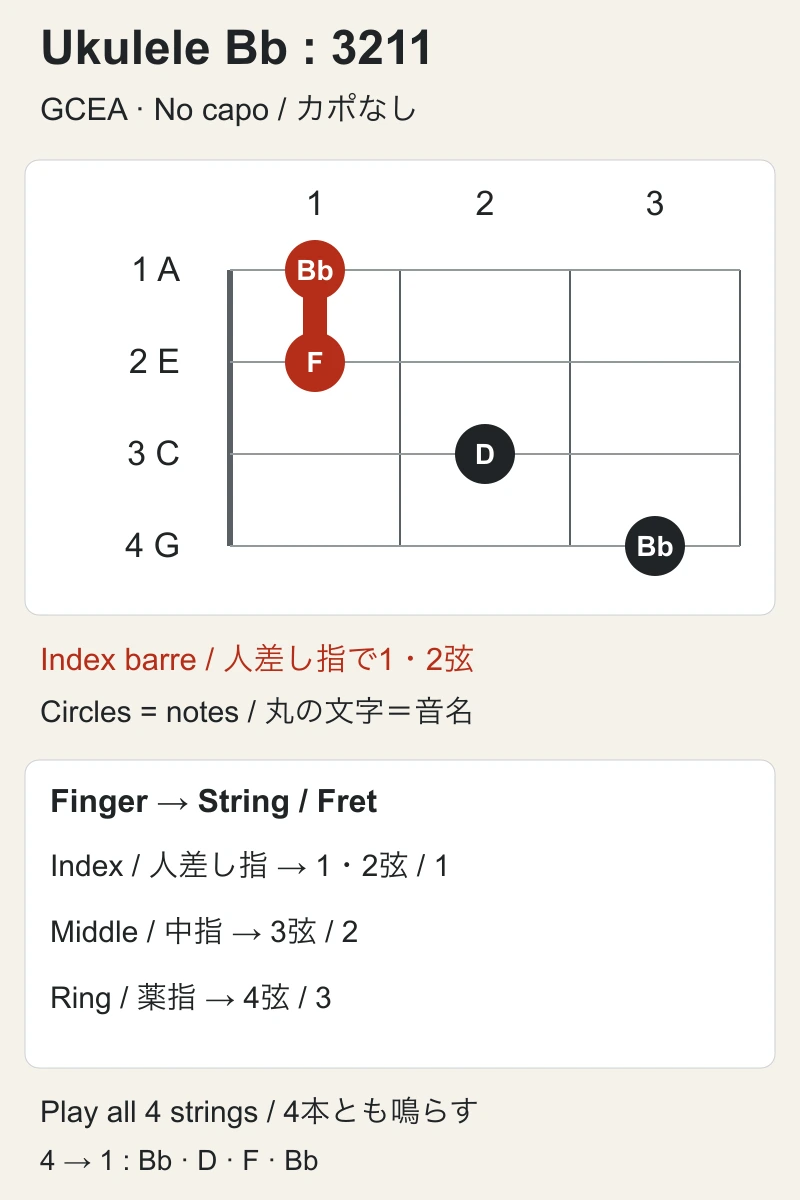
1. Read 3211 from string four: three fingers, four strings
String 4 G takes fret three, string 3 C takes fret two, and strings 2 E and 1 A both take fret one. Use ring, middle, index and index in that order. The diagram puts string 1 at the top and string 4 at the bottom, opposite to the digit sequence. Letters in the circles are note names, not finger numbers. A barre means fretting multiple strings with one finger. For this shape, start with a short barre across strings 1 and 2. You do not need to stretch the index across all four strings. There is no zero in 3211: every string is fretted and all four should sound.
2. Check two strings, then add middle and ring
Place the index on strings 1 and 2 at fret one and pick them separately. Aim just behind the metal fret wire. If either note is dull, release and make a small adjustment to the contact position or finger angle. Add middle on string 3 at fret two, then ring on string 4 at fret three, retesting strings 1 and 2 after each addition. Check whether the side of the newly added finger touches a neighboring string. Finally pick strings four through one. Avoid forcing the wrist into a sharp bend or squeezing through pain. Release and rest between attempts. If adjustments do not help, ask a teacher to check how you hold the instrument and where your fingers contact the strings.
3. B flat has three note names: two strings are not the whole shape
B-flat major contains B-flat, D and F. In 3211, the order from string four is B-flat, D, F, B-flat. Four strings carry three different note names, with B-flat repeated. The first two strings you test provide only B-flat and F, without D. Treat that pair as an intermediate check, not a replacement for the complete basic shape. B-flat and B are different chords. Use this shape where the song calls for B-flat rather than replacing it with B just because a fingering seems easier. Today's target is hearing and checking all four strings, not making a fast chord change.
Pio: Does a barre mean I have to press all four strings with my index?
Dock-sensei: For today's 3211, the index can handle just strings one and two. Find a clear contact position, then add middle and ring. Keep that two-string check separate from the finished four-string shape.
An eight-minute session for today
- 2 minutes: check GCEA tuning and remove any capo. Read 3211 from string four and notice that the diagram starts with string one at the top. Point to each string and fret before trying to hold the shape
- 2 minutes: barre strings 1 and 2 at fret one with the index. Pick them separately; release and reposition if a note is dull. Relax between attempts and stop if there is pain
- 2 minutes: add middle on string 3, fret two, then ring on string 4, fret three. Retest strings 1 and 2 after each addition, then pick all four separately. Once clear, strum all four gently once and rest
- 2 minutes: manually set 60 BPM and 4/4. Strum all four once on beat one and count four beats. On beat one of the next bar, lightly touch the strings with the strumming hand to stop them; rest and reset for that whole bar. Repeat this two-bar cycle, turning off the click if rushed
Review and references
Last content review:
Educator references informed two editorial passes distinguishing frets/fingers, partial checks/the complete shape, B-flat/B, and string count/note-name count. Diagram pitches were independently calculated from standard GCEA. The figure and eight-minute routine with rests are editorial exercises, not grip-strength requirements or mastery guarantees.
- B-flat Major Ukulele Chord — Ukulele Tricks / Brett McQueen
- How to Play Barre Chords on Your Ukulele — Dummies / Alistair Wood
- B-flat Major Ukulele Chord — UkuTabs
References support the editorial review. They do not provide an individual diagnosis or guarantee compatibility with every instrument or model.
الأسئلة الشائعة
Are the digits in 3211 finger numbers?
They are frets: three, two, one, one from string four. In this fingering the fingers are ring, middle, index, index; the index presses two strings.
Are B-flat and B the same chord?
No. B-flat major contains B-flat, D and F; B major contains B, D-sharp and F-sharp. Read the flat symbol as well as the letter and follow the song's chord name.
Can I barre all four strings with the index?
That fingering is possible, but a short barre on strings 1 and 2 is enough to start this 3211 shape. A full-width barre is not compulsory. Choose a comfortable position that lets each string sound at its specified fret.
Can I use only strings 1 and 2 as the finished B-flat?
Those strings give B-flat and F without the major third D. They are an intermediate check in this exercise. Add middle and ring and check all four strings of 3211 before playing the complete basic shape.
Does the diagram work for low G or baritone?
3211 remains B-flat in low-G GCEA, with the fourth-string B-flat one octave below the high-G version. It does not have the same chord name in baritone DGBE tuning. This article assumes GCEA and no capo.
Will the metronome recognize my B-flat chord?
It does not automatically grade chords. Manually set 60 BPM and 4/4 as a beat reference and check each string yourself. The eight-minute plan and rests are editorial suggestions, not a guarantee of learning within that time.