Ukulele E7 Not Ringing? Keep the Open E String Clear
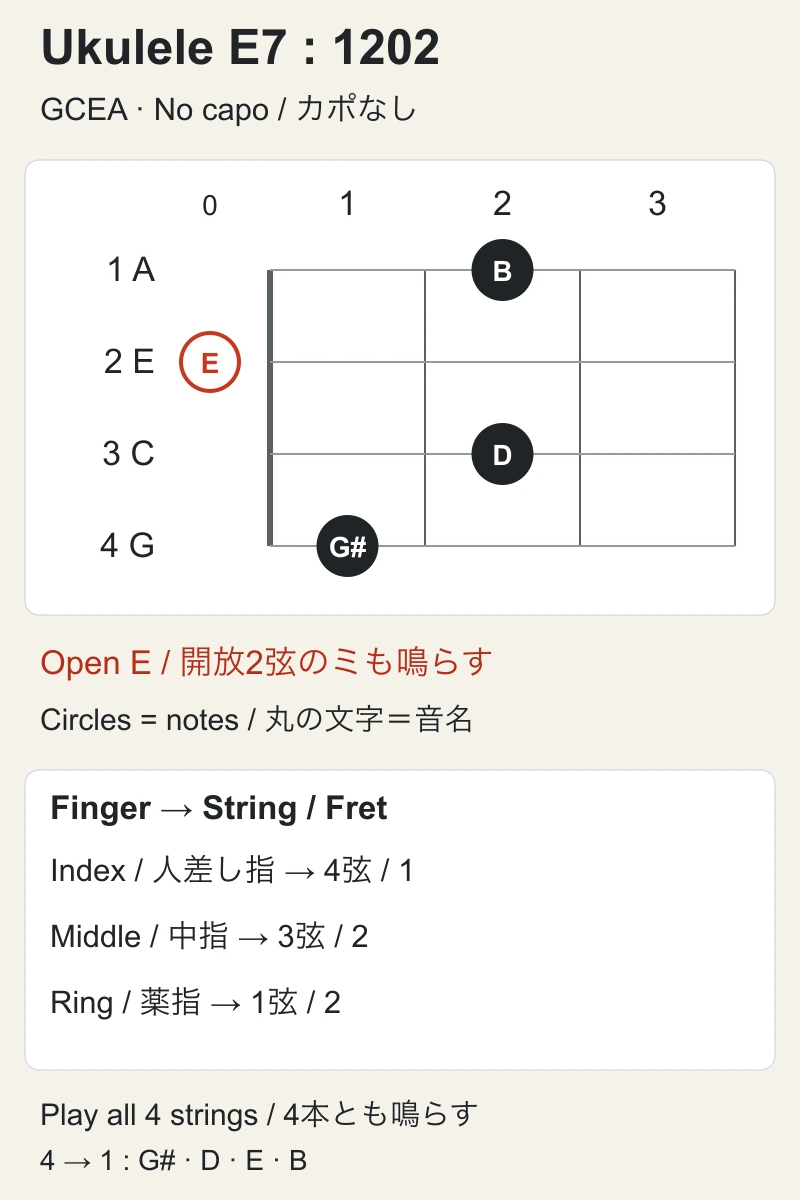
Does your E7 sound thin or give a dull thud? Before squeezing harder, check the string you are not fretting. In this shape for GCEA tuning with no capo, E7 is 1202 from string four to one. The open second string sits between two fretted strings; listen for accidental contact from a nearby finger.
الميزات والخيارات الرئيسية
- 1202 gives frets from string 4 to 1; the zero on string 2 must sound
- Index: string 4, fret 1. Middle: string 3, fret 2. Ring: string 1, fret 2
- Pick each string separately first. If the open E disappears, reposition the nearby fingers
1. Read 1202 as frets, not finger numbers
Assign the digits to G, C, E and A in that order. Use the index on string 4 at fret one, middle on string 3 at fret two and ring on string 1 at fret two. Leave string 2 unfretted but include it when playing all four strings. Our diagram puts string 1 at the top and string 4 at the bottom, opposite to the digit sequence. The circles contain note names. This shape needs no barre: do not flatten a finger across fret two. Find each position without a click first, so that you can check the string assignment without also having to keep time.
2. Test the open E whenever you add a finger
Pick the open second string before fretting anything. Add index, middle and ring one at a time, picking string 2 after each addition. If a newly placed finger silences it, that finger may be touching the string. Check the sides of the middle and ring fingers in particular. Release the grip and reposition so that the fingertip contacts its intended string. Do not force perfectly vertical fingers or a sharply bent wrist. On the three fretted strings, aim just behind the metal wire. Finally pick strings four through one. If the second string is already dull when nothing is fretted, the cause may not be this fingering; ask a teacher or instrument shop for help. Rest when tired and stop if there is pain.
3. The 7 does not mean fret seven
E7 contains E, G-sharp, B and D. In 1202, the order from string four is G-sharp, D, E, B. The root E is on the open second string, not necessarily the fourth string. The 7 is part of the chord-type symbol, not a fret or string count. The added note is D, a minor seventh above E, rather than D-sharp, the seventh note of the E major scale. E, Em7 and Emaj7 contain different notes and are not automatic substitutes. Use E7 where the song calls for it. For today, aim to hear all four strings, including the open E, rather than memorizing every chord label.
Pio: Do I really need to hear string 2 even though I don't press it?
Dock-sensei: In 1202, zero means play it open, not leave it silent. That E is one of the chord's notes. Before gripping harder, listen for a neighboring finger getting in its way.
An eight-minute session for today
- 2 minutes: check GCEA tuning and remove any capo. Sound the open second-string E. Read 1202 from string four and explain that zero means play the open string
- 2 minutes: place index on string 4, fret one; add middle on string 3, fret two, then ring on string 1, fret two. Pick string 2 after each addition. Reposition the last finger if the note stops ringing
- 2 minutes: check strings four through one individually, then gently strum all four once. Stop the sound with the strumming hand, relax the fretting hand and rest. Prioritize checking four notes over speed
- 2 minutes: manually set 60 BPM and 4/4. Strum E7 once on beat one, then lightly touch the strings with the strumming hand at the start of beat three to stop them. Rest for beats three and four and the entire next bar while resetting. Repeat this two-bar cycle; turn off the click if rushed
Review and references
Last content review:
Manufacturer, teacher and university materials informed fingering and harmony checks. Both languages were reviewed twice for digit order, open string 2, the minor seventh D versus the scale's D-sharp, and GCEA assumptions. The diagram, finger-by-finger check and 60 BPM eight-minute routine are editorial suggestions.
- How to Play the E7 Chord on Ukulele — Fender / Ben Nemeroff
- Spicing Up the 12 Bar Blues — Ukulele Go / Steve Phillips
- Introduction to Seventh Chords — University of Puget Sound
References support the editorial review. They do not provide an individual diagnosis or guarantee compatibility with every instrument or model.
الأسئلة الشائعة
Which end do I read 1202 from?
Start at string 4 G and finish at string 1 A in GCEA tuning: fret one, fret two, open, fret two. These are fret numbers, not finger numbers.
Can I skip the second string in E7?
Sound all four for this basic shape. Skipping string 2 removes the root E. Other playing contexts may use incomplete voicings, but today's exercise checks all four notes.
Are E7, Em7 and Emaj7 the same?
No. E7 contains E, G-sharp, B, D; Em7 has E, G, B, D; Emaj7 has E, G-sharp, B, D-sharp. Read the m or maj as well as the letter and number, and follow the song's chord symbol.
Does 1202 work in low G or on baritone?
It remains E7 in low-G GCEA, with the fourth-string G-sharp one octave below the high-G version. It does not have the same chord name in baritone DGBE tuning. This lesson assumes GCEA and no capo.
Do any note names repeat across the four strings?
Not in this E7 shape: G-sharp, D, E and B appear once each. Other ukulele shapes can repeat a note name; four strings do not always mean four different notes.
Will the metronome recognize my E7?
It does not automatically grade chords. Manually set 60 BPM and 4/4 for a beat reference, and check the notes yourself. The eight-minute plan and its pauses are editorial suggestions, not a mastery deadline or a rule for playing songs.