What Happens to Chord Names When You Use a Capo?
A chart may say Capo 2 and still ask for familiar C and G shapes. The shapes look unchanged, but the guitar sounds higher because the capo moves the starting point of every string up the neck. Separate the name of the shape under your fingers from the concert, or sounding, chord name. That one distinction makes most capo charts much easier to read.
Main features and choices
- Each capo fret raises the sounding pitch by one semitone
- A C shape with the capo at fret two sounds like a D chord
- Check whether a chart labels playable shapes or sounding chords
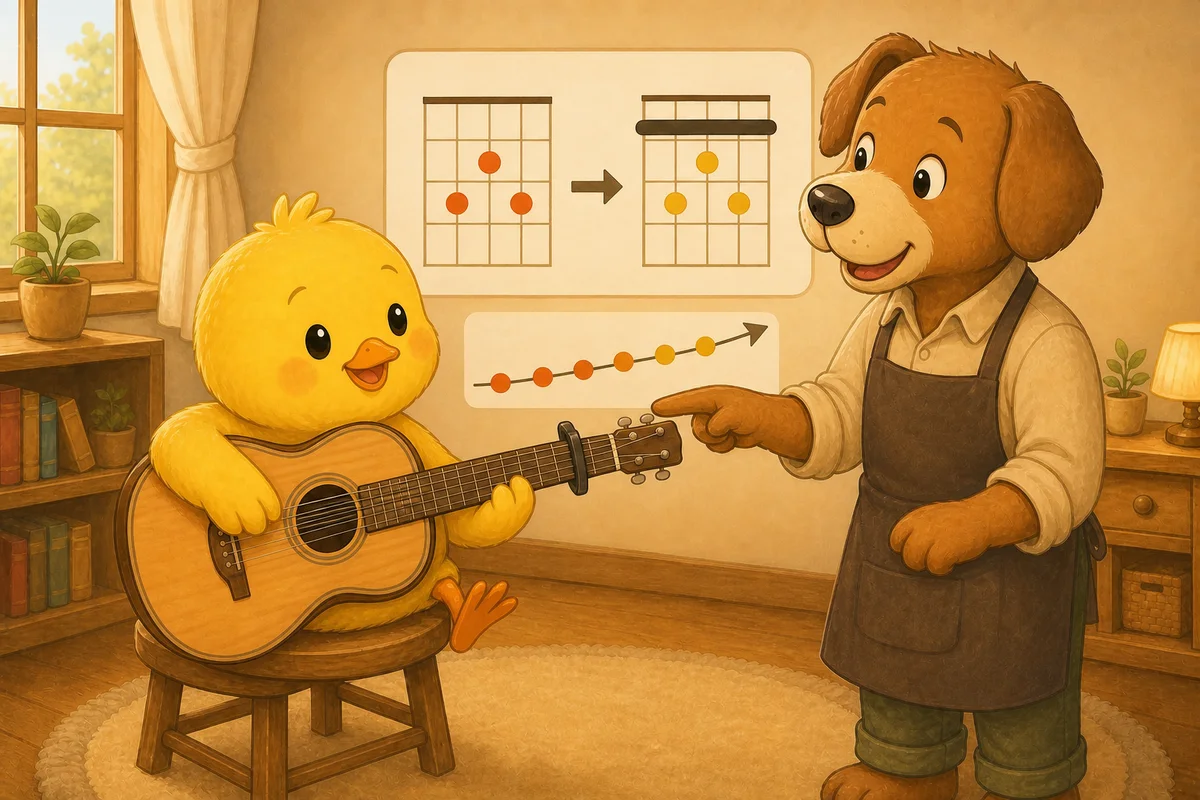
Count the capo fret as a number of semitones
Adjacent guitar frets are one semitone apart. Capo 1 raises every string by one semitone, Capo 2 by two semitones or one whole tone, and Capo 3 by three semitones. With the capo at fret two, treat it like a temporary new nut and make the usual open-chord shapes beyond it. Place the capo straight and close behind the fret wire rather than directly on top of it. Check all six strings, then check tuning again because excessive pressure or awkward placement can pull notes slightly sharp.
Separate the shape name from the sounding chord
Without a capo, a C shape produces C major. At Capo 2, the complete shape is raised by two semitones, so it produces D major. In the same position, a G shape sounds A, an Am shape sounds Bm, and an F shape sounds G. Major remains major and minor remains minor; move the root name upward by the number of capo frets. Start with only C, G, Am, and F, and write a small Capo 0 versus Capo 2 comparison before attempting every possible chord.
Find out which names the chord chart is using
Many beginner song charts print Capo 2 and then label the easy shapes, such as C and G, that the guitarist should finger. A band chart or a theory explanation may instead label the sounding chords, such as D and A. The convention is not identical in every source, so read the note at the top, compare the first chord with the recording, and avoid assuming from the capo number alone. When playing with another musician, say both pieces of information—for example, 'C shape at Capo 2, sounding D.'
Pio: If the chart says C with Capo 2, should I change my fingers to a D shape?
Dock-sensei: A beginner song chart often means play the C shape. The capo raises that shape by two semitones, so the result sounds like D. Some charts show sounding names instead, so always read the note at the top before you begin.
An eight-minute capo exercise for today
- 2 minutes: without a capo, play C, G, Am, and F once each
- 2 minutes: fit the capo just behind fret two, check all six strings, and retune if necessary
- 2 minutes: play the same shapes and say the sounding names D, A, Bm, and G
- 2 minutes: play four beats per shape and record the sound with and without the capo
Frequently asked questions
What chord does a G shape make at Capo 3?
Three semitones above G is A-sharp or B-flat. The two names describe the same pitch here; the key and notation determine which spelling is clearer.
Can I keep every chord shape unchanged after adding a capo?
Yes when you want to raise the entire progression by the same interval. If you move the capo but need to preserve the original sounding key, you must choose a different set of shapes.
Should I tune again after fitting the capo?
Check all six strings after fitting it. If notes move noticeably sharp, reduce unnecessary pressure or place the capo closer and more evenly behind the fret before retuning.
Can I use a capo when the original chart does not mention one?
Yes, to find a comfortable singing range or easier fingering. Simply adding it raises the entire song, so preserving the original pitch also requires transposing the shapes.