Dotted Quarter Notes on Guitar: Count One and a Half Beats
One and a half beats can feel harder to place than to calculate. In 4/4, a dotted quarter lasts three eighth-note slots. Pick on one, hold through ‘one and two’, and play the next note on the following ‘and’. Use open string 1, E, so chord changes do not distract you from the timing.
Main features and choices
- A dot adds half the original note value: a dotted quarter lasts one and a half beats in 4/4
- Count ‘one and two and’ evenly; pick on one and on the and of two
- A dotted quarter plus an eighth totals two beats, not a whole bar of 4/4
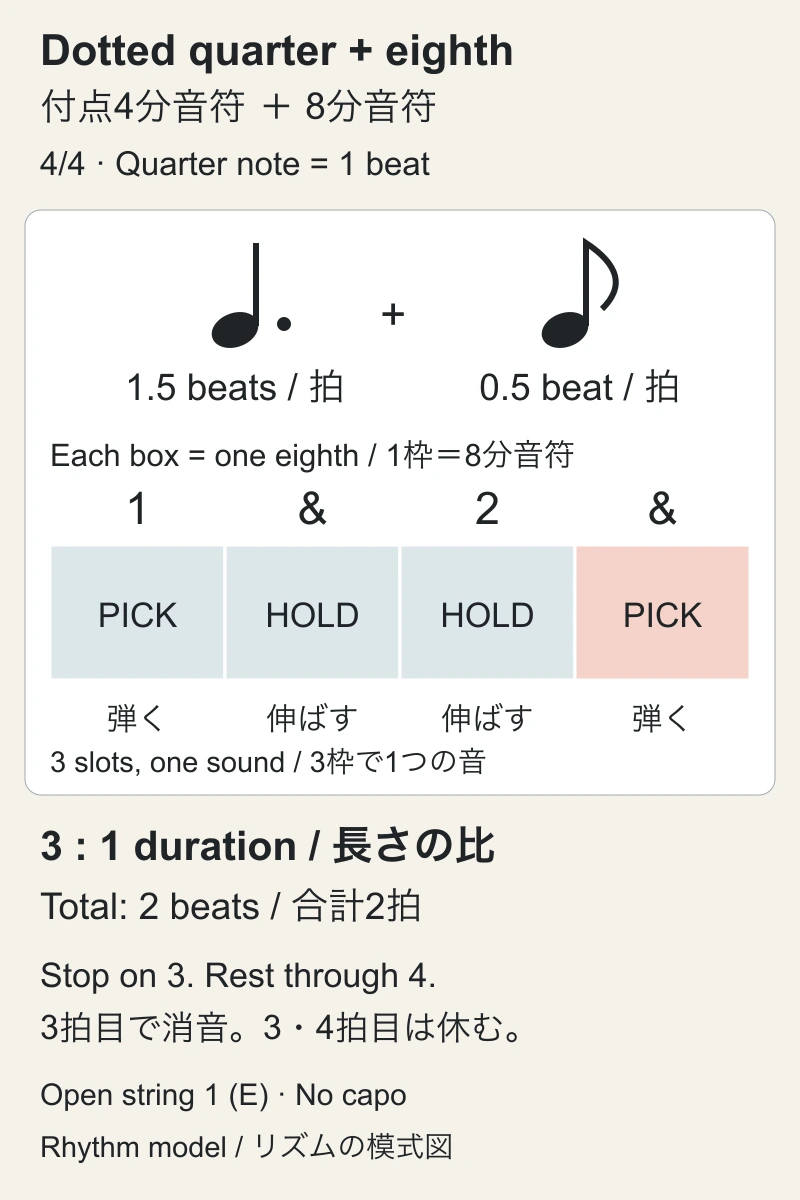
1. Divide the duration into three equal slots
An augmentation dot sits to the right of a note and adds half its original value. With a quarter-note beat in 4/4, one plus a half makes one and a half beats, or three eighth notes. The first three boxes in the diagram represent time, not three separate attacks. Put the guitar aside and say ‘one and two and’ at equal intervals. Lightly clap on one and the last and. At the number two, the first sound is still continuing.
2. Place the following eighth on the and of two
Our example pairs a dotted quarter with an eighth. In standard EADGBE tuning with no capo, pluck open string 1, E, on one and let it ring into beat two. Pick it again exactly halfway between the clicks for two and three: the and of two. At the start of three, gently touch the string with a picking-hand finger to stop it, then rest through beats three and four. The long and short durations are in a 3:1 ratio; this is not an instruction to make the first note louder. Use either a pick or a finger with small, relaxed movements. Stop if you feel pain.
3. Compare it with evenly spaced eighth notes
Alternate picking at all four positions of ‘one and two and’ with picking only on one and the last and. Keep the spoken spacing unchanged. If the second attack lands on the number two, you have shortened the first note to one beat. If you wait until three, it is too long. Do not increase the tempo to solve the problem: locate the and of two with your voice before returning to the string. Let the guitar fade naturally rather than adding attacks during the long sound. Stop after the two-beat example, but keep counting through the rests.
Pio: Does a dot mean I add one more beat?
Dock-sensei: Add half the original note value, not always a whole beat. Today that means half a beat. Hold through one and two, then pick on the following and.
An eight-minute session for today
- 2 minutes: manually set the metronome to 60 BPM and 4/4. Count one, two, three, four on the clicks, placing an and halfway between each pair: one and two and three and four and
- 2 minutes: without the guitar, clap lightly on one and the and of two. Keep counting without clapping on three and four. Check that the last and does not arrive early
- 2 minutes: pluck open string 1, E, on one and the and of two. Stop the sound at the start of three and rest through four. Try four bars; listen for a clear separation between the beat-two click and your second attack
- 2 minutes: alternate a bar with attacks on all four positions of one and two and, and a bar with attacks only on one and the last and. Stop on three in both. Return to clapping if needed and note which position you located successfully
Review and references
Last content review:
The dot definition was checked against university and manufacturer lessons. Both languages were reviewed twice; one and a half plus half a beat, the and of two, the diagram’s 3:1 duration and stopping point were verified. The 6/8 beat-unit distinction is explicit. The 60 BPM, eight-minute routine is an editorial suggestion.
- Dots and Ties — University of Puget Sound / Music Theory for the 21st-Century Classroom
- Reading Music: Notes and Rests (Japanese) — Yamaha Music Entertainment Holdings
References support the editorial review. They do not provide an individual diagnosis or guarantee compatibility with every instrument or model.
Frequently asked questions
How many beats does a dotted quarter last?
With a quarter-note beat in 4/4, one and a half. It always equals three eighth notes, but in 6/8 felt as two large beats, a dotted quarter is one large beat. Check the beat unit first.
Where do I play the eighth after a dotted quarter?
In this example starting on beat one, play it on the and of two, then stop on three. A different starting position changes where the next note falls.
Does a dotted quarter plus an eighth fill a bar?
Not in 4/4: it totals two beats, half a bar. Our exercise rests on the remaining beats three and four.
How is a dot different from a tie?
A dot extends one note; a tie joins durations at the same pitch. A quarter tied to an eighth lasts as long as a dotted quarter. Neither requires a new attack partway through that duration.
Are three eighth-note slots the same as a triplet?
No. Here, three ordinary eighths span one and a half beats. An eighth-note triplet dividing one quarter-note beat into three equal parts has a different slot length and total duration.
Does the linked tool play or grade this dotted rhythm?
We use the metronome only as a beat reference; it does not grade this rhythm. Set 60 BPM and 4/4 manually and count the ands yourself between clicks. The eight-minute session is an editorial practice suggestion, not a deadline for mastering it.