Tied Notes on Guitar: When to Pick and When to Hold
Two written notes do not always mean two pick attacks. A tie joins notes of the same pitch into one sustained duration. Keep counting at the second note, but do not pick again. Today, use open string 1, E, to compare two tied quarter notes with two separate quarter notes in 4/4.
Main features and choices
- Do not re-pick the second tied note; continue the existing sound
- In 4/4, a quarter note tied to a quarter note lasts two beats. Keep counting
- Holding is not resting. Decide where to stop the sound as well as where to start
1. Two written notes, one attack
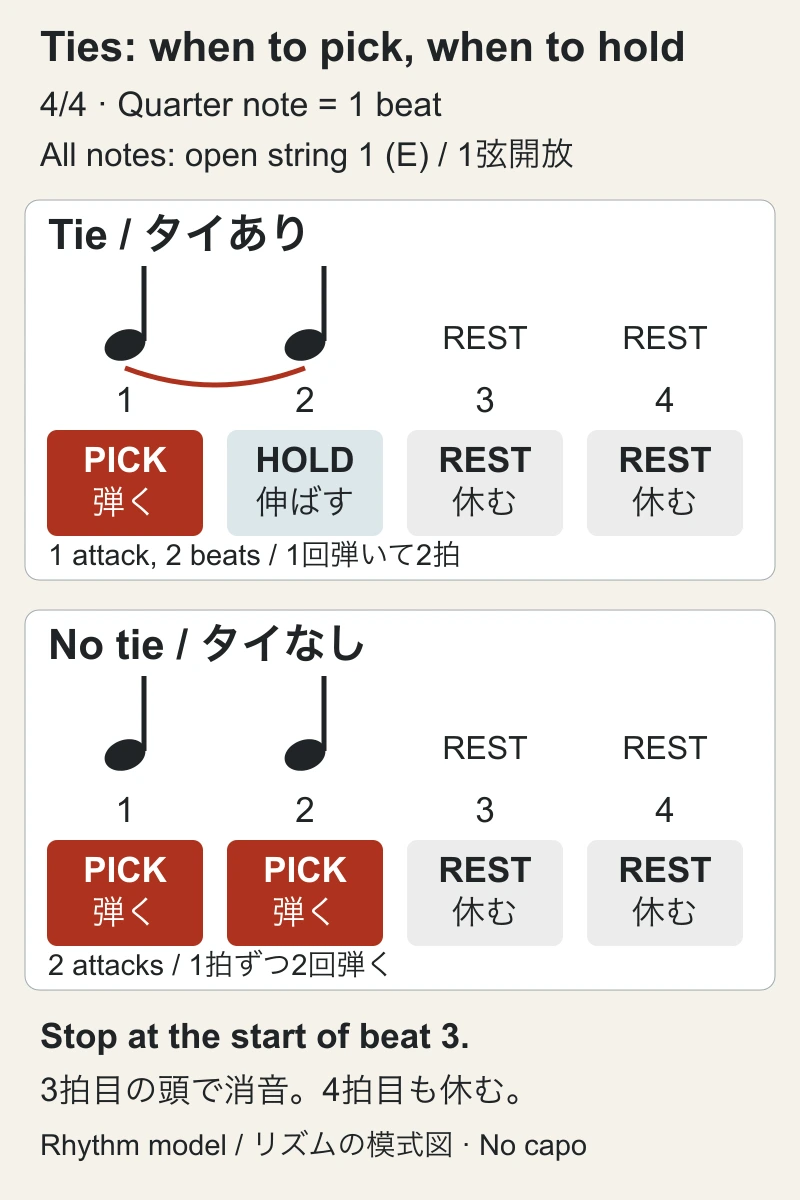
The top row of the diagram ties two quarter notes of the same pitch. In 4/4, each quarter lasts one beat, giving two beats in total. Pick on beat one, sustain through beat two and stop at the start of beat three. The lower row has no tie: pick on both one and two, then stop on three. Listen for one attack versus two, rather than trying to make either example louder. Before using the guitar, say one continuous ‘taa-ah’ over two beats, then two separate ‘ta, ta’ syllables over the same time. Both rows rest on beats three and four.
2. Separate holding from silence on an open string
Use open string 1, E, in standard EADGBE tuning with no capo, so fretting changes do not distract you. After one light pluck, avoid bringing the pick or finger back into contact with the string on beat two. At the start of beat three, gently touch the string with a picking-hand finger and stay silent through four. Touching it too early cuts a gap into the sustained sound. Natural fading is different from deliberately stopping a string: do not add another attack just to keep the volume constant. Stay relaxed and stop if anything hurts.
3. Keep holding across a barline
A quarter note on beat four tied to the same pitch on beat one of the next bar also lasts two beats. Count ‘four | one’ while it rings; for this exercise, stop on the following two. A new bar is not a reason to pick again. A similar-looking slur is a direction to connect notes smoothly, not another name for a tie. Guitar notation may also use hammer-on or pull-off markings. Read the pitches, any h or p symbols, and the score’s legend together instead of interpreting every curved line the same way.
Pio: If I do not pick on two, does that mean beat two is a rest?
Dock-sensei: Your picking action pauses, but the earlier sound continues. Keep saying two without stopping the string. In today’s example, the rest starts on three.
An eight-minute session for today
- 2 minutes: manually set the metronome to 60 BPM and 4/4. Count four clicks as one, two, three, four. Say a continuous ‘taa-ah’ over one and two, then stay silent on three and four
- 2 minutes: pluck open string 1, E, only on one. Let it ring through two, gently stop it on three, and rest on four. Try four bars and listen for any accidental second attack
- 2 minutes: without a tie, pick once on one and once on two; rest on three and four. Alternate a tied bar with an untied bar and compare the number of attacks
- 2 minutes: if comfortable, pick on four, hold through the next one and stop on two. Return to the first example if needed. Finish by writing: keep counting while holding
Review and references
Last content review:
The tie definition and distinction from slurs were checked against university and manufacturer lessons. Both languages were reviewed twice, including two-beat spans from one to three and from four to the next two, attack counts and stopping points. The open-string eight-minute routine is an editorial suggestion.
- Dots and Ties — University of Puget Sound / Music Theory for the 21st-Century Classroom
- Reading Music: Ties and Slurs (Japanese) — Yamaha Music Entertainment Holdings
References support the editorial review. They do not provide an individual diagnosis or guarantee compatibility with every instrument or model.
Frequently asked questions
Should I pick the second tied note again?
No. Continue the first sound for the second note’s duration while keeping your count steady.
How long are two tied quarter notes?
In 4/4 they last two beats. Starting on one means continuing until the start of three. Stopping at the start of two would leave only one beat. Always check the meter’s beat unit.
Does a tie always double a note’s length?
No. Add the written durations. In 4/4, a quarter tied to an eighth lasts one and a half beats. Two equal values double the first value, as in today’s example.
May I pick again if the sound fades?
Not during this tied-note exercise. Check that you are not touching the string too early, then let its natural decay happen. When practising a fretted example later, keep the required fret held for the intended duration.
Are ties and slurs the same?
No. A tie combines durations at one pitch; a slur indicates a smooth connection. In guitar scores, check the technique markings and legend rather than treating every curve as a tie.
Will CHORDOCK grade my tied notes?
No. The linked metronome provides a pulse; it does not grade ties or muting. Set 60 BPM and 4/4 manually, and listen for the number of attacks yourself. The eight-minute routine is an editorial suggestion, not a deadline for mastering the skill.