Half Steps and Whole Steps on Guitar: Count the Gaps
When a lesson says to move up a whole step, how many frets should you move? On the same string, a half step spans one fret and a whole step spans two. Count the moves from your starting position, not the fret labels themselves. Today, compare B–C with C–D using only string 2 in standard EADGBE tuning, with no capo.
Main features and choices
- On the same string, moving one fret changes pitch by a half step; moving two changes it by a whole step
- Fret 1 to fret 3 is two moves: 1 to 2, then 2 to 3. Do not count the starting point as a move
- Among adjacent natural note names, B–C and E–F are half steps. Adjacent letters are not always a whole step apart
1. Steps measure pitch distance, not note duration
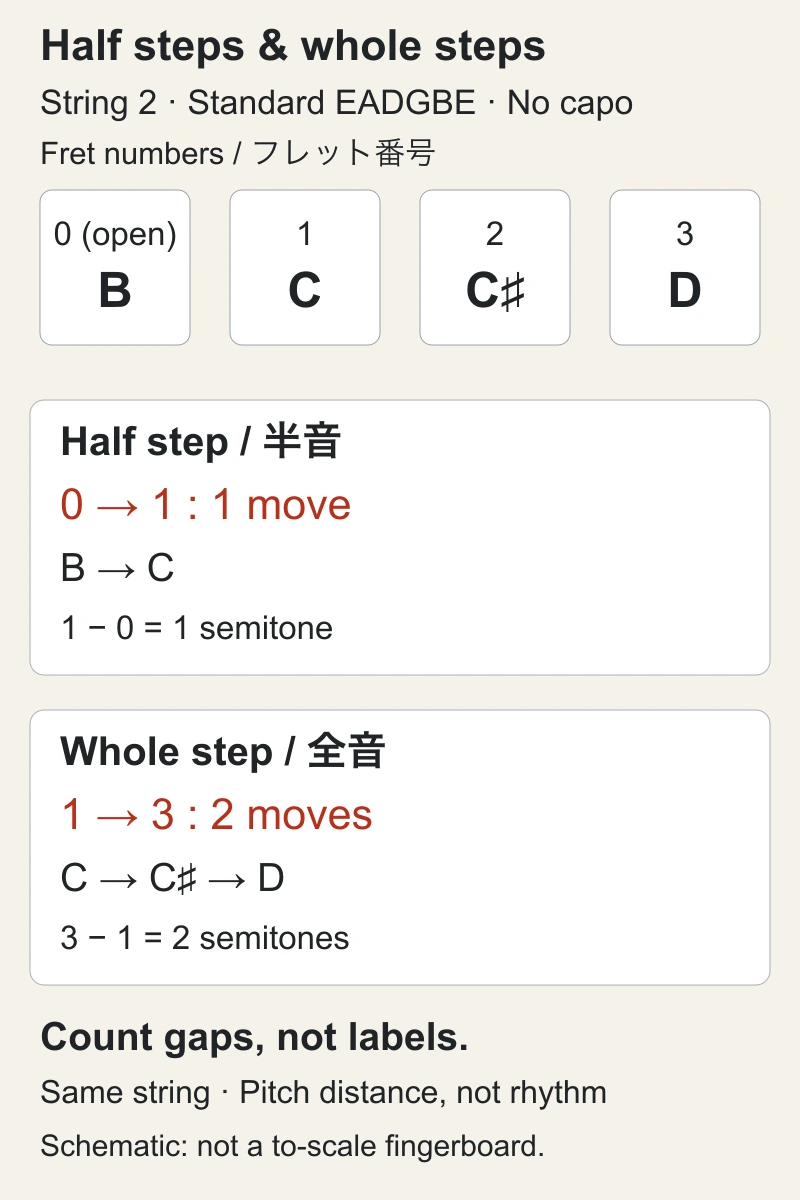
A half step is also called a semitone; a whole step is also called a tone. On an ordinary guitar, increasing a fret number by one on the same string raises pitch by a half step; increasing it by two raises pitch by a whole step. Decreasing the number lowers pitch. Two half steps make one whole step, but this does not mean holding a note twice as long. Our examples are open string 2 for B, fret 1 for C and fret 3 for D. B–C moves from 0 to 1; C–D moves from 1 to 3. You may reposition one finger for each note instead of holding a stretched shape. The diagram numbers are frets, not fingers or beats.
2. Count the gaps, not the number of labels
There are three labels in 1, 2, 3, but only two moves between them: 1 to 2, then 2 to 3. Fret 1 to fret 3 therefore spans two half steps, or one whole step. On the same string, subtract the starting fret from the ending fret and use the size of the difference. Three minus one is two; moving back from 3 to 1 is a whole step downward. First write 0, 1, 2, 3 on paper and trace the gaps. This shortcut does not work by fret numbers alone when changing strings, because the open-string pitches differ. Keep today’s examples on one string.
3. B–C and C–D are different distances
In standard tuning, string 2 at frets 0, 1, 2, 3 gives B, C, C-sharp, D. There is no extra fret between B and C, but C-sharp sits between C and D. In a sequence of natural note names, B–C and E–F are half steps and the other adjacent pairs are whole steps. This does not mean only those two pairs can be half steps: C–C-sharp is another example. Play B–C, stop, and then play C–D. Both rise, but the second pair travels farther in pitch. Use both the positions and the sound to check the difference. If hearing it is difficult, slow repetition is more useful than racing.
Pio: I counted 1, 2, 3. Why is fret 1 to fret 3 not three half steps?
Dock-sensei: You counted the starting label too. Count the gaps instead: 1 to 2, then 2 to 3. That makes two half steps, which is one whole step.
An eight-minute session for today
- 2 minutes: tune to standard EADGBE and remove the capo. Trace 0 to 1 and 1 to 2 to 3 on paper, counting one move and two moves
- 2 minutes: slowly play open string 2 (B), then fret 1 (C). Stop before returning and name the motion: half step up, half step down
- 2 minutes: play string 2 at fret 1 (C), then fret 3 (D). Also play fret 2 (C-sharp) once between them to split the whole step into two half steps
- 2 minutes: if comfortable, manually set the metronome to 60 BPM and 4/4. Alternate B, C, rest, rest with C, D, rest, rest, one event per click. Finish by writing: fret 1 to fret 3 is a whole step
Review and references
Last content review:
Half and whole steps were checked against manufacturer lessons. B, C, C-sharp and D on string 2 were calculated from its open pitch. Both languages were reviewed twice, including the same-string condition and pitch versus duration. The 60 BPM, eight-minute routine is an editorial suggestion.
- Musical Notes Made Easy — Fender / Nick Stoubis
- Six Strings, Each with a Higher Pitch — Yamaha
References support the editorial review. They do not provide an individual diagnosis or guarantee compatibility with every instrument or model.
Frequently asked questions
How many frets make a half step or a whole step?
On the same string, one fret of distance is a half step and two frets are a whole step. Compare the starting and ending positions, rather than using the ending fret number alone.
Is a whole step the same as a whole note?
No. A whole step measures pitch distance; a whole note represents duration. Play both pairs at the same timing in this exercise to keep pitch and rhythm separate.
Is there no note between B and C, or E and F?
In the usual twelve-note system these are adjacent half steps. An ordinary guitar has no extra fret between each pair on the same string. This does not rule out techniques that change pitch continuously.
Are strings 1 and 2 at the same fret the same note?
No. In standard EADGBE their open pitches differ. Counting fret differences alone works on the same string. When changing strings, account for each string’s pitch as well.
Must I keep fingers on frets 1 and 3 at once?
Not for this exercise. You may stop each note and reposition the finger before playing the next. Stay relaxed and stop if you feel pain. Eight minutes is an editorial practice suggestion, not a mastery deadline.
Does the linked metronome check my pitch?
No. It supplies clicks to help space your playing evenly. Select 60 BPM and 4/4 manually, and use the article and diagram to check B, C and D positions. It does not grade pitch automatically.