What Does C/G Mean? Slash Chords on Guitar
Does C/G on a chord sheet mean play C and then G? No: the letter after the slash names the bass note, not a second chord. Start by comparing two low notes, then hear how this changes a familiar C shape. This lesson uses standard EADGBE tuning, no capo and just two shapes; speed is not the goal.
Main features and choices
- C/G means C over a G bass: chord on the left, lowest note on the right
- The root is still C. Both shapes contain C, E and G, but C/G places G at the bottom
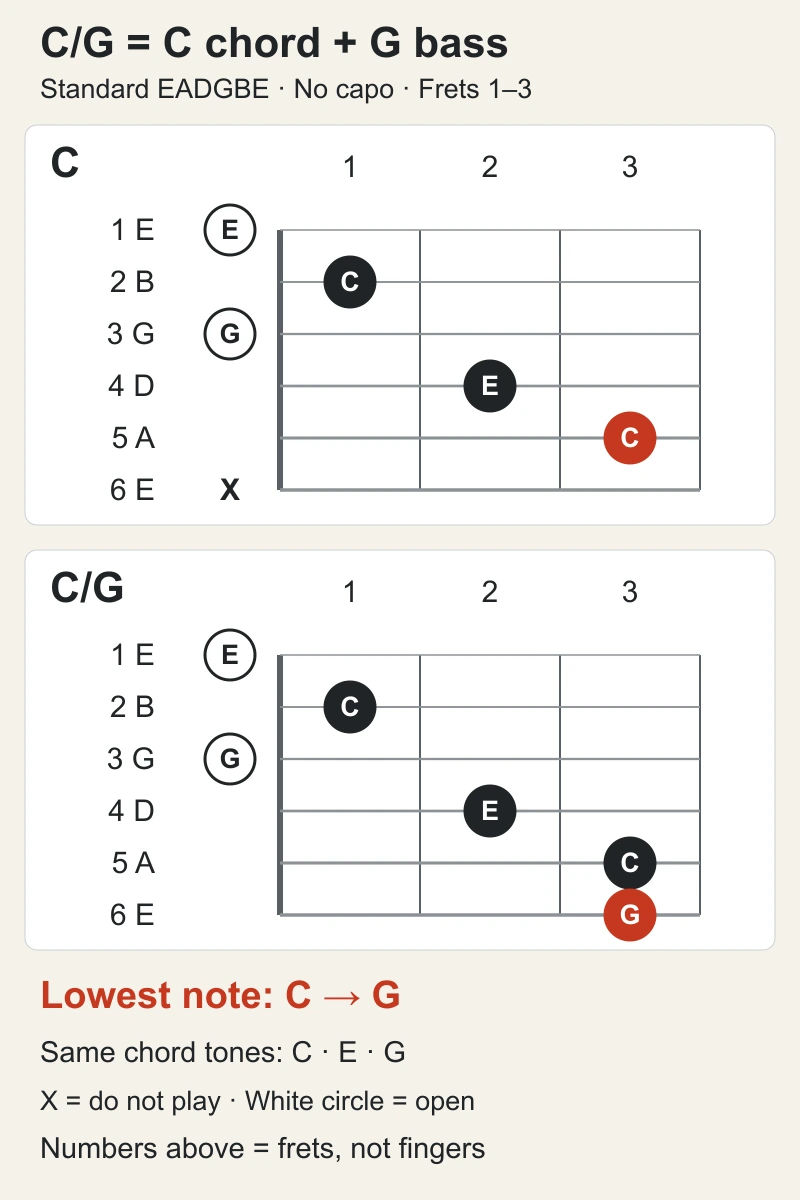
- Play C as x32010 from string 5, and C/G as 332010 from string 6. These are frets from string 6 to 1, not fingers
1. The slash does not mean a chord change
Read C/G as C over G: a C-major chord with G specified as its lowest note. It is neither division nor an instruction to alternate C and G chords. The root is C, the note that identifies the chord; the bass is G, the lowest note actually sounding. Root and bass need not be the same. C major contains C, E and G. As G is its fifth, putting G in the bass makes this a second inversion of C. Not every slash chord is an inversion, though: C/D specifies a bass note outside the C-major triad. Leave those other cases for later and focus on hearing C/G today.
2. Compare the shapes and the strings you play
For ordinary open C, use the index finger on string 2, fret 1, middle on string 4, fret 2, and ring on string 5, fret 3. Strings 3 and 1 are open; do not play string 6. For today’s C/G, keep the index and middle in those positions, put the ring on string 6, fret 3, and the little finger on string 5, fret 3. Playing all six strings gives G–C–E–G–C–E from low to high. This is one possible fingering, not a reason to force your hand. In the diagram, string 1 is at the top and string 6 at the bottom. Circles contain note names, numbers above are frets, white circles are open strings, and X means do not play. Red marks the lowest note of each shape.
3. Listen to low C and G before using four fingers
First play only string 5 at fret 3 for C, then only string 6 at fret 3 for G. Notice that this G is lower. When comfortable, check the C shape one string at a time starting on string 5, then C/G starting on string 6. If string 6 is muted in the second shape, you have lost the intended G bass. Simply adding an open sixth string to ordinary C gives E in the bass, not G. Nor does the open third-string G make an ordinary C shape into C/G: what matters is the lowest sounding note. If the four-finger shape is uncomfortable, keep the single-note comparison for today. Rest when tired and stop if you feel pain.
Pio: My usual C already has a G in it. Why is it not C/G?
Dock-sensei: A G somewhere in the chord is not enough. In x32010, the lowest note is the fifth-string C. Our 332010 shape adds the lower sixth-string G underneath it.
An eight-minute session for today
- 2 minutes: remove the capo and tune to standard EADGBE. Point to C/G and say: C names the chord; G names its lowest note
- 2 minutes: alternate string 5, fret 3 (C) and string 6, fret 3 (G). Stop the previous note before picking the next and compare their pitches
- 2 minutes: check C from string 5 one string at a time. If comfortable, check C/G from string 6 too; single notes are enough if the shape is a stretch
- 2 minutes: slowly alternate C, a rest, then C/G where comfortable. Finish by noting: both roots are C; the bass notes are C and G
Review and references
Last content review:
The C shape and slash notation were checked against manufacturer and university lessons, with both languages reviewed twice. The x32010/332010 pitches were calculated from standard EADGBE. Root, bass, string order and the tool’s lack of a dedicated C/G selector are explicit. The eight-minute routine is an editorial suggestion.
- How to Play the C Chord on Guitar — Fender / Dan Macy
- Inverted Triads — University of Puget Sound / Music Theory for the 21st-Century Classroom
- A Guitarist’s Guide to Playing Bass — Yamaha / Robbie Calvo
References support the editorial review. They do not provide an individual diagnosis or guarantee compatibility with every instrument or model.
Frequently asked questions
Does the root of C/G become G?
No. It remains a C-major chord rooted on C; G specifies the bass. Both shapes here use only C, E and G, but arrange and double them differently.
Is C/G the same as G/C?
No. C/G is a C chord with G in the bass; G/C is a G chord with C in the bass. Keep the two sides of the slash in order. The bass C in G/C is not part of the G-major triad.
Can I replace C/G with ordinary C?
That changes the specified bass, so it is not the same performance. It can be a temporary simplification while practising, but check the intended bass movement separately. In a band the bassist may supply G; the whole arrangement determines how the parts fit together.
What do x32010 and 332010 mean?
They list frets from string 6 to string 1. The x means do not play, and 0 means open. The diagram runs the other way vertically, with string 1 at the top, so do not copy the digits straight down it. These are not finger numbers.
Can the linked chord tool display C/G?
The link currently opens ordinary C major on Guitar to check its C, E and G chord tones. It is not a dedicated C/G selector and does not select an arbitrary bass note. Use this article’s diagram for today’s C/G shape.
Must I learn the four-finger shape in eight minutes?
No. The timing is an editorial practice suggestion, not a mastery promise. Understanding the symbol and hearing the two bass notes is a useful first step. Do not force the little finger to reach an uncomfortable shape.