E vs Em on Guitar: One Finger, One Changing Note
E and Em look similar on a chord chart, but the small m matters. In these open shapes, the difference is whether string 3 is fretted at fret 1 or left open. Listen to that one note before memorising two whole shapes. This session connects the symbol, the string position and the sound; it is not a speed test.
Main features and choices
- E contains E, G♯ and B; Em contains E, G and B. The third changes by one semitone
- In these standard-EADGBE shapes without a capo, only string 3 changes: fret 1 to open
- Loosening the index finger may mute string 3. Lift it clear so the open G can ring
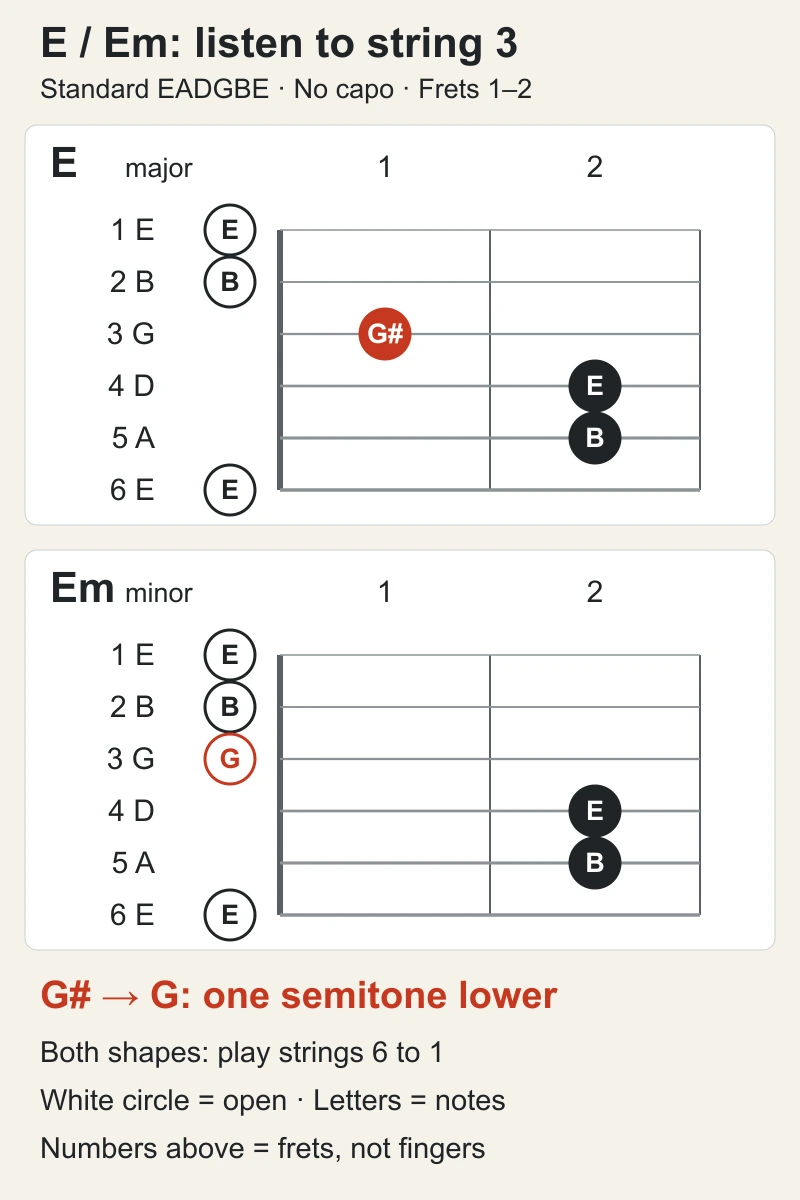
1. The small m changes the third
E alone means E major; Em means E minor. Lower G♯ by a semitone in E–G♯–B and the result is E–G–B. Arranging those tones upwards from E within one octave, E to G♯ is a major third, four semitones; E to G is a minor third, three semitones. A third is an interval, not a finger number or an instruction to use fret 3. In standard tuning, string 3 is G when open and G♯ at fret 1, giving you a direct comparison. The m identifies the chord type; it does not tell you to mute anything. E remains the root of both chords.
2. Keep two fingers in place and move the index
Use standard EADGBE tuning with no capo. Put the middle finger on string 5, fret 2, the ring finger on string 4, fret 2, and the index on string 3, fret 1 for open E. Strings 6, 2 and 1 stay open. For Em, keep the middle and ring fingers where they are and lift the index clear of string 3. This is the fingering used for today’s comparison, not the only possible Em fingering. Both shapes allow all six strings to sound. In the diagram, string 1 is at the top and string 6 at the bottom. Letters inside circles are note names, numbers above are frets, and the white circles to the left show open strings.
3. Expand from one string to the full chord
First, leave the full shapes aside and alternate string 3 at fret 1 and open, picking each note again. Then build each chord and check its strings separately from 6 to 1. If Em’s G is silent, look for contact from the lifted index or the side of the ring finger on string 4. Make a small adjustment to the offending finger before squeezing harder. Once the strings ring, strum E and Em once each at a similar, gentle volume. You do not have to choose the correct mood word: noticing the changing third-string note is enough. Rest when tired and stop if you feel pain.
Pio: I relaxed my index finger, but Em went quiet. Why?
Dock-sensei: If the finger still touches string 3, it can stop the open G. Lift it slightly clear and pick that string again. You are not trying to snap the finger off as a pull-off.
An eight-minute session for today
- 2 minutes: remove the capo and tune to standard EADGBE. Point to string 3 in each diagram and say: fret 1 for E, open for Em
- 2 minutes: play only string 3, alternating G♯ and G for four slow round trips. Pick again after each change; take your time
- 2 minutes: build E and Em using today’s middle-and-ring-finger approach. Pick all six strings separately in each shape, adjust any muted string, then rest
- 2 minutes: strum E once, pause, then Em once. Make four unhurried round trips and finish by noting the changing note names and string number
Review and references
Last content review:
The E/Em shapes were calculated from standard EADGBE pitches and checked against manufacturer lessons. Both languages were reviewed twice, including the different Em fingering in the current tool. The eight-minute routine is an editorial suggestion.
- How to Play the E Chord on Guitar — Fender / Lana Cooper
- How to Play an E Minor Chord on Guitar — Fender / Kristin Bigness
- Basic Piano Chords for Beginners, Part 1 — Yamaha / Jerry Kovarsky
References support the editorial review. They do not provide an individual diagnosis or guarantee compatibility with every instrument or model.
Frequently asked questions
Why are there three chord tones but six sounding strings?
Some note names repeat at different pitches. From string 6 to 1, E gives E–B–E–G♯–B–E, while Em gives E–B–E–G–B–E. Each has three distinct note names spread across six strings.
Can I lift every finger and call it Em?
Not while strumming all six strings: the open A and D add notes outside this Em triad. Keep strings 5 and 4 at fret 2 for this shape. Open strings 1–3 alone form a smaller Em, but that separate shape leaves strings 4–6 unplayed.
Does lifting one finger turn every major chord into minor?
No. This works for the specific open E shape shown. Other shapes place or double the third differently, so check their notes. It does not mean moving the whole chord down one fret.
Must Em sound sad?
The musical context, rhythm and tone also affect the impression. Instead of judging a mood, start by hearing the difference between this G♯ and G.
Why does the chord tool show different Em fingers?
Its current basic Em shape uses the index on string 5 and middle on string 4. This lesson uses middle and ring to simplify the comparison with E. The frets are the same: 022000. The link opens E; select Minor in the chord-type control to view Em.
Will I master it in eight minutes?
The timing is an editorial suggestion, not a promise. Comparing just the two third-string notes is useful progress. In 022100 for E and 022000 for Em, the digits run from string 6 to 1 and show frets, not fingers. Zero means an open string.