Dsus2 vs Dsus4: Hear the Difference from a D Chord
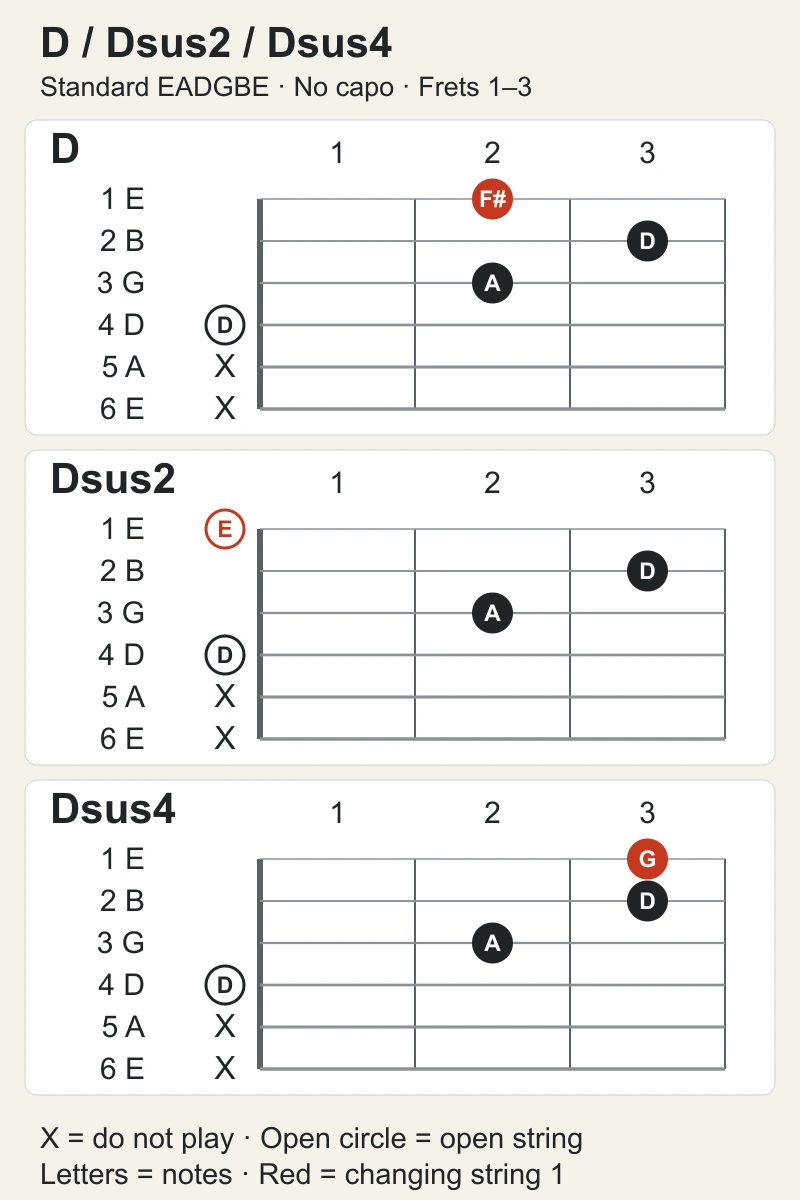
Can you play D but start memorising from scratch when you see Dsus2 or Dsus4? With the shapes in this lesson, strings 3 and 2 stay in the same places while string 1 changes between open, fret 2 and fret 3. Connect that small movement to the note you hear changing.
Main features and choices
- Replace D major’s F♯ with E for Dsus2, or G for Dsus4
- Play only strings 4 through 1 in these shapes; avoid strings 5 and 6
- The 2 and 4 are scale degrees, not finger or fret numbers
1. Keep D and A, and replace F♯
D major contains D, F♯ and A. Dsus2 contains D, E and A; Dsus4 contains D, G and A. Neither suspended triad includes F♯, the third of D major. Counting up the D major scale from D places E second and G fourth. These numbers do not tell you which finger to use or how many strings to play. Before forming the chords, play open E, F♯ at fret 2 and G at fret 3 on string 1 separately. Hearing that line first makes the changing note easier to follow inside the chords.
2. Keep string 3 at fret 2 and string 2 at fret 3
Use standard EADGBE tuning with no capo. The diagram puts string 1 at the top and string 6 at the bottom. Numbers 1, 2 and 3 label frets; letters inside the circles name notes. Start D with the index finger on string 3 fret 2, ring finger on string 2 fret 3, and middle finger on string 1 fret 2. For Dsus2, lift the middle finger and sound the open first string. For Dsus4, fret string 1 at fret 3 with the little finger; you may lift the middle finger. Sound open string 4 in all three shapes and avoid strings 5 and 6. If Dsus2’s first string is muted, check whether the ring finger fretting string 2 touches it. You need not force the hand to stay fixed; stop if there is pain.
3. Listen for the changed note before increasing speed
Pick strings 4, 3, 2 and 1 individually to check them, then brush those four strings together lightly. Compare D–Dsus2–D, followed by D–Dsus4–D, pausing between attempts. Keep the stroke small enough to avoid the lower strings and the volume gentle enough to hear string 1. Returning to D is a listening exercise, not a rule that every suspended chord must immediately resolve to D. The surrounding harmony and melody also affect the sound. Use the chord finder below to check the notes. A chord can have several voicings, so the tool may show a different valid shape from the one taught here.
Pio: Does sus4 mean I have to use four fingers?
Dock-sensei: No. Four is a scale degree counted from the root, not a finger count. Here we replace D major’s F♯ with G. Start by comparing frets 2 and 3 on the first string.
An eight-minute session for today
- 2 minutes: after tuning, play open E, fret-2 F♯ and fret-3 G on string 1 slowly. Say each fret number and note name
- 2 minutes: form D, Dsus2 and Dsus4 separately and pick strings 4–3–2–1. Adjust only notes that do not ring, and avoid strings 5 and 6
- 2 minutes: without a click, repeat D–Dsus2–D four times. Stop and rest after each attempt, checking that open string 1 rings
- 2 minutes: repeat D–Dsus4–D four times. If comfortable, make a short recording and listen for the changed first-string note. Record one position that still needs work
Review and references
Last content review:
The sus and add definitions were checked against manufacturer lessons. The three diagrams were verified against standard EADGBE pitches, with four sounding strings and the changing first-string note checked in both languages. The eight-minute sequence is an editorial suggestion.
- The Sus-Piciously Easy Way to Liven Up Basic Chords — Fender / Nick Stoubis
- Constructing Basic Guitar Chords, Part 2 — Yamaha / Robbie Calvo
References support the editorial review. They do not provide an individual diagnosis or guarantee compatibility with every instrument or model.
Frequently asked questions
Are Dsus2 and Dadd9 the same?
No. Dsus2 contains D, E and A, without F♯. Dadd9 adds E to D, F♯ and A, retaining the third. Distinguish replacing a note with sus from adding a note with add.
Is Dsus4 a D minor chord?
No. D minor contains D, F and A; Dsus4 contains D, G and A. Lowering F♯ to F and replacing it with G are different changes.
How do I read xx0232, xx0230 and xx0233?
Read from string 6 to string 1: D is xx0232, Dsus2 is xx0230 and Dsus4 is xx0233. An x means do not play that string, 0 means open, and numbers give frets. Do not confuse this text order with the diagram, which has string 1 at the top.
Must the middle finger stay down behind the little finger?
No. For this Dsus4 shape, string 1 needs to sound fret 3; the middle finger may leave fret 2. Pausing to reset the shape before playing is fine.
Will the chord finder show exactly this shape?
A chord can have several voicings. Check Guitar, D and sus4 in the linked tool and compare its chord tones. Use this lesson’s text and diagram for the specific fingering exercise.
Is this routine copied from the sources?
No. The manufacturer lessons support the sus and add definitions. CHORDOCK’s editors designed the eight-minute sequence for comparing these three D shapes by ear, without a speed target.