Eighth-Note Triplets on Guitar: Count Three in One Beat
Does the small 3 over a group of notes make you count three whole beats? An eighth-note triplet fits three equal notes into one quarter-note beat in 4/4. Straight eighth notes fit two into the same beat. Keep the click unchanged and use open string 1, E, to hear the difference between two and three.
Main features and choices
- In 4/4, one quarter-note beat holds two straight eighths or three eighth-note triplet notes
- Say ‘one-trip-let’ evenly, placing the number one on the click
- The third note comes before the next click: divide the whole gap from one to two into three equal parts
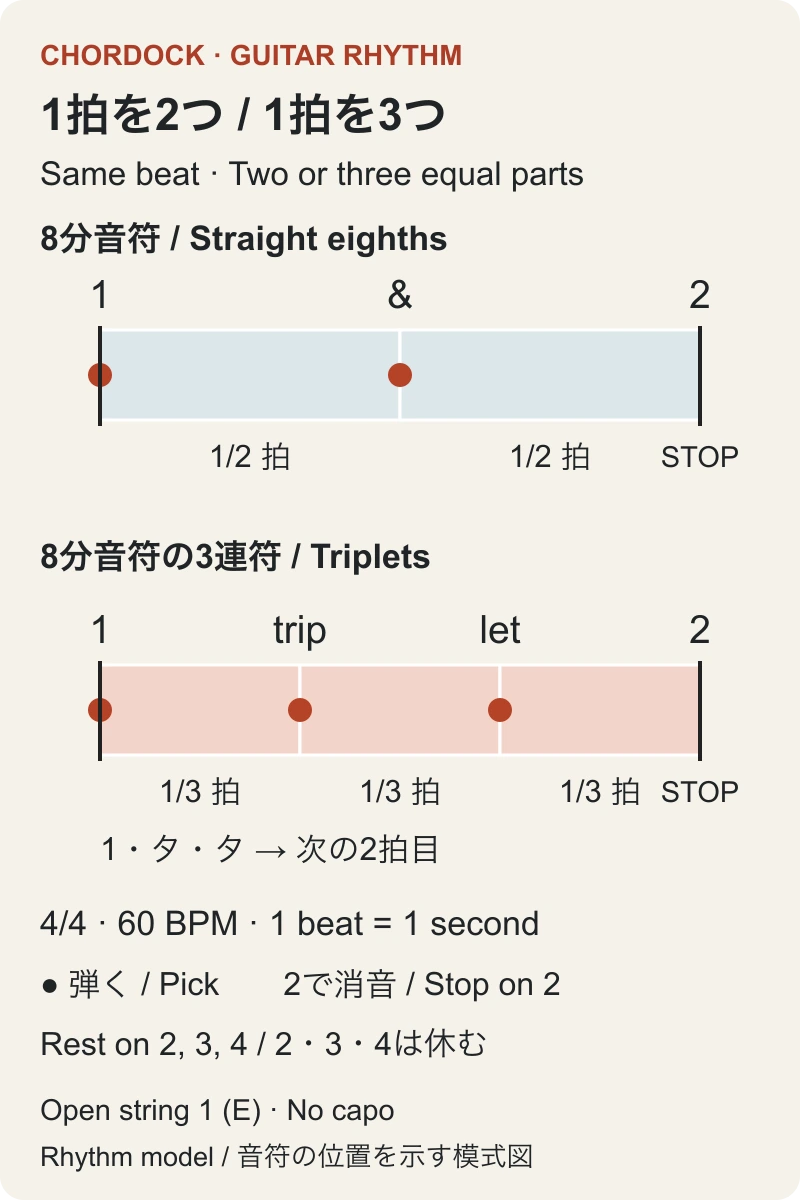
1. Divide the same beat into two, then three
Use 4/4 with a quarter-note beat. Two straight eighth notes fill one beat as ‘one-and’; three eighth-note triplet notes fill that same beat as ‘one-trip-let’. Each straight eighth lasts half a beat; each triplet note lasts a third. The small 3 identifies the three-way division of this group, not a fret or finger number. The diagram uses two strips of identical width. At 60 BPM with quarter-note clicks, either strip spans one second. Adding another note inside it does not lengthen the beat or require a higher BPM setting.
2. Say ‘one-trip-let, two’ before picking
Count one, two, three, four with the clicks. Then fill the gap from one to two with ‘one-trip-let’. Keep every gap equal, including the gap from ‘let’ to the next number two. If ‘let’ lands on the beat-two click, the group has run beyond the first beat. If only ‘trip-let’ is rushed, you have made a long note followed by two short ones instead. You can eventually continue ‘one-trip-let, two-trip-let’, but today use triplets on beat one only and say just the numbers two, three and four. Stay with your voice until the spacing feels manageable.
3. Separate the three attacks from the stopping point
Use open string 1, E, in standard EADGBE tuning with no capo. Pick it gently three times on ‘one-trip-let’. At the start of beat two, touch the string with a picking-hand finger to stop it. Rest through beats two, three and four, then repeat on the next one. For this short, slow exercise, use three small downstrokes or three finger plucks if comfortable. The aim is to avoid learning a new picking-direction pattern at the same time as a new rhythm. Keep the movement light and stop if it hurts. Next, alternate this with a bar using two straight eighths on beat one. Listen for the same beat-two stopping point in both.
Pio: Should I set the metronome to three beats for triplets?
Dock-sensei: Keep 4/4 today. We are dividing each beat into three parts, not changing the number of beats in a bar to three.
An eight-minute session for today
- 2 minutes: manually set the metronome to 60 BPM and 4/4. Count one, two, three, four on the clicks without playing the guitar
- 2 minutes: say one-trip-let evenly on beat one, then place two on the next click. Say only the numbers on two, three and four. Try four bars at a time
- 2 minutes: pick open string 1, E, three times within beat one and stop it at the start of two. Rest and keep counting through two, three and four. Check that the third attack does not land late on the next click
- 2 minutes: alternate a bar with two notes on one-and and a bar with three on one-trip-let. Stop on two in both and leave BPM unchanged. Return to speaking without playing if needed
Review and references
Last content review:
Triplet definitions were checked against university and manufacturer lessons. Both languages were reviewed twice, including half-beat and third-beat durations in 4/4, attack positions and stopping on two. Meter, note value and tool settings are distinguished. The 60 BPM, eight-minute routine is an editorial suggestion.
- Music Theory for the 21st-Century Classroom: Tuplets — University of Puget Sound
- Music Theory for Producers, Part 1 — Yamaha / Mike Levine
- Steps to Music Theory: Advanced Rhythm and Meter — Texas A&M University Libraries
References support the editorial review. They do not provide an individual diagnosis or guarantee compatibility with every instrument or model.
Frequently asked questions
Does every triplet last one beat?
No. Here, a group of three eighth-note triplet notes fills one quarter-note beat in 4/4. A quarter-note triplet group fills two beats under the same conditions. Check the written note value and the duration of the whole group.
Does the third note land on the next click?
No. Starting on beat one, the attacks are at one, one plus a third, and one plus two thirds. The next click is beat two, another third of a beat after the third attack. That is where this exercise stops the sound.
Should I raise BPM when switching from straight eighths?
No. Keep quarter-note clicks at 60 BPM and switch between two and three attacks per beat. There are more notes, but the beat rate stays the same.
Is this the same as 6/8 or 3/4?
No. In 3/4 there are three quarter-note beats per bar. In 6/8 felt as two large beats, each dotted-quarter beat already divides into three ordinary eighths. Today we are making a special three-way division of a quarter-note beat in 4/4.
Should I play a long-short, swung rhythm?
Not in this exercise: play all three parts evenly. A two-note long-short shuffle or swing pattern is not the same set of attacks. First make all three gaps, including the gap to the next beat, equal.
Does CHORDOCK automatically play or grade these triplets?
This lesson uses the metronome only as a quarter-note reference; it does not grade triplets. Manually set 60 BPM and 4/4 and count between the clicks yourself. The 3/4 button changes the meter, not the subdivision. The eight-minute routine is an editorial suggestion, not a deadline for mastering it.