The First Four Ukulele Chords for Beginners
Ukulele chords can begin with just one finger. Add C and Am first, then F and G7, so you can build accompaniment without memorising too many shapes at once.
मुख्य सुविधाएँ और विकल्प
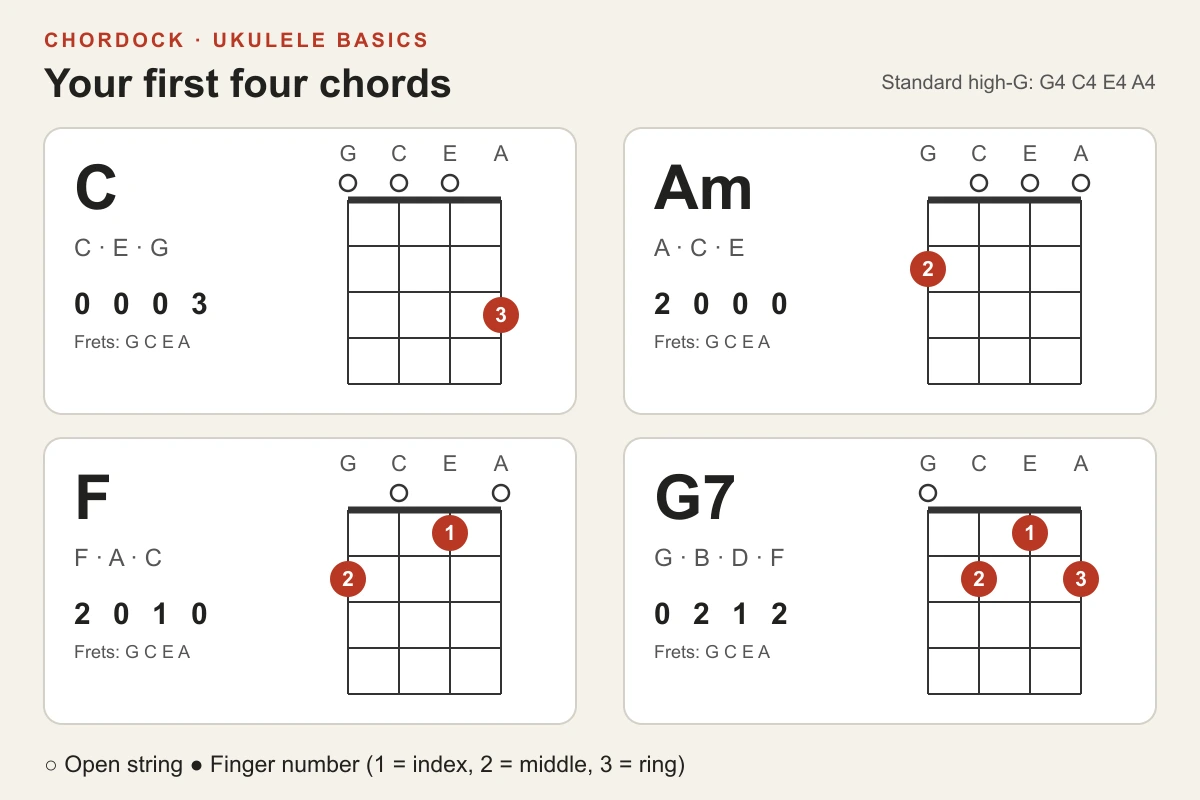
- From string four to one: C is 0003 and Am is 2000
- F is 2010 and G7 is 0212
- Connect C-Am-F-G7 for four beats each
Test C and Am with one finger
Fret string one at fret three for C and string four at fret two for Am, immediately behind the fret wire. Play strings four through one separately. If an open string is muted, check whether the fretting finger touches it and raise the fingertip before squeezing harder. Begin changes after all four strings respond consistently in three C shapes and three Am shapes.
Keep the shared Am finger for F
Leave the middle finger on string four at fret two and add the index to string two at fret one. In F, check the open third and first strings as well as the two fretted notes. Make three Am–F changes without a beat. When the shared finger stays in place and all four strings ring, try four beats per chord at 50–60 BPM.
Build G7 as a small triangle
For G7, fret string three at fret two, string two at fret one, and string one at fret two while leaving string four open. Place the index on string two first, then add the two notes at fret two. If string one or three is muted, check for a flat index finger or fingers placed too far behind the frets. Move to a short song section after three C–Am–F–G7 loops work for four beats each.
Pio: Why does G7 suddenly feel much harder?
Dock-sensei: You do not need to land all three fingers together yet. Place the index first, then build the small triangle around it.
Complete one four-chord cycle
- Check strings four through one in C and Am and repeat each shape three times
- Keep the shared Am finger into F; make three untimed changes, then try 50–60 BPM
- Play three C–Am–F–G7 loops for four beats each and note any muted string
Review and references
Last content review:
Standard high-G string order was checked against the manufacturer's lesson. The C, Am, F, and G7 diagram was calculated from GCEA pitches and the written fret positions, and the string-identification advice no longer relies on thickness.
- How to Tune a Ukulele — Fender
References support the editorial review. They do not provide an individual diagnosis or guarantee compatibility with every instrument or model.
अक्सर पूछे जाने वाले प्रश्न
Can I learn G instead of G7?
Yes. G is 0232 from string four to one. G7 is used here because it can make some first progressions easier.
How do I remember string order?
On a normally strung right-handed ukulele in playing position, the string nearest your face is string four, G; the floor-side string is one, A. Standard tuning is G-C-E-A. In high-G tuning, string three C is lower than string four G, so do not use thickness or pitch alone to identify the string number.
What should I check when only one string is muted?
Play that string alone and look for contact from a neighbouring finger or a fingertip too far from the fret wire. Adjust only that area instead of squeezing the entire chord harder.
When can I start using the four chords in a song?
After three C–Am–F–G7 loops keep four beats per chord with no major mute, try a short song section containing those shapes. Return to a two-chord pair wherever the song stops.