Where Are Octaves on Bass? Two Simple Shapes in Standard EADG
Want to follow a low G with a higher G but unsure where to go? On a standard EADG four-string bass, move two strings towards the thinner side and add two to the fret number. Start with two pairs, G and C, and connect their positions to what you hear.
Fitur dan pilihan utama
- Move from string 4 to 2, or 3 to 1, and add two to the fret number
- Octaves share a note name but differ in pitch; another position at the same pitch is different
- Locate each note without a beat first, stopping the previous string before sounding the next
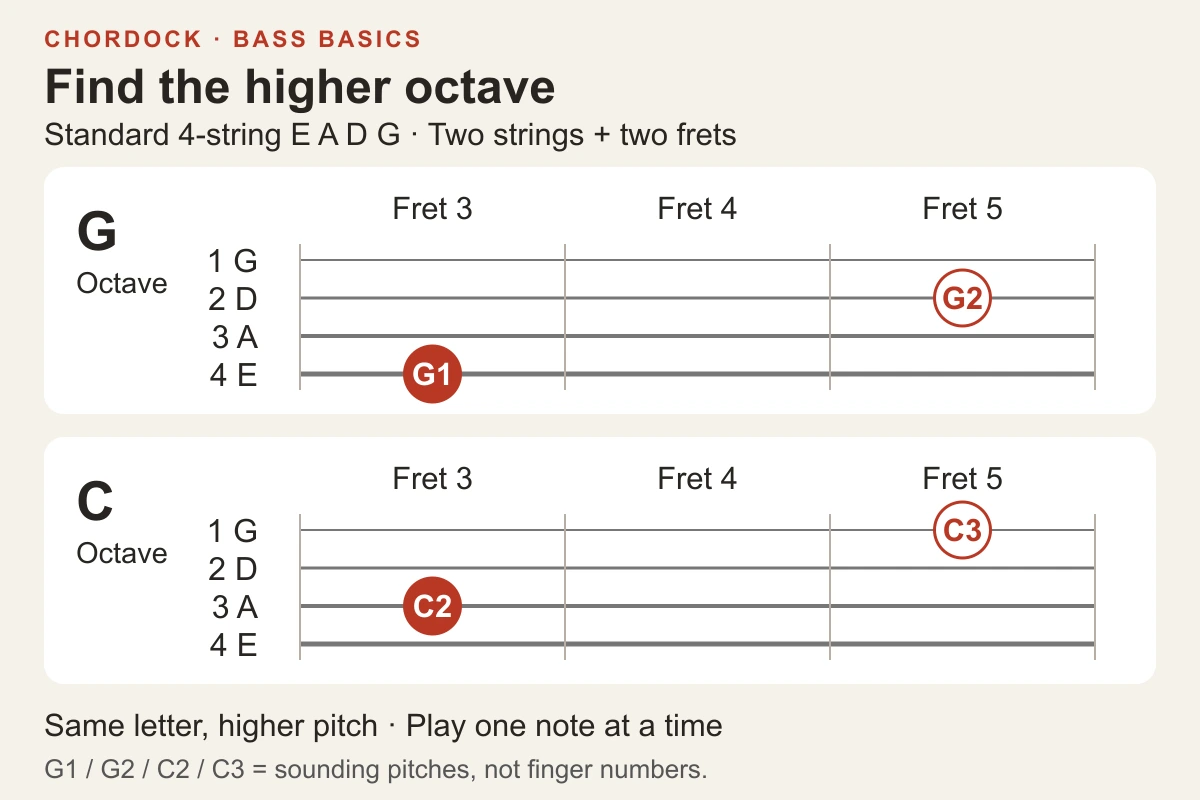
1. Skip one string and add two frets
From thickest to thinnest, the strings are 4 E, 3 A, 2 D, and 1 G. G at string 4, fret 3 has its higher octave at string 2, fret 5. Likewise, C at string 3, fret 3 pairs with C at string 1, fret 5. Increasing fret numbers takes you towards the body. The diagram places string 1 at the top and string 4 at the bottom; circles show fretting positions. Starting on strings 4 or 3 keeps this shape within four strings. These instructions assume standard EADG; check the intervals again if you use Drop D or another tuning.
2. Separate the same name from the same pitch
G1 to G2 and C2 to C3 label sounding pitches, not finger, string, or fret numbers. Each pair shares a note name and spans twelve semitones. By contrast, string 2 at fret 5 and the open first string are both G2: a unison, not an octave. A change of string can change tone without changing pitch. Compare the low-to-high G pair with the fretted-to-open G pair separately, listening instead of relying only on a visual shape.
3. Move between notes instead of holding a stretch
You do not need to hold both positions at once in this exercise. Fret one note, play it, touch the string lightly to stop it, and then move to the other note. Once the route is familiar, try a comfortable fretting-hand combination such as index and little finger or index and ring finger. Let the whole hand move when needed instead of forcing the fingers to stay planted. Stop if there is pain. Add a click only when you can choose the positions without hesitation, and listen for unwanted strings continuing to ring.
Pio: If both notes are G, am I just playing the same thing twice?
Dock-sensei: The name stays G, but the higher octave has a different pitch. Play the two positions separately. Today's goal is to hear which is higher, not to move the shape quickly.
An eight-minute session for today
- 2 minutes: tune to EADG, then point to the four marked G and C positions without playing. Say each string and fret number
- 2 minutes: without a click, make four low–high round trips on G, stopping each note; then do four on C. Use the remaining time to rest and recheck positions
- 2 minutes: set the metronome manually to 60 BPM. Alternate low and high G for eight notes total, one note per click. Stop and rest, then try C if comfortable. Return to an unmetered exercise if the change is rushed
- 2 minutes: compare low–high G with string 2 fret 5 followed by open string 1. Identify the octave versus the unison and record one position that still needs checking
Review and references
Last content review:
The standard-EADG octave shape and the distinction from a unison were checked against author and manufacturer lessons. Diagram pitches were calculated from tuning and fret numbers, and both languages were reviewed twice. The eight-minute routine is an editorial suggestion.
- Octaves — StudyBass
- Bass Fingering 101 — Yamaha
References support the editorial review. They do not provide an individual diagnosis or guarantee compatibility with every instrument or model.
Pertanyaan umum
Can I start this shape on any string?
On a four-string bass, the move to two higher strings is available from strings 4 and 3. From strings 2 or 1 you run out of strings. Twelve frets higher on the same string is another octave location, but today's two pairs are enough to begin.
Does two frets higher mean leaving two empty frets?
No. Add two to the number: fret 3 becomes fret 5, with only fret 4 between them. Fret the note just behind the target fret wire.
Are the numbers in G1 and G2 finger numbers?
No. They identify the octave of the sounding pitch. Here G1 is string 4, fret 3 and G2 is string 2, fret 5. Use the labels outside the diagram for string and fret numbers.
What if my little finger cannot reach?
Stop the lower note and move your hand before fretting the higher one. This is not a sustained two-note stretch. Do not continue through pain; review the instrument height and hand position first.
Does the link set 60 BPM automatically?
No. Open the metronome below and set its BPM value to 60 manually. If one note per click is too quick, lower the tempo or return to locating the notes without a click.
Is the eight-minute routine copied from the sources?
No. The sources support the interval and position facts; the timed G-and-C routine and its checkpoints are CHORDOCK editorial suggestions for checking note names, locations, and clean endings.