Bass Root Notes: How to Follow Chord Changes
The root is the note that gives a chord its name. Playing one correct root whenever the chord changes can support a whole song with very few notes.
Fitur dan pilihan utama
- Read the first letter of the chord symbol
- Find that note on the E or A string
- Begin with one note per bar, then quarter notes
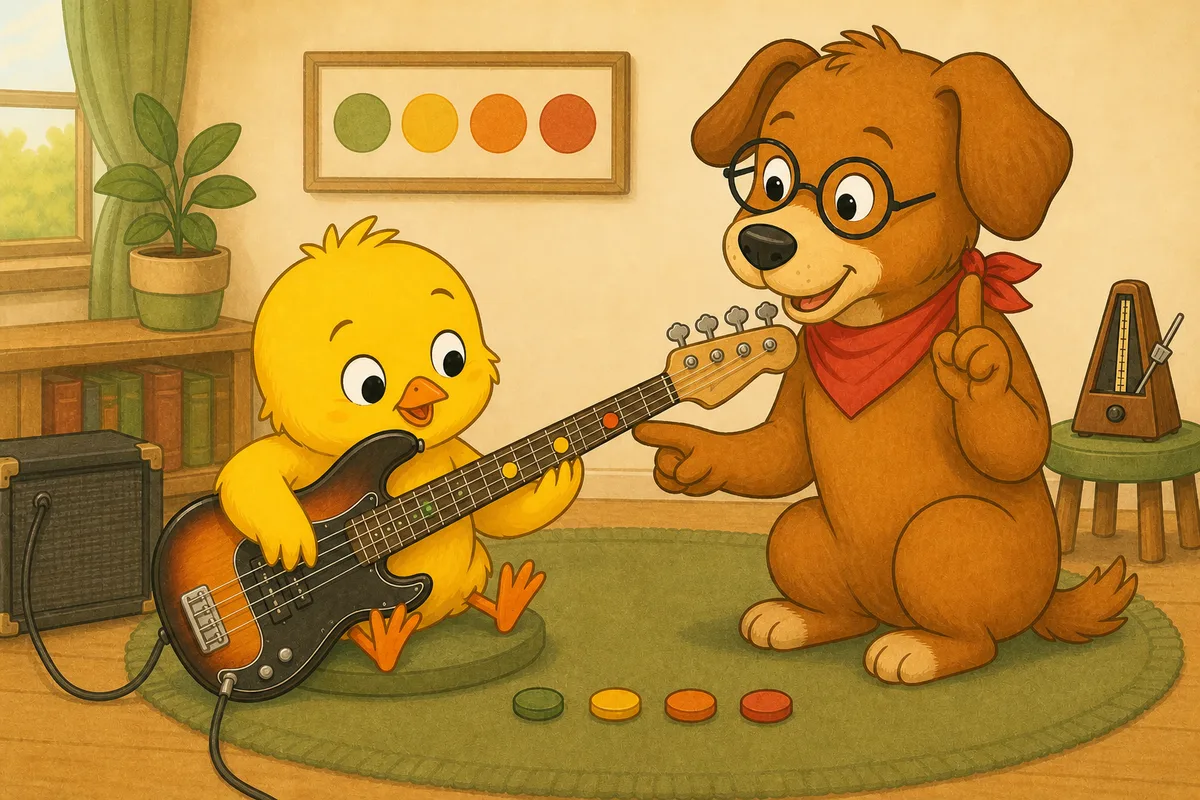
Read only the root accurately
C has a C root and Am has an A root. Set aside suffixes such as m, 7, maj7, and sus4 for this exercise, but keep a sharp or flat attached to the first note name. F-sharp minor has an F-sharp root, and B-flat 7 has a B-flat root. Before playing, say only the roots in the progression so you can separate a symbol-reading pause from a fretboard-location pause.
Map reference points on the E and A strings
On a standard four-string bass, use open E, F at fret one, G at fret three, and A at fret five; then open A, B at fret two, C at fret three, and D at fret five. For C–Am–F–G, one option is C at A-string fret three, A as the open A or E-string fret five, F at E-string fret one, and G at E-string fret three. Choose one set of nearby positions you can reproduce. Point to all four notes in random order three times before adding time.
Control the start and end of each root
At 60 BPM, play C, A, F, and G on beat one and hold each for the rest of the bar. If the next root is late, isolate those two notes and look toward the next position on beat four. After three loops in which every root lands correctly on beat one, repeat the root as four quarter notes. Release fretting pressure to end each note and touch unused strings lightly; record a loop to check that rests are as clear as attacks.
Pio: Is one note too easy to count as bass playing?
Dock-sensei: Putting the correct note at the correct change is a core bass skill. Once it is steady, add rhythm while keeping the same root.
Play four chords using roots only
- Read C, Am, F, and G and say only C, A, F, and G
- Point to all four notes on the E and A strings in random order three times
- Play one root per bar for three loops at 60 BPM, then add quarter notes
Pertanyaan umum
What do I play for a slash chord such as C/G?
The note after the slash is the requested bass note, so C/G uses G. Practise ordinary roots first if slash chords are still unfamiliar.
Which position should I use when a note appears twice?
Choose the lower, easier nearby position first. Add octave choices after your basic map feels secure.
When should I move beyond roots?
Use the chord symbols to name the roots, place the correct note on beat one for three complete four-bar loops, and control unwanted ringing. Then vary the rhythm on the same roots before adding fifths or other chord tones.
The note is correct, but I cannot reach it in time. What should I do?
Isolate only the two late roots and look toward the destination immediately after playing the first. Lower the tempo if one-note bars are still late, then return after three successful round trips.