C Major Scale on Piano: Right-Hand Fingering for One Octave
Can you play C to G, but run out of fingers before reaching the next C? Move the hand instead of trying to stretch across all eight notes. Today, play from middle C to the C above using only your right hand. The goal is a clear finger change, not speed or hands-together coordination.
Tính năng và lựa chọn chính
- Ascending: 1–2–3–1–2–3–4–5. Finger 1 is the thumb; 5 is the little finger
- Play E with 3, then F with 1; let the hand move rather than stretching from a fixed position
- Descending: 5–4–3–2–1–3–2–1. Cross finger 3 to E after the thumb plays F
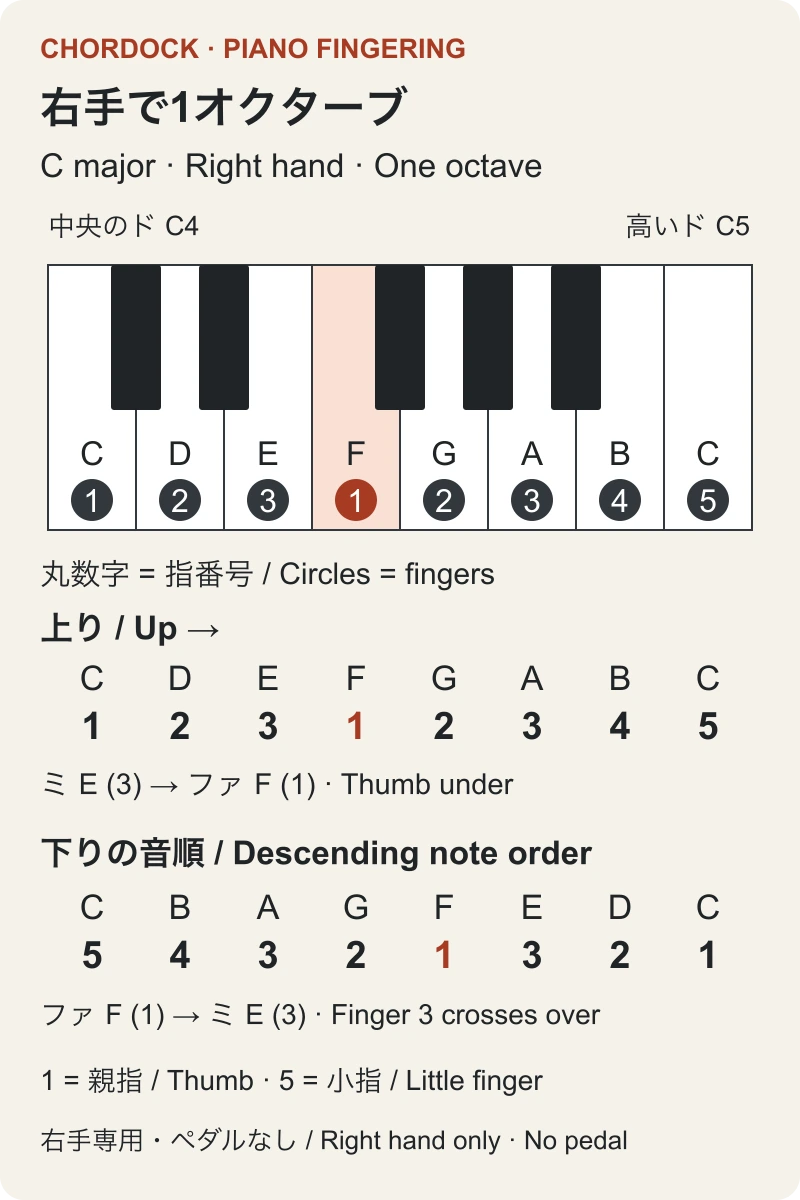
1. Match eight white keys to finger numbers
For either hand, thumb to little finger is numbered 1 to 5. Use only the right hand today. C is the white key just left of a pair of black keys. Starting at middle C, play C–D–E–F–G–A–B–C on successive white keys, with fingers 1–2–3–1–2–3–4–5. In the chart, C4 and C5 identify registers, not fingers. A five-note C-to-G exercise may use 1–2–3–4–5; this longer scale changes to the thumb at F instead. You do not need to cover all eight keys at once.
2. Isolate the E-to-F change
Play C–D–E with 1–2–3. As you move to F, pass the thumb under the hand. Let the hand and arm travel right along the keyboard instead of keeping them fixed and stretching the thumb. Play F with 1, then G–A–B–C with 2–3–4–5. At first, pause between E and F to find a comfortable placement; shorten the gap gradually. Listen for an unwanted loud bump on F. Avoid locking the wrist or dropping it heavily at the crossing. Stop if there is pain rather than repeating a strained motion.
3. Reverse the change on the way down
From the upper C, play C–B–A–G–F–E–D–C with 5–4–3–2–1–3–2–1. After the thumb plays F, bring finger 3 over to E while the hand moves left. The same keys take the same fingers in both directions, but the crossing motion reverses. Isolate F to E before attempting the full descent. Leave the pedal off to hear gaps and overlaps. A smooth line does not require holding every earlier key down. Stop after one octave today: the left hand and a continuing two-octave scale need different finger sequences.
Pio: If I play G with my little finger, what finger is left for A?
Dock-sensei: Use a different pattern from the five-note exercise. Play C, D and E with 1, 2 and 3, then use your thumb for F. Move the hand instead of trying to reach the upper C all at once.
An eight-minute session
- 2 minutes: check right-hand finger numbers and point to the eight white keys from middle C to upper C. Say note names separately from finger numbers, then check ascending 1–2–3–1–2–3–4–5
- 2 minutes: with no pedal or click, try E with 3 followed by F with 1. Lift and reset between attempts; try four times. Allow the hand to move, and use the remaining time to rest and check placement
- 2 minutes: try F with 1 to E with 3 four times. Then play the eight-note ascent and eight-note descent separately once each. Pause and replace a finger if necessary rather than rushing
- 2 minutes: if comfortable, manually set 60 BPM and 4/4. Play one note per beat: ascend for two bars, then release the keys and rest for one bar. From upper C, descend for two bars and rest for one bar again. Remove the click if needed
Review and references
Last content review:
Lesson fingerings and manufacturer technique guidance were cross-checked. Both languages were reviewed twice, including C4–C5 pitches, right-hand ascent and descent, and differences from left-hand, five-note and two-octave patterns. The 60 BPM, eight-minute routine is an editorial suggestion.
- The C Major Scale (PDF, page 1) — Piano Guide Lessons
- Fix It: Teaching Tips for Playing Even Scales on the Piano — Yamaha / Stephen Pierce
- Major Scales Fingering Guide (PDF, page 1) — Hoffman Academy
References support the editorial review. They do not provide an individual diagnosis or guarantee compatibility with every instrument or model.
Câu hỏi thường gặp
What are the right-hand numbers up and down?
C–D–E–F–G–A–B–C uses 1–2–3–1–2–3–4–5. C–B–A–G–F–E–D–C uses 5–4–3–2–1–3–2–1. Finger 1 is the thumb and 5 is the little finger.
Does the left hand ascend with the same numbers?
No. Its usual one-octave ascent is 5–4–3–2–1–3–2–1, with a different crossing location. This chart and routine are for the right hand only. Check each hand separately before combining them.
Why did my five-note exercise use 1–2–3–4–5?
That fingering works for a five-note C-to-G pattern. Here, you continue to upper C, so the thumb takes F. A note does not permanently belong to a particular finger: the range and surrounding notes matter.
Should I use 5 on C in a two-octave scale?
In the usual right-hand fingering when continuing upward, use the thumb on the intermediate C. That adds a B-with-4 to C-with-1 crossing. Today, use 5 on the upper C where the one-octave ascent ends; do not simply repeat the one-octave finger sequence.
What if the thumb crossing breaks the sound?
First isolate E to F without a click and find a comfortable move. All-white-key playing is not necessarily easy for the hand. Leave the pedal off and try a small shift rather than concealing the gap. Ask a teacher to check persistent awkwardness.
Will CHORDOCK grade the fingering?
This lesson does not automatically grade it. Set the metronome to 60 BPM and 4/4 manually, then check fingers and continuity yourself. The eight-minute plan is an editorial suggestion, not a promise of mastery in eight minutes.