Can't Play Piano with Both Hands? Three Practice Steps
You can play the right hand and the left hand separately, yet both seem to stop when you combine them. This is a common beginner problem because two-handed playing adds decisions about which notes coincide, when only one hand moves, and what comes next. Instead of forcing a whole piece, check one or two bars with each hand and combine them early in a simpler form.
Tính năng và lựa chọn chính
- Practise only one or two bars at a time
- Check each hand, then combine them slowly
- Temporarily reduce the number of left-hand notes
Check the two rhythms before playing notes
The obstacle may be rhythm rather than key location. Tap the right-hand rhythm with your right hand and the left-hand rhythm with your left on a desk or your knees. If needed, tap right only, left only, and then both while counting 'one, two, three, four' aloud. Tap together where the parts coincide and let one hand wait where only the other part sounds. Removing the key-finding task lets you focus on coordination.
Combine a short section before either hand feels perfect
Separate practice helps you confirm notes, fingering, and rhythm, but completing an entire piece with one hand can turn coordination into a second large task. Choose one or two bars, play the right hand two or three times, the left hand two or three times, and then both hands once at a slow tempo. If you stop, repeat two beats or one bar around that point instead of restarting the piece. Choose a speed that gives you time to think about the next key.
Simplify the left hand to learn the combination
When the right hand has a melody and the left hand has an accompaniment, temporarily reduce the left-hand notes. If the left hand shows a C chord, begin with one low C on the first beat instead of C, E, and G together. Once the timing feels clear, restore two notes and then the written chord or pattern. The simpler version is a temporary coordination step, not the final arrangement.
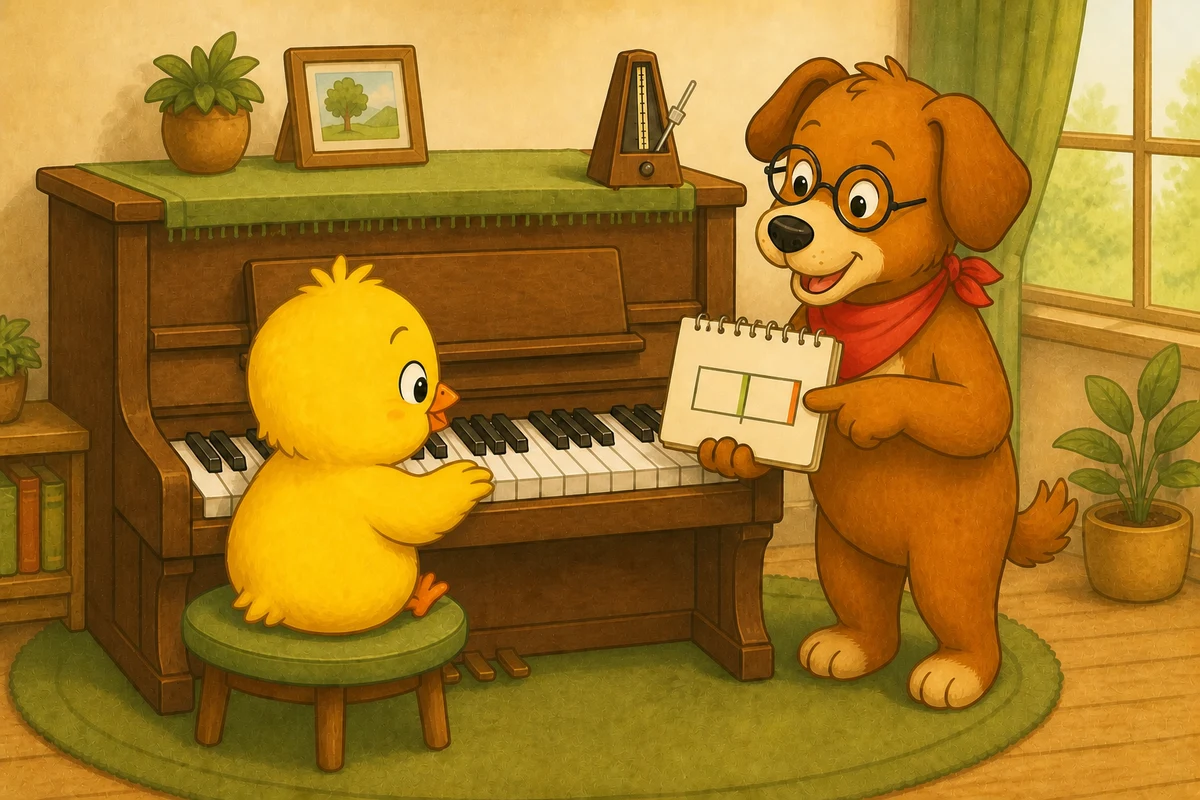
Pio: Why does my right hand forget everything as soon as I add the left hand?
Dock-sensei: You do not need to force two independent motions at once. Find the notes that happen together, then repeat a short right-hand, left-hand, and both-hands cycle until it begins to feel like one movement.
A seven-minute hands-together routine
- 1 minute: release shoulder and wrist tension and count four steady beats aloud
- 2 minutes: choose one or two bars and play the right hand two or three times with consistent fingering
- 2 minutes: play the left hand alone, reducing it to one note at the start of the bar if needed
- 2 minutes: combine the right hand with the simplified left hand and repeat only two beats around a stopping point
Câu hỏi thường gặp
Should each hand be perfect before I combine them?
No. Once notes and fingering are clear, combine a very short passage slowly and move back and forth between separate and together practice.
Why do I always stop at the same place?
Start just before that point and isolate two beats. Identify which notes coincide so the coordination target is clear.
What if watching the left hand makes me lose the right?
Looking at the keys is fine at first. Use your eyes for larger moves and gradually learn the feel of passages that stay in one position.
What metronome tempo should I use?
There is no single correct number. Choose a tempo where you can think ahead without stopping, and try five to ten BPM slower when the pattern breaks down.
Can I keep the simplified left hand?
Use it while learning the timing, then gradually restore the written notes once the combination is stable.
Should I repeat until my hands and arms are tired?
Pause before tension builds. Keep the shoulders and wrists comfortable, and stop if you feel pain or numbness.