What Does 440 Hz on a Guitar Tuner Mean?
Your tuner says 440, but playing string 5 gives about 110 Hz. You may be comparing the reference setting with the detected frequency, not seeing a fault. Use a six-string guitar in standard tuning without a capo to separate those two readings. Do not tighten every string to 440 Hz.
主要功能与选项
- A4 = 440 Hz is a shared pitch reference, not the target frequency for all six strings
- Open string 5 is A2 = 110 Hz, two octaves below A4. The same letter can mean different heights
- Check the string, note and octave before the meter. A centred needle alone does not identify the right string's pitch
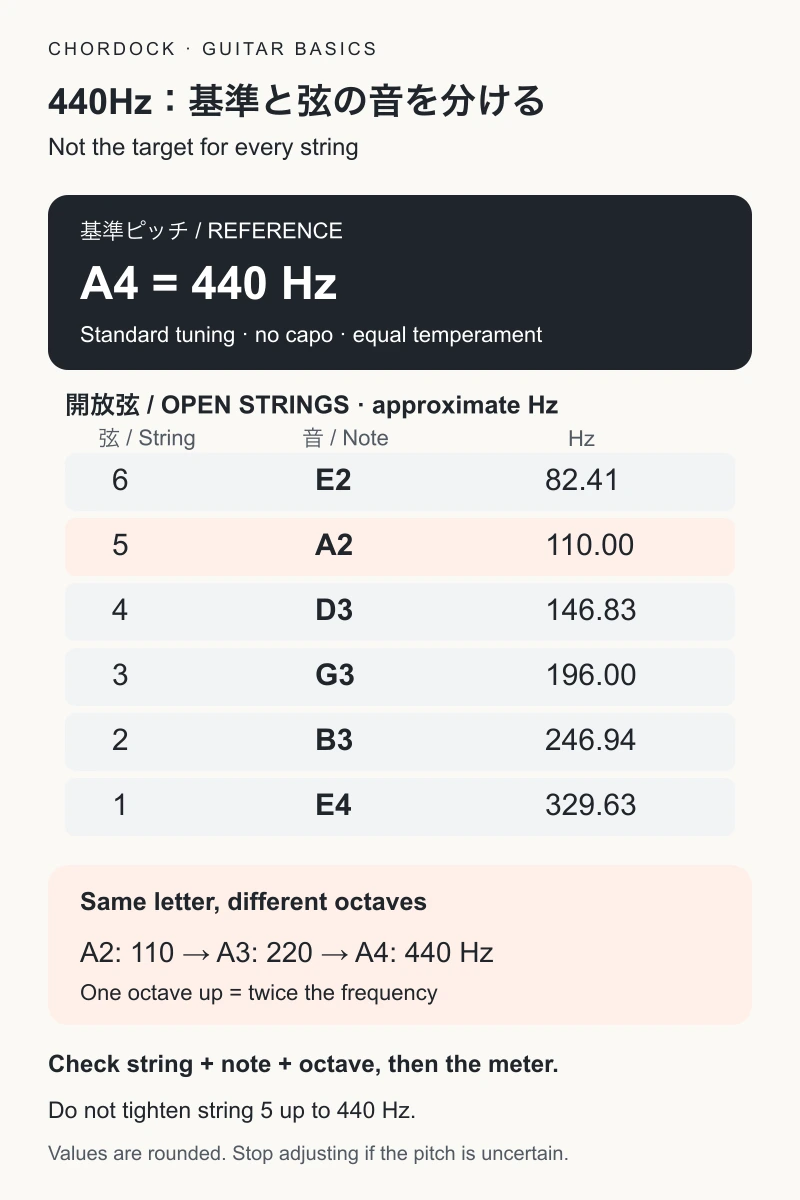
1. Separate the reference from the detected frequency
Hertz counts vibrations per second. A setting labelled CALIB, A4 or reference pitch tells the tuner which frequency to use for A4. A changing Hz readout during playing may instead show the detected frequency. Check your model's manual to identify each field. Unless your ensemble or lesson specifies otherwise, begin with A4 = 440 Hz. Changing calibration changes the reference; it does not physically tune the strings for you.
2. Open A is 110 Hz, not the reference A4
From string 6 to 1, standard open notes are E2, A2, D3, G3, B3 and E4. At A4 = 440 Hz in twelve-tone equal temperament, their approximate frequencies are 82.41, 110.00, 146.83, 196.00, 246.94 and 329.63 Hz. These rounded calculations are not a demand to freeze the readout to two decimal places. The numbers after the letters identify octaves here, not strings or frets. An octave doubles frequency: A2 is 110 Hz, A3 is 220 Hz and A4 is 440 Hz. Do not tighten the fifth string up to 440 Hz. If you lose track of the octave, stop turning and check a guitar reference tone or ask a teacher or guitar shop.
3. Check the note before centring the meter
Remove the capo, leave the string open and pluck one string gently while keeping the others quiet. Compare the detected note with the string you chose: A2 for string 5, for example. A chromatic tuner can show a centred reading for a different note, so the centre alone is not enough. Once the note and octave are correct, make small peg adjustments and recheck. Cents measure pitch difference; 100 cents is one semitone. CHORDOCK's current tuner uses fixed A4 = 440 Hz and its Hz readout shows detected frequency. There is no calibration control. The standard-tuning row below is a reference list; read the large central note for the actual detection.
Pio: If the setting says 440, is 110 really right for string 5?
Dock-sensei: Yes. The reference is A4, while string 5 is A2, two octaves lower. The same letter can have different heights. First distinguish the reference setting from the detected note.
An eight-minute check
- 2 minutes: leave the pegs alone and use your tuner's manual to identify reference and detection fields. Use A4 = 440 Hz unless instructed otherwise. CHORDOCK has a fixed reference, so no calibration step is needed
- 2 minutes: remove the capo and match strings 6 to 1 with E2, A2, D3, G3, B3 and E4 in the chart. Do not turn the pegs yet. Say that string 5 targets A2, around 110 Hz
- 2 minutes: start the tuner and allow microphone access if needed. Pluck string 5 gently once and read the detection. If the note or octave is uncertain, ask for help before adjusting. Only make small adjustments once identified, then pluck again and read
- 2 minutes: check the remaining strings individually, comparing note and meter. Take breaks rather than racing the clock. Stop for unusual noises or abnormal tension. Finish by stopping the tuner and microphone
Review and references
Last content review:
Manufacturer and university sources informed checks of reference settings and pitch. Both languages were reviewed twice for reference versus detected Hz, A2 versus A4, octave numbers, cents and proportional scaling to 442 Hz. CHORDOCK's fixed-440 implementation was checked; six string frequencies were independently calculated. The chart and eight-minute routine with breaks are editorial suggestions.
- What does the 440 mean on my guitar tuner? — D’Addario
- TU-3: How to Change the Reference Pitch — Roland / BOSS
- How does a guitar work? — UNSW Music Acoustics
- Note names, MIDI numbers and frequencies — UNSW / Joe Wolfe
References support the editorial review. They do not provide an individual diagnosis or guarantee compatibility with every instrument or model.
常见问题
Do all guitar strings need to reach 440 Hz?
No. A4 = 440 Hz is the common reference. Standard open strings are E2, A2, D3, G3, B3 and E4, with different target frequencies. Do not tighten them all to 440 Hz.
Does an A display prove string 5 is in tune?
Some tuners show the letter without distinguishing octaves. Open string 5 is A2. Also check an octave or string-number display or a guitar reference tone. Do not keep turning a peg while unsure.
If asked for 442 Hz, do I raise every string by 2 Hz?
No. Set a compatible tuner to A4 = 442 Hz and tune to it. Frequencies scale by the same ratio: A2 becomes 110.5 Hz. You do not add 2 Hz to each string. CHORDOCK's current tuner does not offer reference adjustment.
Should I change calibration when I see A♯?
A♯ is a detected note name, a semitone above A. Check the string, intended note and octave rather than changing calibration to force a match. Stop adjusting if tension feels abnormal.
Do zero cents and 440 Hz mean the same thing?
No. Zero cents means no difference from the selected or detected target note. With an A4 = 440 Hz reference, A2 near 110 Hz can read zero cents. You must still identify the correct string and note.
Have I failed if tuning takes more than eight minutes?
No. This is an editorial checking routine with breaks, not a deadline or automatic assessment. Distinguishing reference from detection is a useful stopping point today. Avoid tightening a string when its pitch is uncertain.